JavaScript is disabled in your browser. Please enable JavaScript to view this website.
AB121109

Anti-TECPR2 antibody

Be the first to review this product! Submit a review

|

(1 Publication)

Rabbit Polyclonal TECPR2 antibody. Suitable for IHC-P, ICC/IF and reacts with Human samples. Cited in 1 publication. Immunogen corresponding to Recombinant Fragment Protein within Human TECPR2 aa 1250 to C-terminus.
2 Images
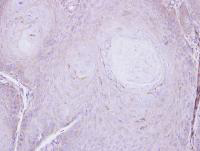
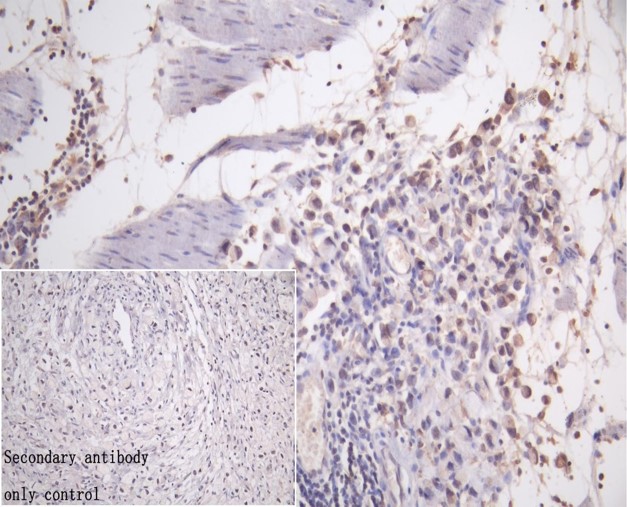
Immunohistochemistry (Formalin/PFA-fixed paraffin-embedded sections) - Anti-TECPR2 antibody (AB121109)
  • IHC-P

Unknown

Immunohistochemistry (Formalin/PFA-fixed paraffin-embedded sections) - Anti-TECPR2 antibody (AB121109)

ab121109 at 1/100 dilution staining TECPR2 in Paraffin-embedded Human Cerebral cortex tissue by Immunohistochemistry.
Note : strong nuclear and cytoplasmic positivity in neuronal cells.
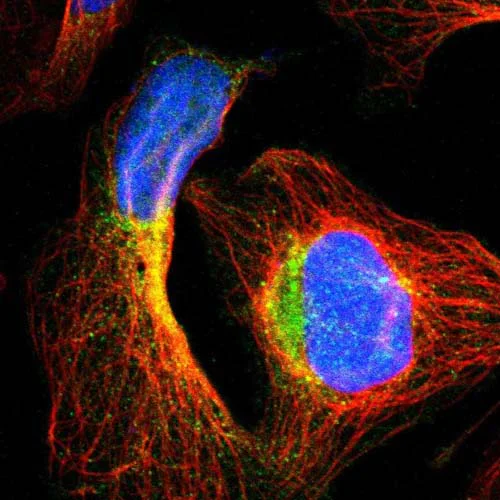
Immunocytochemistry/ Immunofluorescence - Anti-TECPR2 antibody (AB121109)
  • ICC/IF

Unknown

Immunocytochemistry/ Immunofluorescence - Anti-TECPR2 antibody (AB121109)

Immunofluorescent staining of Human cell line U-2 OS shows positivity in cytoplasm. Recommended concentration of ab121109 0.25-2 μg/ml. Cells treated with PFA/Triton X-100.

Key facts

Host species

Rabbit

Clonality

Polyclonal

Isotype

IgG

Carrier free

No

Reacts with

Human

Applications

ICC/IF, IHC-P

applications

Immunogen

Recombinant Fragment Protein within Human TECPR2 aa 1250 to C-terminus. The exact immunogen used to generate this antibody is proprietary information.

O15040

Reactivity data

{ "title": "Reactivity Data", "filters": { "stats": ["", "Species", "Dilution Info", "Notes"], "tabs": { "all-applications": {"fullname" : "All Applications", "shortname": "All Applications"}, "IHCP" : {"fullname" : "Immunohistochemistry (Formalin/PFA-fixed paraffin-embedded sections)", "shortname":"IHC-P"}, "ICCIF" : {"fullname" : "Immunocytochemistry/ Immunofluorescence", "shortname":"ICC/IF"} }, "product-promise": { "all": "all", "testedAndGuaranteed": "tested", "guaranteed": "expected", "predicted": "predicted", "notRecommended": "not-recommended" } }, "values": { "Human": { "IHCP-species-checked": "testedAndGuaranteed", "IHCP-species-dilution-info": "1/200 - 1/500", "IHCP-species-notes": "<p></p> Perform heat-mediated antigen retrieval with citrate buffer pH 6 before commencing with IHC staining protocol.", "ICCIF-species-checked": "testedAndGuaranteed", "ICCIF-species-dilution-info": "0.25-2 µg/mL", "ICCIF-species-notes": "<p>Recommend PFA Fixation and Triton X-100 treatment</p>" } } }

Properties and storage information

Form
Liquid
Purification technique
Affinity purification Immunogen
Storage buffer
pH: 7.2 Preservative: 0.02% Sodium azide Constituents: PBS, 40% Glycerol (glycerin, glycerine)
Shipped at conditions
Blue Ice
Appropriate short-term storage conditions
+4°C
Appropriate long-term storage conditions
-20°C
Aliquoting information
Upon delivery aliquot
Storage information
Avoid freeze / thaw cycle

Supplementary information

This supplementary information is collated from multiple sources and compiled automatically.

TECPR2 also known as Tectonin Beta-Propeller Repeat Containing 2 is a protein with a mass of approximately 150 kDa. It plays a significant role in autophagy which the body uses to clean out damaged cells and regenerate new ones. Researchers have found TECPR2 expressed highly in the brain and muscle tissues suggesting its integral role in nervous system health and muscular functions. The technical aspects of TECPR2 include its involvement in cellular mechanisms that help maintain cellular homeostasis.
Biological function summary

The protein TECPR2 assists in the regulation of autophagosome maturation a critical step in the autophagy process. It is a part of a complex that mediates efficient autophagic flux interacting with other autophagic machinery proteins to ensure correct progression and completion of autophagy. TECPR2 contributes to cellular waste disposal by ensuring damaged organelle degradation maintaining cellular integrity and function through this mechanism.

Pathways

The protein TECPR2 participates mainly in the autophagy pathway where it works closely with LC3 and p62 proteins. This pathway is important for removing damaged components and recycling cellular resources. TECPR2 helps regulate these processes directly linking to how cell responds to stress conditions and nutrient deficiency. The balance maintained by TECPR2 in these pathways is key for overall cellular health and its failure can lead to detrimental outcomes.

Mutations or dysfunctions in TECPR2 have been associated with neurodegenerative diseases such as hereditary spastic paraplegia. TECPR2 mutations disrupt normal autophagic balance and can lead to the accumulation of damaged proteins that harm neural cells. Additionally research indicates potential links to muscle wasting disorders due to its critical role in muscle tissue homeostasis. Connections between dysfunctional TECPR2 and abnormal protein aggregates often overlap with proteins involved in neurodegeneration emphasizing its healthcare importance.

Product protocols

For this product, it's our understanding that no specific protocols are required. You can visit:

Target data

Probably plays a role as positive regulator of autophagy.
See full target information TECPR2

Alternative Names

KIAA0297, KIAA0329, TECPR2, Tectonin beta-propeller repeat-containing protein 2, WD repeat-containing protein KIAA0329/KIAA0297

Publications (1)

Recent publications for all applications. Explore the full listand refine your search

OncoTargets and therapy 12:11183-11193 PubMed31908485

2019

Baicalin Inhibits Cell Viability, Migration and Invasion in Breast Cancer by Regulating miR-338-3p and MORC4.

Applications

Unspecified application

Species

Unspecified reactive species

Xin Duan,Guangcheng Guo,Xinhong Pei,Xinxing Wang,Lin Li,Youyi Xiong,Xinguang Qiu
View all publications

Product promise

We are committed to supporting your work with high-quality reagents, and we're here for you every step of the way. In the unlikely event that one of our products does not perform as expected, you're protected by our Product Promise.
For full details, please see our Terms & Conditions

Please note: All products are 'FOR RESEARCH USE ONLY. NOT FOR USE IN DIAGNOSTIC OR THERAPEUTIC PROCEDURES'.

For licensing inquiries, please contact partnerships@abcam.com