JavaScript is disabled in your browser. Please enable JavaScript to view this website.
AB237624

Anti-THIK-1 antibody

Be the first to review this product! Submit a review

|

(2 Publications )

Rabbit Polyclonal THIK-1 antibody. Suitable for WB, IHC-P, ICC/IF and reacts with Human samples. Cited in 2 publications. Immunogen corresponding to Recombinant Fragment Protein within Human KCNK13 aa 250 to C-terminus.
3 Images
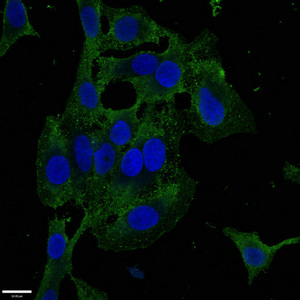
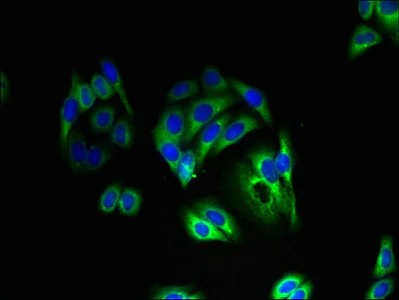
Immunocytochemistry/ Immunofluorescence - Anti-THIK-1 antibody (AB237624)
  • ICC/IF

Supplier Data

Immunocytochemistry/ Immunofluorescence - Anti-THIK-1 antibody (AB237624)

HepG2 (human liver hepatocellular carcinoma cell line) cells stained for THIK-1 using ab237624 at a dilution of 1/100 in ICC/IF. Secondary used is an Alexa-Fluor®488-conjugated Goat Anti-Rabbit IgG (H+L).
Immunohistochemistry (Formalin/PFA-fixed paraffin-embedded sections) - Anti-THIK-1 antibody (AB237624)
  • IHC-P

Supplier Data

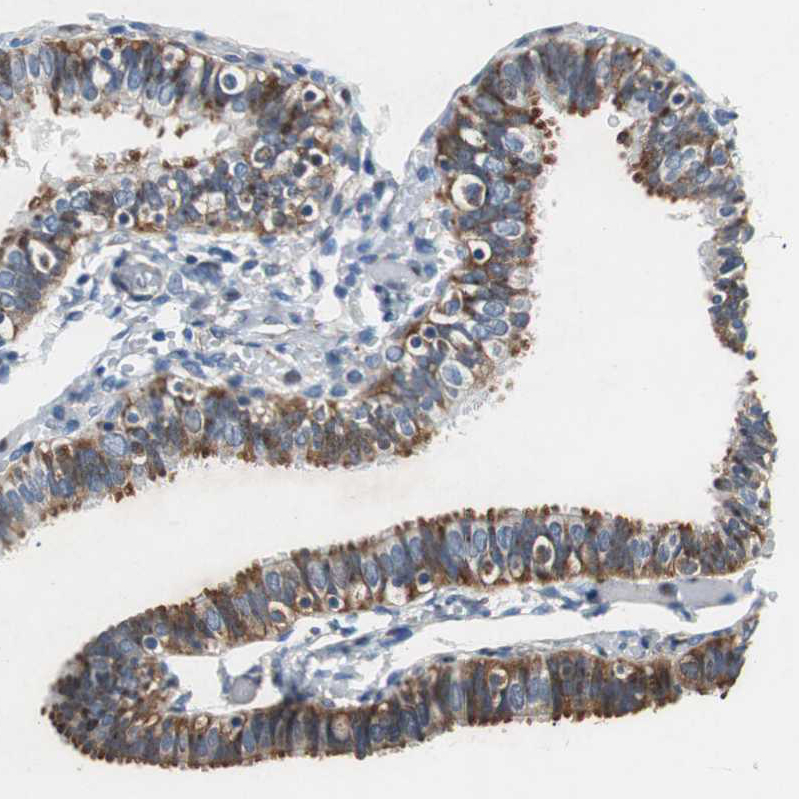
Immunohistochemistry (Formalin/PFA-fixed paraffin-embedded sections) - Anti-THIK-1 antibody (AB237624)

Paraffin-embedded human glioma tissue stained for THIK-1 with ab237624 at a 1/100 dilution in immunohistochemical analysis.
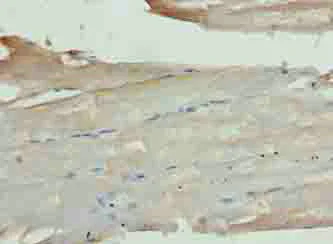
Immunohistochemistry (Formalin/PFA-fixed paraffin-embedded sections) - Anti-THIK-1 antibody (AB237624)
  • IHC-P

Supplier Data

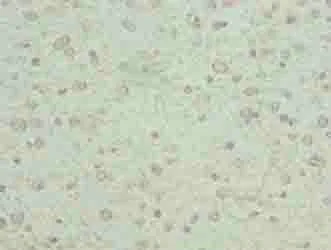
Immunohistochemistry (Formalin/PFA-fixed paraffin-embedded sections) - Anti-THIK-1 antibody (AB237624)

Paraffin-embedded human skeletal muscle tissue stained for THIK-1 with ab237624 at a 1/100 dilution in immunohistochemical analysis.

Key facts

Host species

Rabbit

Clonality

Polyclonal

Isotype

IgG

Carrier free

No

Reacts with

Human

Applications

IHC-P, WB, ICC/IF

applications

Immunogen

Recombinant Fragment Protein within Human KCNK13 aa 250 to C-terminus. The exact immunogen used to generate this antibody is proprietary information.

Q9HB14

Reactivity data

{ "title": "Reactivity Data", "filters": { "stats": ["", "Species", "Dilution Info", "Notes"], "tabs": { "all-applications": {"fullname" : "All Applications", "shortname": "All Applications"}, "WB" : {"fullname" : "Western blot", "shortname":"WB"}, "IHCP" : {"fullname" : "Immunohistochemistry (Formalin/PFA-fixed paraffin-embedded sections)", "shortname":"IHC-P"}, "ICCIF" : {"fullname" : "Immunocytochemistry/ Immunofluorescence", "shortname":"ICC/IF"} }, "product-promise": { "all": "all", "testedAndGuaranteed": "tested", "guaranteed": "expected", "predicted": "predicted", "notRecommended": "not-recommended" } }, "values": { "Human": { "WB-species-checked": "testedAndGuaranteed", "WB-species-dilution-info": "1/500 - 1/2000", "WB-species-notes": "<p></p>", "IHCP-species-checked": "testedAndGuaranteed", "IHCP-species-dilution-info": "1/20 - 1/200", "IHCP-species-notes": "<p></p>", "ICCIF-species-checked": "testedAndGuaranteed", "ICCIF-species-dilution-info": "1/50 - 1/200", "ICCIF-species-notes": "<p></p>" } } }

Properties and storage information

Form
Liquid
Purification technique
Affinity purification Protein G
Purification notes
Purity greater than 95%.
Storage buffer
pH: 7.4 Preservative: 0.03% Proclin 300 Constituents: PBS, 50% Glycerol (glycerin, glycerine)
Shipped at conditions
Blue Ice
Appropriate short-term storage duration
1-2 weeks
Appropriate short-term storage conditions
+4°C
Appropriate long-term storage conditions
-20°C
Aliquoting information
Upon delivery aliquot
Storage information
Avoid freeze / thaw cycle

Supplementary information

This supplementary information is collated from multiple sources and compiled automatically.

THIK-1 also known as KCNK13 is a member of the two-pore domain potassium (K2P) channels. It has a molecular mass of approximately 41 kDa. This protein functions mechanically as a background potassium channel which helps to maintain the resting membrane potential and regulate the excitability of cells. THIK-1 is expressed in various tissues including the brain lungs and immune cells indicating its role in diverse physiological processes.
Biological function summary

THIK-1 contributes to maintaining the cellular ionic homeostasis by facilitating the passive movement of potassium ions across the cell membrane. This movement does not require additional energy input like ATP making THIK-1 efficient in sustaining ionic gradients. THIK-1 does not function as part of a larger complex but works independently to influence cell polarization and signaling important for neuron function and immune cell response.

Pathways

THIK-1 is involved in the neuronal signaling pathway and the immune response pathway. In neuronal signaling THIK-1 contributes to setting the resting potential affecting neuronal excitability and neurotransmission. In connection to the immune response THIK-1 influences the activation and function of immune cells. THIK-1 interacts with proteins such as TREK-1 and TASK channels which are also potassium channels involved in similar pathways showing redundancy and complementarity within potassium channel families.

THIK-1 is linked to neurological disorders and immune dysregulation. Changes in THIK-1 function or expression may contribute to epilepsy where abnormal neuronal excitability is a characteristic feature. In immune dysregulation alterations in THIK-1 can affect immune cell responses potentially impacting diseases such as autoimmune disorders. Research indicates that proteins like TASK-1 may interact with THIK-1 amplifying these effects in disease contexts due to shared pathways involving potassium channel regulation.

Product protocols

For this product, it's our understanding that no specific protocols are required. You can visit:

Target data

K(+) channel that conducts outward rectifying tonic currents potentiated by purinergic signals (PubMed : 24163367, PubMed : 25148687, PubMed : 30472253, PubMed : 38409076). Homo- and heterodimerizes to form functional channels with distinct regulatory and gating properties (PubMed : 25148687, PubMed : 40011745, PubMed : 40011746, PubMed : 40307591, PubMed : 40178898). Contributes most of K(+) currents at the plasma membrane of resting microglia (PubMed : 38409076). Maintains a depolarized membrane potential required for proper ramified microglia morphology and phagocytosis, selectively mediating microglial pruning of presynaptic compartments at hippocampal excitatory synapses (PubMed : 38409076). Upon local release of ATP caused by neuronal injury or infection, it is potentiated by P2RY12 and P2RX7 receptor signaling and contributes to ATP-triggered K(+) efflux underlying microglial NLRP3 inflammasome assembly and IL1B release (PubMed : 38409076).
See full target information KCNK13

Alternative Names

Potassium channel subfamily K member 13, Tandem pore domain halothane-inhibited potassium channel 1, THIK-1, KCNK13

Publications (2)

Recent publications for all applications. Explore the full listand refine your search

BMC anesthesiology 25:81 PubMed39966746

2025

Toxic effects of prolonged propofol exposure on cardiac development in zebrafish larvae.

Applications

Unspecified application

Species

Unspecified reactive species

Shaojie Qian,Huizi Liu,Hanwei Wei,Jintao Liu,Xiaojun Li,Xiaopan Luo

Nature neuroscience 24:19-23 PubMed33318667

2020

Microglial G-dependent dynamics regulate brain network hyperexcitability.

Applications

Unspecified application

Species

Unspecified reactive species

Mario Merlini,Victoria A Rafalski,Keran Ma,Keun-Young Kim,Eric A Bushong,Pamela E Rios Coronado,Zhaoqi Yan,Andrew S Mendiola,Elif G Sozmen,Jae Kyu Ryu,Matthias G Haberl,Matthew Madany,Daniel Naranjo Sampson,Mark A Petersen,Sophia Bardehle,Reshmi Tognatta,Terry Dean,Rosa Meza Acevedo,Belinda Cabriga,Reuben Thomas,Shaun R Coughlin,Mark H Ellisman,Jorge J Palop,Katerina Akassoglou
View all publications

Product promise

We are committed to supporting your work with high-quality reagents, and we're here for you every step of the way. In the unlikely event that one of our products does not perform as expected, you're protected by our Product Promise.
For full details, please see our Terms & Conditions

Please note: All products are 'FOR RESEARCH USE ONLY. NOT FOR USE IN DIAGNOSTIC OR THERAPEUTIC PROCEDURES'.

For licensing inquiries, please contact partnerships@abcam.com