JavaScript is disabled in your browser. Please enable JavaScript to view this website.
AB197894

Anti-Tin2 antibody [EPR15319]

Be the first to review this product! Submit a review

|

(10 Publications )
Rabbit Recombinant Monoclonal Tin2 antibody. Suitable for WB and reacts with Mouse, Human, Rat samples. Cited in 10 publications.
3 Images
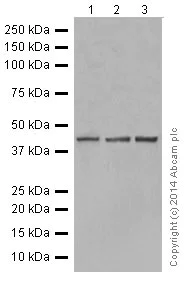
Western blot - Anti-Tin2 antibody [EPR15319] (AB197894)
  • WB

Supplier Data

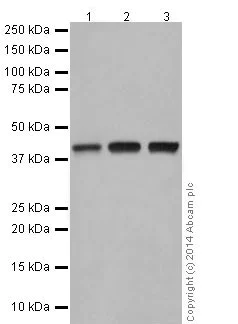
Western blot - Anti-Tin2 antibody [EPR15319] (AB197894)

5% NFDM/TBST : Blocking and diluting buffer.

All lanes:

Western blot - Anti-Tin2 antibody [EPR15319] (ab197894) at 1/2000 dilution

Lane 1:

Human thymus lysate at 10 µg

Lane 2:

Mouse thymus lysate at 10 µg

Lane 3:

Rat thymus lysate at 10 µg

Secondary

All lanes:

Goat Anti-Rabbit IgG, (H+L), Peroxidase conjugated at 1/1000 dilution

Predicted band size: 50 kDa

Observed band size: 38 kDa

false

Exposure time: 1min
Western blot - Anti-Tin2 antibody [EPR15319] (AB197894)
  • WB

Supplier Data

Western blot - Anti-Tin2 antibody [EPR15319] (AB197894)

5% NFDM/TBST : Blocking and diluting buffer.

All lanes:

Western blot - Anti-Tin2 antibody [EPR15319] (ab197894) at 1/10000 dilution

Lane 1:

MCF7 (Human breast adenocarcinoma cell line) whole cell lysate at 20 µg

Lane 2:

WI38 (Human fetal lung fibroblast cells) whole cell lysate at 20 µg

Lane 3:

HUVEC (Human umbilical vein endothelial cell line) whole cell lysate at 20 µg

Secondary

All lanes:

Goat Anti-Rabbit IgG, (H+L), Peroxidase conjugated at 1/1000 dilution

Predicted band size: 50 kDa

Observed band size: 39 kDa

false

Exposure time: 1min
Western blot - Anti-Tin2 antibody [EPR15319] (AB197894)
  • WB

Supplier Data

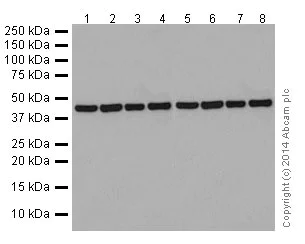
Western blot - Anti-Tin2 antibody [EPR15319] (AB197894)

5% NFDM/TBST : Blocking and diluting buffer.

All lanes:

Western blot - Anti-Tin2 antibody [EPR15319] (ab197894) at 1/1000 dilution

Lane 1:

Mouse brain lysate at 10 µg

Lane 2:

Mouse heart lysate at 10 µg

Lane 3:

Mouse kidney lysate at 10 µg

Lane 4:

Mouse spleen lysate at 10 µg

Lane 5:

C6 (Rat glial tumor cells) whole cell lysate at 10 µg

Lane 6:

RAW264.7 (Mouse macrophage cells transformed with Abelson murine leukemia virus) whole cell lysate at 10 µg

Lane 7:

PC12 (Rat adrenal gland pheochromocytoma) whole cell lysate at 10 µg

Lane 8:

NIH3T3 (Mouse embyro fibroblast cells) whole cell lysate at 10 µg

Secondary

All lanes:

Goat Anti-Rabbit IgG, (H+L), Peroxidase conjugated at 1/1000 dilution

Predicted band size: 50 kDa

Observed band size: 38 kDa

false

Exposure time: 30s

  • Carrier free

    Anti-Tin2 antibody [EPR15319] - BSA and Azide free

Key facts

Host species

Rabbit

Clonality

Monoclonal

Clone number

EPR15319

Isotype

IgG

Carrier free

No

Reacts with

Mouse, Rat, Human

Applications

WB

applications

Immunogen

The exact immunogen used to generate this antibody is proprietary information.

Reactivity data

{ "title": "Reactivity Data", "filters": { "stats": ["", "Species", "Dilution Info", "Notes"], "tabs": { "all-applications": {"fullname" : "All Applications", "shortname": "All Applications"}, "WB" : {"fullname" : "Western blot", "shortname":"WB"} }, "product-promise": { "all": "all", "testedAndGuaranteed": "tested", "guaranteed": "expected", "predicted": "predicted", "notRecommended": "not-recommended" } }, "values": { "Human": { "WB-species-checked": "testedAndGuaranteed", "WB-species-dilution-info": "1/1000", "WB-species-notes": "<p></p>" }, "Mouse": { "WB-species-checked": "testedAndGuaranteed", "WB-species-dilution-info": "1/1000", "WB-species-notes": "<p></p>" }, "Rat": { "WB-species-checked": "testedAndGuaranteed", "WB-species-dilution-info": "1/1000", "WB-species-notes": "<p></p>" } } }

Product details

Patented technology
Our RabMAb® technology is a patented hybridoma-based technology for making rabbit monoclonal antibodies. For details on our patents, please refer to RabMAb® patents.

What are the advantages of a recombinant monoclonal antibody?
This product is a recombinant monoclonal antibody, which offers several advantages including:

  • - High batch-to-batch consistency and reproducibility
  • - Improved sensitivity and specificity
  • - Long-term security of supply
  • - Animal-free batch production

For more information, read more on recombinant antibodies.

Properties and storage information

Form
Liquid
Purification technique
Affinity purification Protein A
Storage buffer
pH: 7.2 - 7.4 Preservative: 0.01% Sodium azide Constituents: PBS, 40% Glycerol (glycerin, glycerine), 0.05% BSA
Shipped at conditions
Conditional Ambient
Appropriate short-term storage duration
1-2 weeks
Appropriate short-term storage conditions
+4°C
Appropriate long-term storage conditions
-20°C
Aliquoting information
Upon delivery aliquot
Storage information
Avoid freeze / thaw cycle

Supplementary information

This supplementary information is collated from multiple sources and compiled automatically.

TIN2 also known as TERF1-interacting nuclear factor 2 is a pivotal protein involved in telomere maintenance. It has a molecular mass of approximately 50 kDa. This protein is expressed in the nucleus where it plays an integral role in structuring chromosome ends. TIN2 specifically associates with telomeric regions to regulate their length and integrity. It forms connections with other proteins to facilitate its function in telomers' structural configuration.
Biological function summary

TIN2 integrates into the shelterin complex a group of six proteins that protect telomeres from being recognized as DNA damage. It acts as a stabilizer within this complex and helps maintain telomere integrity. In doing so TIN2 modulates the actions of telomerase and other telomere-binding proteins to ensure proper chromosome end function. This responsibility makes it essential for preventing excessive telomere shortening which can lead to genomic instability.

Pathways

The involvement of TIN2 is significant in telomere length regulation and DNA damage response mechanisms. TIN2 operates within these pathways to manage telomerase activity and interaction with telomere ends. It collaborates with other shelterin proteins like TRF1 and TRF2 which also participate in maintaining telomere function. TIN2's role in these pathways highlights its contribution to chromosome end protection and preventive response against DNA damage.

TIN2 dysfunction is linked to conditions like dyskeratosis congenita and aplastic anemia. These disorders are marked by defective telomere maintenance leading to progressive bone marrow failure and other cellular deficiencies. Mutations in TIN2 can perturb the function of shelterin proteins including TRF1 contributing to the compromised telomere integrity seen in these diseases. Understanding TIN2's role offers insights into therapeutic targets for managing telomere-associated disorders.

Product protocols

For this product, it's our understanding that no specific protocols are required. You can visit:

Target data

Component of the shelterin complex (telosome) that is involved in the regulation of telomere length and protection. Shelterin associates with arrays of double-stranded TTAGGG repeats added by telomerase and protects chromosome ends; without its protective activity, telomeres are no longer hidden from the DNA damage surveillance and chromosome ends are inappropriately processed by DNA repair pathways. Plays a role in shelterin complex assembly. Isoform 1 may have additional role in tethering telomeres to the nuclear matrix.
See full target information TINF2

Alternative Names

TIN2, TINF2, TERF1-interacting nuclear factor 2, TRF1-interacting nuclear protein 2

Publications (10)

Recent publications for all applications. Explore the full listand refine your search

Acta pharmacologica Sinica 45:1276-1286 PubMed38438580

2024

Discovery of a selective TRF2 inhibitor FKB04 induced telomere shortening and senescence in liver cancer cells.

Applications

Unspecified application

Species

Unspecified reactive species

Yin-da Qiu,Qi Yan,Yi Wang,Yan-Fei Ye,Yan Wang,Meng-Ying Wang,Pei-Pei Wang,Shu-Yuan Zhang,Da-Long Wang,Hao Yan,Jing Ruan,Yun-Jie Zhao,Le-Hao Huang,Namki Cho,Kun Wang,Xiao-Hui Zheng,Zhi-Guo Liu

Nucleic acids research 51:1154-1172 PubMed36651296

2023

Phosphorylation of TRF2 promotes its interaction with TIN2 and regulates DNA damage response at telomeres.

Applications

Unspecified application

Species

Unspecified reactive species

Radka Storchova,Matous Palek,Natalie Palkova,Pavel Veverka,Tomas Brom,Ctirad Hofr,Libor Macurek

European heart journal open 2:oeac047 PubMed36117952

2022

Vascular senescence in progeria: role of endothelial dysfunction.

Applications

Unspecified application

Species

Unspecified reactive species

Qiu Xu,Anahita Mojiri,Luay Boulahouache,Elisa Morales,Brandon K Walther,John P Cooke

PloS one 17:e0264073 PubMed35176105

2022

Insights into POT1 structural dynamics revealed by cryo-EM.

Applications

Unspecified application

Species

Unspecified reactive species

Emmanuel W Smith,Simon Lattmann,Zhehui Barry Liu,Bilal Ahsan,Daniela Rhodes

Breast cancer research : BCR 23:89 PubMed34488828

2021

TAZ maintains telomere length in TNBC cells by mediating Rad51C expression.

Applications

Unspecified application

Species

Unspecified reactive species

Lu Yang,Bo Wang,Xinyan Jiao,Can Zhou,Su Chen,Xiaoqian Gao,Wei Sun,Shaoran Song,Juan Li,Jie Liu,Yaochun Wang,Peijun Liu

PLoS genetics 17:e1009410 PubMed33690611

2021

AKT-dependent signaling of extracellular cues through telomeres impact on tumorigenesis.

Applications

Unspecified application

Species

Unspecified reactive species

Raúl Sánchez-Vázquez,Paula Martínez,Maria A Blasco

Neoplasia (New York, N.Y.) 22:61-75 PubMed31846834

2019

Long interspersed element-1 ribonucleoprotein particles protect telomeric ends in alternative lengthening of telomeres dependent cells.

Applications

Unspecified application

Species

Unspecified reactive species

Thomas Aschacher,Brigitte Wolf,Olivia Aschacher,Florian Enzmann,Viktoria Laszlo,Barbara Messner,Adrian Türkcan,Serge Weis,Sabine Spiegl-Kreinecker,Klaus Holzmann,Günther Laufer,Marek Ehrlich,Michael Bergmann

Molecular cell 65:818-831.e5 PubMed28216227

2017

Nek7 Protects Telomeres from Oxidative DNA Damage by Phosphorylation and Stabilization of TRF1.

Applications

Unspecified application

Species

Unspecified reactive species

Rong Tan,Satoshi Nakajima,Qun Wang,Hongxiang Sun,Jing Xue,Jian Wu,Sabine Hellwig,Xuemei Zeng,Nathan A Yates,Thomas E Smithgall,Ming Lei,Yu Jiang,Arthur S Levine,Bing Su,Li Lan

Scientific reports 7:41670 PubMed28195144

2017

Concomitant underexpression of TGFBR2 and overexpression of hTERT are associated with poor prognosis in cervical cancer.

Applications

WB

Species

Human

Hui Yang,Hongyan Zhang,Yahua Zhong,Qiaoli Wang,Lei Yang,Hong Kang,Xiaojia Gao,Haijun Yu,Conghua Xie,Fuxiang Zhou,Yunfeng Zhou

Journal of Cancer 7:1152-62 PubMed27326259

2016

Downregulation of Ubiquitin-conjugating Enzyme UBE2D3 Promotes Telomere Maintenance and Radioresistance of Eca-109 Human Esophageal Carcinoma Cells.

Applications

WB

Species

Unspecified reactive species

Hui Yang,Lin Wu,Shaobo Ke,Wenbo Wang,Lei Yang,Xiaojia Gao,Hongyan Fang,Haijun Yu,Yahua Zhong,Conghua Xie,Fuxiang Zhou,Yunfeng Zhou
View all publications

Product promise

We are committed to supporting your work with high-quality reagents, and we're here for you every step of the way. In the unlikely event that one of our products does not perform as expected, you're protected by our Product Promise.
For full details, please see our Terms & Conditions

Please note: All products are 'FOR RESEARCH USE ONLY. NOT FOR USE IN DIAGNOSTIC OR THERAPEUTIC PROCEDURES'.

For licensing inquiries, please contact partnerships@abcam.com