JavaScript is disabled in your browser. Please enable JavaScript to view this website.
AB153814

Anti-TMED4 antibody

Be the first to review this product! Submit a review

|

(1 Publication)

Rabbit Polyclonal TMED4 antibody. Suitable for WB, ICC/IF, IHC-P and reacts with Human samples. Cited in 1 publication. Immunogen corresponding to Recombinant Fragment Protein within Human TMED4 aa 1-250.
2 Images
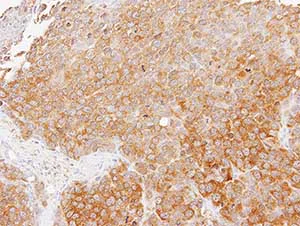
Immunohistochemistry (Formalin/PFA-fixed paraffin-embedded sections) - Anti-TMED4 antibody (AB153814)
  • IHC-P

Unknown

Immunohistochemistry (Formalin/PFA-fixed paraffin-embedded sections) - Anti-TMED4 antibody (AB153814)

Immunohistochemical analysis of paraffin-embedded Human lung SCC tissue labeling TMED4 with ab153814 at 1/100 dilution.
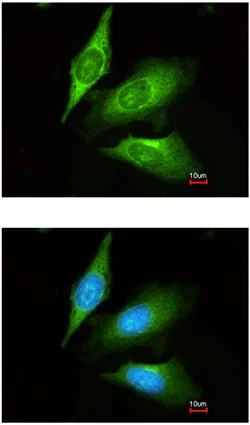
Immunocytochemistry/ Immunofluorescence - Anti-TMED4 antibody (AB153814)
  • ICC/IF

Unknown

Immunocytochemistry/ Immunofluorescence - Anti-TMED4 antibody (AB153814)

Immunofluorescent analysis of methanol-fixed HeLa cells labeling TMED4 with ab153814 at 1/200 dilution. Lower panel co-stained with Hoechst 33342.

Key facts

Host species

Rabbit

Clonality

Polyclonal

Isotype

IgG

Carrier free

No

Reacts with

Human

Applications

IHC-P, WB, ICC/IF

applications

Immunogen

Recombinant Fragment Protein within Human TMED4 aa 1-250. The exact immunogen used to generate this antibody is proprietary information.

Q7Z7H5

Reactivity data

{ "title": "Reactivity Data", "filters": { "stats": ["", "Species", "Dilution Info", "Notes"], "tabs": { "all-applications": {"fullname" : "All Applications", "shortname": "All Applications"}, "WB" : {"fullname" : "Western blot", "shortname":"WB"}, "ICCIF" : {"fullname" : "Immunocytochemistry/ Immunofluorescence", "shortname":"ICC/IF"}, "IHCP" : {"fullname" : "Immunohistochemistry (Formalin/PFA-fixed paraffin-embedded sections)", "shortname":"IHC-P"} }, "product-promise": { "all": "all", "testedAndGuaranteed": "tested", "guaranteed": "expected", "predicted": "predicted", "notRecommended": "not-recommended" } }, "values": { "Human": { "WB-species-checked": "testedAndGuaranteed", "WB-species-dilution-info": "1/500 - 1/3000", "WB-species-notes": "<p></p>", "ICCIF-species-checked": "testedAndGuaranteed", "ICCIF-species-dilution-info": "1/100 - 1/1000", "ICCIF-species-notes": "<p></p>", "IHCP-species-checked": "testedAndGuaranteed", "IHCP-species-dilution-info": "1/100 - 1/1000", "IHCP-species-notes": "<p>Perform heat mediated antigen retrieval before commencing with IHC staining protocol using 10mM Citrate buffer (pH6.0) or Tris-EDTA buffer (pH8.0).</p>" }, "Mouse": { "WB-species-checked": "predicted", "WB-species-dilution-info": "", "WB-species-notes": "", "ICCIF-species-checked": "predicted", "ICCIF-species-dilution-info": "", "ICCIF-species-notes": "", "IHCP-species-checked": "predicted", "IHCP-species-dilution-info": "", "IHCP-species-notes": "" }, "Cow": { "WB-species-checked": "predicted", "WB-species-dilution-info": "", "WB-species-notes": "", "ICCIF-species-checked": "predicted", "ICCIF-species-dilution-info": "", "ICCIF-species-notes": "", "IHCP-species-checked": "predicted", "IHCP-species-dilution-info": "", "IHCP-species-notes": "" }, "Xenopus laevis": { "WB-species-checked": "predicted", "WB-species-dilution-info": "", "WB-species-notes": "", "ICCIF-species-checked": "predicted", "ICCIF-species-dilution-info": "", "ICCIF-species-notes": "", "IHCP-species-checked": "predicted", "IHCP-species-dilution-info": "", "IHCP-species-notes": "" }, "Xenopus tropicalis": { "WB-species-checked": "predicted", "WB-species-dilution-info": "", "WB-species-notes": "", "ICCIF-species-checked": "predicted", "ICCIF-species-dilution-info": "", "ICCIF-species-notes": "", "IHCP-species-checked": "predicted", "IHCP-species-dilution-info": "", "IHCP-species-notes": "" }, "Zebrafish": { "WB-species-checked": "predicted", "WB-species-dilution-info": "", "WB-species-notes": "", "ICCIF-species-checked": "predicted", "ICCIF-species-dilution-info": "", "ICCIF-species-notes": "", "IHCP-species-checked": "predicted", "IHCP-species-dilution-info": "", "IHCP-species-notes": "" } } }

Properties and storage information

Form
Liquid
Purification technique
Affinity purification Immunogen
Storage buffer
pH: 7 Preservative: 0.01% Thimerosal (merthiolate) Constituents: 20% Glycerol (glycerin, glycerine), 1.21% Tris, 0.75% Glycine
Shipped at conditions
Blue Ice
Appropriate short-term storage conditions
+4°C
Appropriate long-term storage conditions
-20°C
Aliquoting information
Upon delivery aliquot
Storage information
Avoid freeze / thaw cycle

Supplementary information

This supplementary information is collated from multiple sources and compiled automatically.

TMED4 also known as Transmembrane Emp24 Domain-Containing Protein 4 is a protein with a mass of approximately 25 kDa. It belongs to the p24 family of proteins that are involved in vesicle trafficking within cells. TMED4 is an integral membrane protein primarily located in the endoplasmic reticulum and Golgi apparatus where it participates in the transport of cargo molecules. It plays a role in facilitating the movement of proteins and lipids between organelles within the secretory pathway.
Biological function summary

The Transmembrane Emp24 Domain-Containing Protein 4 is part of a larger complex essential for the proper sorting and packaging of cargo proteins. By functioning as a scaffold TMED4 assists in maintaining the integrity of protein complexes during their transit through cellular compartments. Its expression is not restricted to a specific cell type; rather it is found ubiquitously across various tissues which suggests an important function in diverse cellular processes.

Pathways

TMED4 functions in the secretory pathway and ER-to-Golgi transport. It is integral in the regulation of vesicle formation budding and fusion events connecting with protein partners such as TMED9. These interactions play a role in processes like protein glycosylation and folding which are vital elements of cellular homeostasis. TMED4's role in these pathways highlights its importance in maintaining cellular function and protein processing.

Transmembrane Emp24 Domain-Containing Protein 4 has been implicated in disorders such as cancer and neurodegenerative diseases. Alterations in its function can disrupt normal vesicle trafficking potentially leading to an accumulation of misfolded proteins. This disruption has associations with proteins like p53 in cancer where altered protein transport can influence cell proliferation. Similarly it connects with pathways involved with amyloid precursor protein in Alzheimer's disease illustrating its relationship to the development and progression of such conditions.

Product protocols

For this product, it's our understanding that no specific protocols are required. You can visit:

Target data

Involved in vesicular protein trafficking, mainly in the early secretory pathway. targeting. Involved in the maintenance of the Golgi apparatus. Appears to play a role in the biosynthesis of secreted cargo including processing. Involved in endoplasmic reticulum stress response. May play a role in the regulation of heat-shock response and apoptosis (By similarity).
See full target information TMED4

Alternative Names

ERS25, TMED4, Transmembrane emp24 domain-containing protein 4, Endoplasmic reticulum stress-response protein 25, GMP25iso, Putative NF-kappa-B-activating protein 156, p24 family protein alpha-3, p24alpha3

Publications (1)

Recent publications for all applications. Explore the full listand refine your search

Journal of dental sciences 18:282-294 PubMed36643258

2023

Hsa_circ_0005050 regulated the progression of oral squamous cell carcinoma via miR-487a-3p/CHSY1 axis.

Applications

Unspecified application

Species

Unspecified reactive species

Xubin Chen,Qiaojiang Chen,Chen Zhao,Zhiqi Lu
View all publications

Product promise

We are committed to supporting your work with high-quality reagents, and we're here for you every step of the way. In the unlikely event that one of our products does not perform as expected, you're protected by our Product Promise.
For full details, please see our Terms & Conditions

Please note: All products are 'FOR RESEARCH USE ONLY. NOT FOR USE IN DIAGNOSTIC OR THERAPEUTIC PROCEDURES'.

For licensing inquiries, please contact partnerships@abcam.com