JavaScript is disabled in your browser. Please enable JavaScript to view this website.
AB188300

Anti-TMEM8C antibody

1

(1 Review)

|

(6 Publications )

Rabbit Polyclonal TMEM8C antibody. Suitable for IHC-P and reacts with Human samples. Cited in 6 publications. Immunogen corresponding to Recombinant Fragment Protein within Human MYMK aa 100-200.

View Alternative Names

TMEM226, TMEM8C, MYMK, Protein myomaker, Myoblast fusion maker, Transmembrane protein 226, Transmembrane protein 8C
1 Images
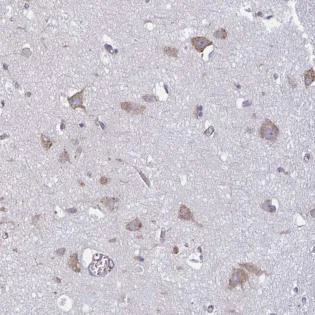
Immunohistochemistry (Formalin/PFA-fixed paraffin-embedded sections) - Anti-TMEM8C antibody (AB188300)
  • IHC-P

Supplier Data

Immunohistochemistry (Formalin/PFA-fixed paraffin-embedded sections) - Anti-TMEM8C antibody (AB188300)

Immunohistochemical analysis of paraffin embedded Human cerebral cortex labeling TMEM8C with ab188300 at 1/50 dilution

Key facts

Host species

Rabbit

Clonality

Polyclonal

Isotype

IgG

Carrier free

No

Reacts with

Human

Applications

IHC-P

applications

Immunogen

Recombinant Fragment Protein within Human MYMK aa 100-200. The exact immunogen used to generate this antibody is proprietary information.

A6NI61

Reactivity data

{ "title": "Reactivity Data", "filters": { "stats": ["", "Species", "Dilution Info", "Notes"], "tabs": { "all-applications": {"fullname" : "All Applications", "shortname": "All Applications"}, "IHCP" : {"fullname" : "Immunohistochemistry (Formalin/PFA-fixed paraffin-embedded sections)", "shortname":"IHC-P"} }, "product-promise": { "all": "all", "testedAndGuaranteed": "tested", "guaranteed": "expected", "predicted": "predicted", "notRecommended": "not-recommended" } }, "values": { "Human": { "IHCP-species-checked": "testedAndGuaranteed", "IHCP-species-dilution-info": "1/50 - 1/200", "IHCP-species-notes": "<p></p> Perform heat-mediated antigen retrieval with citrate buffer pH 6 before commencing with IHC staining protocol." }, "Mouse": { "IHCP-species-checked": "predicted", "IHCP-species-dilution-info": "", "IHCP-species-notes": "" } } }

Properties and storage information

Form
Liquid
Purification technique
Affinity purification Immunogen
Storage buffer
pH: 7.2 Preservative: 0.02% Sodium azide Constituents: PBS, 40% Glycerol (glycerin, glycerine)
Shipped at conditions
Blue Ice
Appropriate short-term storage duration
1-2 weeks
Appropriate short-term storage conditions
+4°C
Appropriate long-term storage conditions
-20°C
Aliquoting information
Upon delivery aliquot
Storage information
Avoid freeze / thaw cycle

Supplementary information

This supplementary information is collated from multiple sources and compiled automatically.

TMEM8C also known as Myomaker is a protein with a molecular weight of approximately 33 kDa. This protein has an important role in the mechanism of cell fusion during muscle development. TMEM8C is highly expressed in skeletal muscle tissue specifically within myoblasts that are involved in muscle formation and regeneration. Its expression is temporally regulated coinciding with periods of myoblast fusion which indicates its role in muscle cell fusion.
Biological function summary

TMEM8C facilitates the fusion of myoblast cells into multinucleated myotubes an essential step in the formation and repair of muscle tissue. This protein works in conjunction with another protein called Myomerger forming a complex that is indispensable for the myoblast fusion process. Its activity is not limited to embryonic muscle development; it also plays a part in adult muscle regeneration contributing significantly to maintaining healthy muscle function.

Pathways

Knowledge of TMEM8C links it to the myogenesis pathway which governs the formation of muscular tissue. It interacts and cooperates with Myomaker and Myomerger to execute muscle cell fusion during the myogenic process. TMEM8C also has association with the Notch signaling pathway a pathway which regulates cell differentiation. The link to Notch is pivotal for coordinating myoblast differentiation an essential precursor to effective muscle fusion and development.

TMEM8C has a significant relationship with muscle-related conditions such as muscular dystrophy. Mutations or dysregulation of this protein can result in impaired muscle development and repair leading to progressive muscle weakness as seen in certain dystrophies. Its function is also connected to disorders like rhabdomyolysis where muscle tissue breakdown occurs. Investigation has shown that abnormal TMEM8C expression may impact pathways regulated by the Notch signaling protein compromising muscle repair processes and exacerbating conditions associated with muscle degeneration.

Product protocols

For this product, it's our understanding that no specific protocols are required. You can visit:

Target data

Myoblast-specific protein that mediates myoblast fusion, an essential step for the formation of multi-nucleated muscle fibers (PubMed : 28681861). Actively participates in the membrane fusion reaction by mediating the mixing of cell membrane lipids (hemifusion) upstream of MYMX. Acts independently of MYMX (By similarity). Involved in skeletal muscle regeneration in response to injury by mediating the fusion of satellite cells, a population of muscle stem cells, with injured myofibers (By similarity). Also involved in skeletal muscle hypertrophy, probably by mediating the fusion of satellite cells with myofibers (By similarity).
See full target information MYMK

Publications (6)

Recent publications for all applications. Explore the full list and refine your search

Molecular therapy. Nucleic acids 36:102443 PubMed39967852

2025

Antisense oligonucleotide-mediated exon 27 skipping restores dysferlin function in dysferlinopathy patient-derived muscle cells.

Applications

Unspecified application

Species

Unspecified reactive species

Saeed Anwar,Rohini Roy Roshmi,Stanley Woo,Umme Sabrina Haque,Joshua James Arthur Lee,William John Duddy,Anne Bigot,Rika Maruyama,Toshifumi Yokota

EMBO reports 25:3812-3841 PubMed39143258

2024

Satellite cell-derived TRIM28 is pivotal for mechanical load- and injury-induced myogenesis.

Applications

Unspecified application

Species

Unspecified reactive species

Kuan-Hung Lin,Jamie E Hibbert,Corey Gk Flynn,Jake L Lemens,Melissa M Torbey,Nathaniel D Steinert,Philip M Flejsierowicz,Kiley M Melka,Garrison T Lindley,Marcos Lares,Vijayasaradhi Setaluri,Amy J Wagers,Troy A Hornberger

Nature cell biology 24:1541-1557 PubMed36192632

2022

Alternative RNA splicing modulates ribosomal composition and determines the spatial phenotype of glioblastoma cells.

Applications

Unspecified application

Species

Unspecified reactive species

Tatyana D Larionova,Soniya Bastola,Tatiana E Aksinina,Ksenia S Anufrieva,Jia Wang,Victoria O Shender,Dmitriy E Andreev,Tatiana F Kovalenko,Georgij P Arapidi,Polina V Shnaider,Anastasia N Kazakova,Yaroslav A Latyshev,Victor V Tatarskiy,Alexander A Shtil,Pascale Moreau,Francis Giraud,Chaoxi Li,Yichan Wang,Maria P Rubtsova,Olga A Dontsova,Michael Condro,Benjamin M Ellingson,Mikhail I Shakhparonov,Harley I Kornblum,Ichiro Nakano,Marat S Pavlyukov

Journal of cachexia, sarcopenia and muscle 12:1098-1116 PubMed34115448

2021

Survival motor neuron deficiency slows myoblast fusion through reduced myomaker and myomixer expression.

Applications

Unspecified application

Species

Unspecified reactive species

Nikki M McCormack,Eric Villalón,Coralie Viollet,Anthony R Soltis,Clifton L Dalgard,Christian L Lorson,Barrington G Burnett

Oxidative medicine and cellular longevity 2019:3585390 PubMed31827673

2019

NADPH Oxidase 4 Contributes to Myoblast Fusion and Skeletal Muscle Regeneration.

Applications

Unspecified application

Species

Unspecified reactive species

Tae Hyun Youm,Sun-Hee Woo,Eun-Soo Kwon,Sung Sup Park

Developmental cell 46:767-780.e7 PubMed30197239

2018

Myomaker and Myomerger Work Independently to Control Distinct Steps of Membrane Remodeling during Myoblast Fusion.

Applications

Unspecified application

Species

Unspecified reactive species

Evgenia Leikina,Dilani G Gamage,Vikram Prasad,Joanna Goykhberg,Michael Crowe,Jiajie Diao,Michael M Kozlov,Leonid V Chernomordik,Douglas P Millay
View all publications

Product promise

We are committed to supporting your work with high-quality reagents, and we're here for you every step of the way. In the unlikely event that one of our products does not perform as expected, you're protected by our Product Promise.
For full details, please see our Terms & Conditions

Please note: All products are 'FOR RESEARCH USE ONLY. NOT FOR USE IN DIAGNOSTIC OR THERAPEUTIC PROCEDURES'.

For licensing inquiries, please contact partnerships@abcam.com