JavaScript is disabled in your browser. Please enable JavaScript to view this website.
AB119915

Anti-TPC2 antibody

Be the first to review this product! Submit a review

|

(7 Publications )

Rabbit Polyclonal TPC2 antibody. Suitable for WB, IHC-P and reacts with Human samples. Cited in 7 publications. Immunogen corresponding to Synthetic Peptide within Human TPCN2.
2 Images
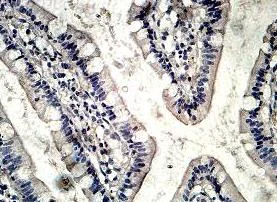
Immunohistochemistry (Formalin/PFA-fixed paraffin-embedded sections) - Anti-TPC2 antibody (AB119915)
  • IHC-P

Unknown

Immunohistochemistry (Formalin/PFA-fixed paraffin-embedded sections) - Anti-TPC2 antibody (AB119915)

ab119915 at 1/100 dilution staining TPC2 in Formalin-fixed, Paraffin-embedded Human fetal small intestine tissue by Immunohistochemistry.
Western blot - Anti-TPC2 antibody (AB119915)
  • WB

Unknown

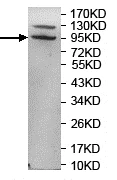
Western blot - Anti-TPC2 antibody (AB119915)

The amount of protein per lane : 30ug

PVDF membrane

Blocking solution : 5% (W/V) skim milk, with 1 X TBST buffer

Shake membrane at room temperature with ab119915, 1/500, for 30 minutes, then transfer to 4°C overnight.

All lanes:

Western blot - Anti-TPC2 antibody (ab119915) at 1/500 dilution

All lanes:

MCF7 cell lysate

Predicted band size: 85 kDa

false

Key facts

Host species

Rabbit

Clonality

Polyclonal

Isotype

IgG

Carrier free

No

Reacts with

Human

Applications

IHC-P, WB

applications

Immunogen

Synthetic Peptide within Human TPCN2. The exact immunogen used to generate this antibody is proprietary information.

Q8NHX9

Reactivity data

{ "title": "Reactivity Data", "filters": { "stats": ["", "Species", "Dilution Info", "Notes"], "tabs": { "all-applications": {"fullname" : "All Applications", "shortname": "All Applications"}, "WB" : {"fullname" : "Western blot", "shortname":"WB"}, "IHCP" : {"fullname" : "Immunohistochemistry (Formalin/PFA-fixed paraffin-embedded sections)", "shortname":"IHC-P"} }, "product-promise": { "all": "all", "testedAndGuaranteed": "tested", "guaranteed": "expected", "predicted": "predicted", "notRecommended": "not-recommended" } }, "values": { "Human": { "WB-species-checked": "testedAndGuaranteed", "WB-species-dilution-info": "1/500 - 1/1000", "WB-species-notes": "<p></p>", "IHCP-species-checked": "testedAndGuaranteed", "IHCP-species-dilution-info": "1/100 - 1/500", "IHCP-species-notes": "<p></p>" }, "Mouse": { "WB-species-checked": "predicted", "WB-species-dilution-info": "", "WB-species-notes": "", "IHCP-species-checked": "predicted", "IHCP-species-dilution-info": "", "IHCP-species-notes": "" }, "Rat": { "WB-species-checked": "predicted", "WB-species-dilution-info": "", "WB-species-notes": "", "IHCP-species-checked": "predicted", "IHCP-species-dilution-info": "", "IHCP-species-notes": "" } } }

Properties and storage information

Form
Lyophilized
Reconstitution
reconstitute with water at 200µL
Purification technique
Affinity purification Immunogen
Purification notes
ab119915 is purified by a peptide affinity column.
Storage buffer
pH: 7.2 Preservative: 0.02% Sodium azide Constituents: 1% BSA
Shipped at conditions
Blue Ice
Appropriate short-term storage duration
1-2 weeks
Appropriate short-term storage conditions
+4°C
Appropriate long-term storage conditions
-20°C
Aliquoting information
Upon delivery aliquot

Supplementary information

This supplementary information is collated from multiple sources and compiled automatically.

TPC2 also known as Two-Pore Channel 2 functions as an ion channel that conducts calcium ions within acidic intracellular compartments like lysosomes and endosomes. The mass of TPC2 is approximately 92 kDa. This protein is found in a variety of tissues with notable expression in the immune system brain and heart. TPC2 operates by forming a channel across the membranes of these organelles helping regulate ionic balance and maintaining the function of the endolysosomal system.
Biological function summary

TPC2 regulates the release of calcium within cells influencing many cellular processes such as trafficking and signaling. TPC2 can participate in complex formation with other proteins within the endolysosomal system affecting the calcium dynamics there. By helping control intracellular calcium levels TPC2 contributes to processes like autophagy and membrane trafficking which are critical for proper cellular function and metabolism.

Pathways

TPC2 plays a part in calcium signaling and autophagy pathways. It modulates calcium responses associated with the activation of lysosomal channels that are vital in these pathways. In calcium signaling TPC2's regulation affects proteins like NAADP and IP3Rs which contribute to the modulation of intracellular calcium levels and downstream signaling events. These interactions highlight its role in maintaining cellular homeostasis and responsiveness to environmental cues.

TPC2 has connections to conditions such as neurodegenerative diseases and cancer. Abnormal TPC2 function can lead to altered calcium homeostasis affecting cellular processes and potentially leading to these diseases. Research reveals that in some tumors changes in TPC2 expression alter the behavior of cancer cells implicating it in cancer progression. The protein's role in neurodegeneration also links to Tau protein and amyloid beta pathways as disruptions in calcium signaling and lysosomal function can exacerbate such disorders.

Product protocols

For this product, it's our understanding that no specific protocols are required. You can visit:

Target data

Intracellular channel initially characterized as a non-selective Ca(2+)-permeable channel activated by NAADP (nicotinic acid adenine dinucleotide phosphate), it is also a highly-selective Na(+) channel activated directly by PI(3,5)P2 (phosphatidylinositol 3,5-bisphosphate) (PubMed : 19387438, PubMed : 19620632, PubMed : 20880839, PubMed : 23063126, PubMed : 23394946, PubMed : 24502975, PubMed : 24776928, PubMed : 30860481, PubMed : 31825310, PubMed : 32167471). Localizes to the lysosomal and late endosome membranes where it regulates organellar membrane excitability, membrane trafficking, and pH homeostasis. Is associated with a plethora of physiological processes, including mTOR-dependent nutrient sensing, skin pigmentation and autophagy (PubMed : 18488028, PubMed : 23394946, PubMed : 32167471). Ion selectivity is not fixed but rather agonist-dependent and under defined ionic conditions, can be readily activated by both NAADP and PI(3,5)P2 (PubMed : 24502975, PubMed : 31825310, PubMed : 32167471). As calcium channel, it increases the pH in the lysosomal lumen, as sodium channel, it promotes lysosomal exocytosis (PubMed : 31825310, PubMed : 32167471). Plays a crucial role in endolysosomal trafficking in the endolysosomal degradation pathway and is potentially involved in the homeostatic control of many macromolecules and cell metabolites (By similarity) (PubMed : 18488028, PubMed : 19387438, PubMed : 19620632, PubMed : 20880839, PubMed : 23063126, PubMed : 23394946, PubMed : 24502975, PubMed : 24776928, PubMed : 31825310, PubMed : 32167471, PubMed : 32679067). Also expressed in melanosomes of pigmented cells where mediates a Ca(2+) channel and/or PI(3,5)P2-activated melanosomal Na(+) channel to acidify pH and inhibit tyrosinase activity required for melanogenesis and pigmentation (PubMed : 27140606). Unlike the voltage-dependent TPCN1, TPCN2 is voltage independent and can be activated solely by PI(3,5)P2 binding. In contrast, PI(4,5)P2, PI(3,4)P2, PI(3)P and PI(5)P have no obvious effect on channel activation (PubMed : 30860481).. (Microbial infection) During Ebola virus (EBOV) infection, controls the movement of endosomes containing virus particles and is required by EBOV to escape from the endosomal network into the cell cytoplasm.. (Microbial infection) Required for cell entry of coronaviruses SARS-CoV and SARS-CoV-2, as well as human coronavirus EMC (HCoV-EMC), by endocytosis.
See full target information TPCN2

Alternative Names

TPC2, TPCN2, Two pore channel protein 2, Two pore calcium channel protein 2

Publications (7)

Recent publications for all applications. Explore the full listand refine your search

Scientific reports 14:31223 PubMed39732974

2024

Hypoxia-induced TPC2 transcription and glycosylation aggravates pulmonary arterial hypertension by blocking autophagy flux.

Applications

Unspecified application

Species

Unspecified reactive species

Chao Li,Cheng Li,YuFei Jiang,MoFei Liu,ChengYi Yang,JiaXin Lu,YongLiang Jiang

Frontiers in cell and developmental biology 10:874043 PubMed35392169

2022

Nicotinic Acid Adenine Dinucleotide Phosphate Induces Intracellular Ca Signalling and Stimulates Proliferation in Human Cardiac Mesenchymal Stromal Cells.

Applications

Unspecified application

Species

Unspecified reactive species

Pawan Faris,Claudio Casali,Sharon Negri,Lara Iengo,Marco Biggiogera,Angela Serena Maione,Francesco Moccia

Autophagy 18:204-222 PubMed34313548

2021

LRRK2 is required for CD38-mediated NAADP-Ca signaling and the downstream activation of TFEB (transcription factor EB) in immune cells.

Applications

Unspecified application

Species

Unspecified reactive species

Neel R Nabar,Christopher N Heijjer,Chong-Shan Shi,Il-Young Hwang,Sundar Ganesan,Mikael C I Karlsson,John H Kehrl

Journal of cellular and molecular medicine 25:7485-7499 PubMed34263977

2021

NAADP-induced intracellular calcium ion is mediated by the TPCs (two-pore channels) in hypoxia-induced pulmonary arterial hypertension.

Applications

Unspecified application

Species

Unspecified reactive species

Wen Hu,Fei Zhao,Ling Chen,Jiamin Ni,Yongliang Jiang

Science advances 6: PubMed32998896

2020

Inhibition of two-pore channels in antigen-presenting cells promotes the expansion of TNFR2-expressing CD4Foxp3 regulatory T cells.

Applications

Unspecified application

Species

Unspecified reactive species

Tianzhen He,De Yang,Xiao-Qing Li,Mengmeng Jiang,Md Sahidul Islam,Shaokui Chen,Yibo Chen,Yang Yang,Chon-Kit Chou,Anna L Trivett,Joost J Oppenheim,Xin Chen

FASEB journal : official publication of the Federa 34:4147-4162 PubMed31950548

2020

Two-pore channels regulate Tat endolysosome escape and Tat-mediated HIV-1 LTR transactivation.

Applications

Unspecified application

Species

Unspecified reactive species

Nabab Khan,Peter W Halcrow,Koffi L Lakpa,Zahra Afghah,Nicole M Miller,Steven F Dowdy,Jonathan D Geiger,Xuesong Chen

eLife 7: PubMed29993362

2018

Highly multiplexed immunofluorescence imaging of human tissues and tumors using t-CyCIF and conventional optical microscopes.

Applications

Unspecified application

Species

Unspecified reactive species

Jia-Ren Lin,Benjamin Izar,Shu Wang,Clarence Yapp,Shaolin Mei,Parin M Shah,Sandro Santagata,Peter K Sorger
View all publications

Product promise

We are committed to supporting your work with high-quality reagents, and we're here for you every step of the way. In the unlikely event that one of our products does not perform as expected, you're protected by our Product Promise.
For full details, please see our Terms & Conditions

Please note: All products are 'FOR RESEARCH USE ONLY. NOT FOR USE IN DIAGNOSTIC OR THERAPEUTIC PROCEDURES'.

For licensing inquiries, please contact partnerships@abcam.com