JavaScript is disabled in your browser. Please enable JavaScript to view this website.
AB204499

Anti-Transcription Factor SP9 antibody

Be the first to review this product! Submit a review

|

(1 Publication)
Rabbit Polyclonal Transcription Factor SP9 antibody. Suitable for IHC-P, ICC/IF and reacts with Human samples. Cited in 1 publication. Immunogen corresponding to Recombinant Fragment Protein within Human SP9 aa 400 to C-terminus.
5 Images
Immunohistochemistry (Formalin/PFA-fixed paraffin-embedded sections) - Anti-Transcription Factor SP9 antibody (AB204499)
  • IHC-P

Supplier Data

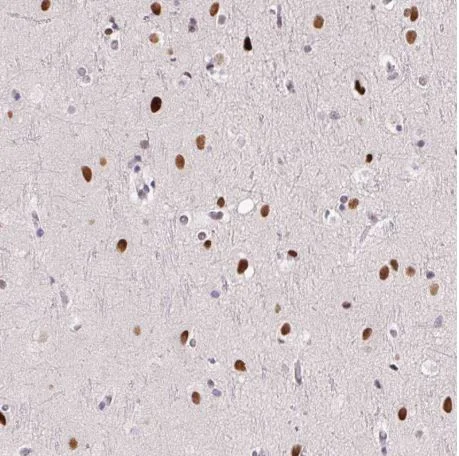
Immunohistochemistry (Formalin/PFA-fixed paraffin-embedded sections) - Anti-Transcription Factor SP9 antibody (AB204499)

Paraffin embedded human cerebral cortex tissue stained for Transcription Factor SP9 using ab204499 at 1/200 dilution in immunohistochemical analysis.

Heat mediated antigen retrieval was performed with citrate buffer pH 6 before the IHC staining protocol.
Immunohistochemistry (Formalin/PFA-fixed paraffin-embedded sections) - Anti-Transcription Factor SP9 antibody (AB204499)
  • IHC-P

Supplier Data

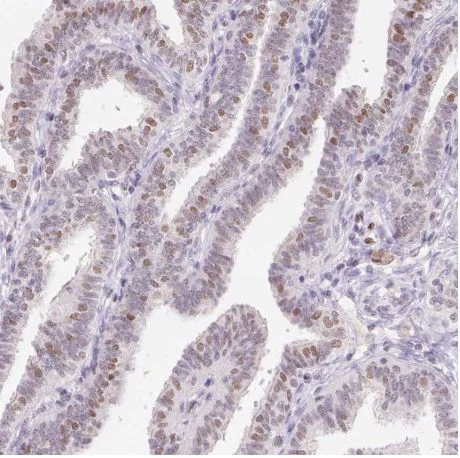
Immunohistochemistry (Formalin/PFA-fixed paraffin-embedded sections) - Anti-Transcription Factor SP9 antibody (AB204499)

Paraffin embedded human fallopian tube tissue stained for Transcription Factor SP9 using ab204499 at 1/200 dilution in immunohistochemical analysis.

Heat mediated antigen retrieval was performed with citrate buffer pH 6 before the IHC staining protocol.
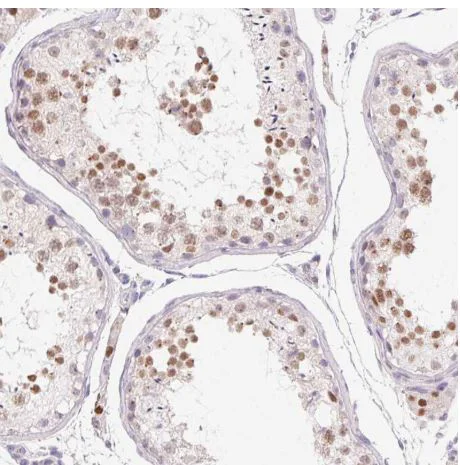
Immunohistochemistry (Formalin/PFA-fixed paraffin-embedded sections) - Anti-Transcription Factor SP9 antibody (AB204499)
  • IHC-P

Supplier Data

Immunohistochemistry (Formalin/PFA-fixed paraffin-embedded sections) - Anti-Transcription Factor SP9 antibody (AB204499)

Paraffin embedded human testis tissue stained for Transcription Factor SP9 using ab204499 at 1/200 dilution in immunohistochemical analysis.

Heat mediated antigen retrieval was performed with citrate buffer pH 6 before the IHC staining protocol.
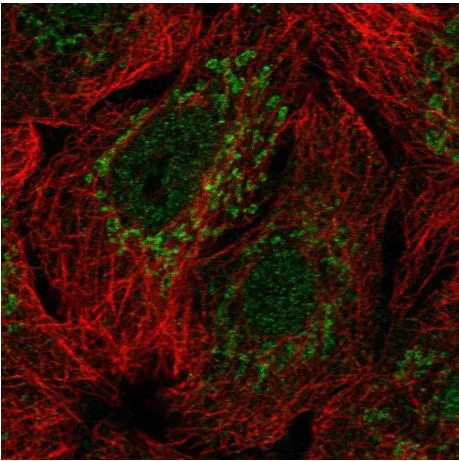
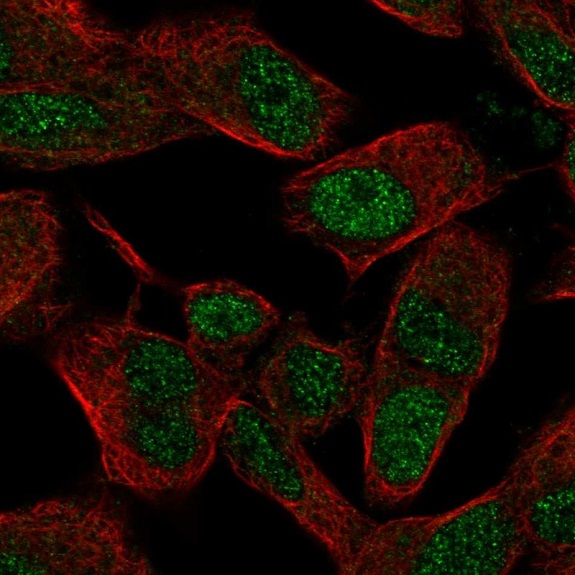
Immunocytochemistry/ Immunofluorescence - Anti-Transcription Factor SP9 antibody (AB204499)
  • ICC/IF

Supplier Data

Immunocytochemistry/ Immunofluorescence - Anti-Transcription Factor SP9 antibody (AB204499)

A549 cells stained for Transcription Factor SP9 (green) using ab204499 at 2 μg/ml in ICC/IF.
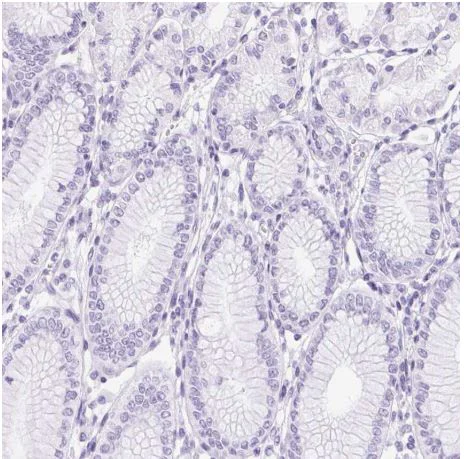
Immunohistochemistry (Formalin/PFA-fixed paraffin-embedded sections) - Anti-Transcription Factor SP9 antibody (AB204499)
  • IHC-P

Supplier Data

Immunohistochemistry (Formalin/PFA-fixed paraffin-embedded sections) - Anti-Transcription Factor SP9 antibody (AB204499)

Paraffin embedded human stomach tissue stained for Transcription Factor SP9 using ab204499 at 1/200 dilution in immunohistochemical analysis. Shows no positivity in gladular cells as expected.

Heat mediated antigen retrieval was performed with citrate buffer pH 6 before the IHC staining protocol.

Key facts

Host species

Rabbit

Clonality

Polyclonal

Isotype

IgG

Carrier free

No

Reacts with

Human

Applications

ICC/IF, IHC-P

applications

Immunogen

Recombinant Fragment Protein within Human SP9 aa 400 to C-terminus. The exact immunogen used to generate this antibody is proprietary information.

P0CG40

Reactivity data

{ "title": "Reactivity Data", "filters": { "stats": ["", "Species", "Dilution Info", "Notes"], "tabs": { "all-applications": {"fullname" : "All Applications", "shortname": "All Applications"}, "IHCP" : {"fullname" : "Immunohistochemistry (Formalin/PFA-fixed paraffin-embedded sections)", "shortname":"IHC-P"}, "ICCIF" : {"fullname" : "Immunocytochemistry/ Immunofluorescence", "shortname":"ICC/IF"} }, "product-promise": { "all": "all", "testedAndGuaranteed": "tested", "guaranteed": "expected", "predicted": "predicted", "notRecommended": "not-recommended" } }, "values": { "Human": { "IHCP-species-checked": "testedAndGuaranteed", "IHCP-species-dilution-info": "1/50 - 1/200", "IHCP-species-notes": "<p></p> Perform heat-mediated antigen retrieval with citrate buffer pH 6 before commencing with IHC staining protocol.", "ICCIF-species-checked": "testedAndGuaranteed", "ICCIF-species-dilution-info": "0.25-2 µg/mL", "ICCIF-species-notes": "<p></p>" }, "Mouse": { "IHCP-species-checked": "predicted", "IHCP-species-dilution-info": "", "IHCP-species-notes": "", "ICCIF-species-checked": "predicted", "ICCIF-species-dilution-info": "", "ICCIF-species-notes": "" }, "Rat": { "IHCP-species-checked": "predicted", "IHCP-species-dilution-info": "", "IHCP-species-notes": "", "ICCIF-species-checked": "predicted", "ICCIF-species-dilution-info": "", "ICCIF-species-notes": "" } } }

Properties and storage information

Form
Liquid
Purification technique
Affinity purification Immunogen
Storage buffer
pH: 7.2 Preservative: 0.02% Sodium azide Constituents: PBS, 40% Glycerol (glycerin, glycerine)
Shipped at conditions
Blue Ice
Appropriate short-term storage duration
1-2 weeks
Appropriate short-term storage conditions
+4°C
Appropriate long-term storage conditions
-20°C
Aliquoting information
Upon delivery aliquot
Storage information
Avoid freeze / thaw cycle

Supplementary information

This supplementary information is collated from multiple sources and compiled automatically.

Transcription Factor SP9 also known as Specificity protein 9 is a member of the SP/KLF family of transcription factors. The protein has a molecular mass of approximately 55 kDa. You can find SP9 expressed mainly in the brain especially during developmental stages. It functions mechanically by binding to GC-rich promoter elements facilitating transcriptional regulation. The protein predominantly acts in the context of neural tissue development.
Biological function summary

SP9 influences several developmental processes. It is not a part of a larger complex but operates through direct DNA binding to regulate the expression of target genes involved in neural differentiation. SP9 directs the transcriptional programs necessary for the proper formation of the striatal and corticospinal pathways. Its activity contributes to neural patterning and growth impacting neuronal identity and connectivity.

Pathways

Researchers link SP9 to important developmental pathways including the Wnt and sonic hedgehog (SHH) signaling pathways. SP9 works in conjunction with other transcription factors like SP8 and PAX6 to orchestrate these pathways. These pathways are important in guiding neural progenitors during early neurological development influencing cell fate and tissue specification in the central nervous system.

Alterations in SP9 may associate with neurodevelopmental disorders like autism and schizophrenia. Studies show a connection between SP9 and other transcription factors such as SP8 in disorders related to disrupted neural development. Abnormal SP9 expression or mutations might contribute to the improper formation of neural circuits potentially playing a role in the manifestation of these neurological conditions.

Product protocols

For this product, it's our understanding that no specific protocols are required. You can visit:

Target data

Transcription factor which plays a key role in limb development. Positively regulates FGF8 expression in the apical ectodermal ridge (AER) and contributes to limb outgrowth in embryos (By similarity).
See full target information SP9

Alternative Names

Transcription factor Sp9, SP9

Publications (1)

Recent publications for all applications. Explore the full listand refine your search

Cell reports. Medicine 4:101277 PubMed37944531

2023

Personalized drug screening in patient-derived organoids of biliary tract cancer and its clinical application.

Applications

Unspecified application

Species

Unspecified reactive species

Xiaoxue Ren,Mingle Huang,Weixiang Weng,Yubin Xie,Yifan Wu,Shenghua Zhu,Ying Zhang,Dongming Li,Jiaming Lai,Shunli Shen,Jie Lin,Ming Kuang,Xiaoxing Li,Jun Yu,Lixia Xu
View all publications

Product promise

We are committed to supporting your work with high-quality reagents, and we're here for you every step of the way. In the unlikely event that one of our products does not perform as expected, you're protected by our Product Promise.
For full details, please see our Terms & Conditions

Please note: All products are 'FOR RESEARCH USE ONLY. NOT FOR USE IN DIAGNOSTIC OR THERAPEUTIC PROCEDURES'.

For licensing inquiries, please contact partnerships@abcam.com