JavaScript is disabled in your browser. Please enable JavaScript to view this website.
AB133238

Anti-TRAP alpha/TRAPA antibody [EPR5603]

Be the first to review this product! Submit a review

|

(16 Publications )
Rabbit Recombinant Monoclonal TRAP alpha/TRAPA antibody. Suitable for WB, Flow Cyt (Intra) and reacts with Human, Mouse, Rat samples. Cited in 16 publications.
2 Images
Flow Cytometry (Intracellular) - Anti-TRAP alpha/TRAPA antibody [EPR5603] (AB133238)
  • Flow Cyt (Intra)

Unknown

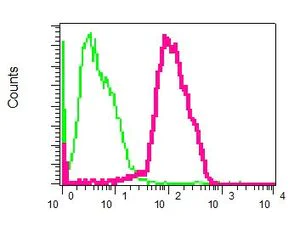
Flow Cytometry (Intracellular) - Anti-TRAP alpha/TRAPA antibody [EPR5603] (AB133238)

Intracellular flow cytometric analysis of TRAP alpha/TRAPA in permeabilized HepG2 cells, using ab133238 at a 1/10 dilution (red) or a rabbit IgG (negative) (green).
Western blot - Anti-TRAP alpha/TRAPA antibody [EPR5603] (AB133238)
  • WB

Unknown

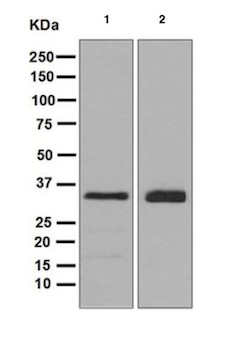
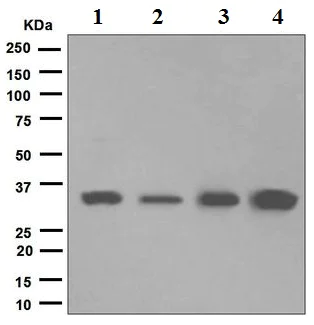
Western blot - Anti-TRAP alpha/TRAPA antibody [EPR5603] (AB133238)

All lanes:

Western blot - Anti-TRAP alpha/TRAPA antibody [EPR5603] (ab133238) at 1/10000 dilution

Lane 1:

A431 cell lysate at 10 µg

Lane 2:

HL60 cell lysate at 10 µg

Lane 3:

T47D cell lysate at 10 µg

Lane 4:

HepG2 cell lysate at 10 µg

Secondary

All lanes:

HRP labelled goat anti-rabbit at 1/2000 dilution

Predicted band size: 32 kDa

Observed band size: 34 kDa

false

  • Carrier free

    Anti-TRAP alpha/TRAPA antibody [EPR5603] - BSA and Azide free

Key facts

Host species

Rabbit

Clonality

Monoclonal

Clone number

EPR5603

Isotype

IgG

Carrier free

No

Reacts with

Human

Applications

Flow Cyt (Intra), WB

applications

Immunogen

The exact immunogen used to generate this antibody is proprietary information.

Reactivity data

{ "title": "Reactivity Data", "filters": { "stats": ["", "Species", "Dilution Info", "Notes"], "tabs": { "all-applications": {"fullname" : "All Applications", "shortname": "All Applications"}, "ICCIF" : {"fullname" : "Immunocytochemistry/ Immunofluorescence", "shortname":"ICC/IF"}, "IP" : {"fullname" : "Immunoprecipitation", "shortname":"IP"}, "WB" : {"fullname" : "Western blot", "shortname":"WB"}, "IHCP" : {"fullname" : "Immunohistochemistry (Formalin/PFA-fixed paraffin-embedded sections)", "shortname":"IHC-P"}, "FlowCytIntra" : {"fullname" : "Flow Cytometry (Intracellular)", "shortname":"Flow Cyt (Intra)"} }, "product-promise": { "all": "all", "testedAndGuaranteed": "tested", "guaranteed": "expected", "predicted": "predicted", "notRecommended": "not-recommended" } }, "values": { "Human": { "ICCIF-species-checked": "notRecommended", "ICCIF-species-dilution-info": "", "ICCIF-species-notes": "<p></p>", "IP-species-checked": "notRecommended", "IP-species-dilution-info": "", "IP-species-notes": "<p></p>", "WB-species-checked": "testedAndGuaranteed", "WB-species-dilution-info": "1/10000 - 1/50000", "WB-species-notes": "<p></p>", "IHCP-species-checked": "notRecommended", "IHCP-species-dilution-info": "", "IHCP-species-notes": "<p></p>", "FlowCytIntra-species-checked": "testedAndGuaranteed", "FlowCytIntra-species-dilution-info": "1/10 - 1/100", "FlowCytIntra-species-notes": "<p><a href='/en-us/products/primary-antibodies/rabbit-igg-monoclonal-epr25a-isotype-control-ab172730'>ab172730</a> - Rabbit monoclonal IgG, is suitable for use as an isotype control with this antibody.</p>" }, "Mouse": { "ICCIF-species-checked": "notRecommended", "ICCIF-species-dilution-info": "", "ICCIF-species-notes": "", "IP-species-checked": "notRecommended", "IP-species-dilution-info": "", "IP-species-notes": "", "WB-species-checked": "guaranteed", "WB-species-dilution-info": "", "WB-species-notes": "<p></p>", "IHCP-species-checked": "notRecommended", "IHCP-species-dilution-info": "", "IHCP-species-notes": "", "FlowCytIntra-species-checked": "predicted", "FlowCytIntra-species-dilution-info": "", "FlowCytIntra-species-notes": "" }, "Rat": { "ICCIF-species-checked": "notRecommended", "ICCIF-species-dilution-info": "", "ICCIF-species-notes": "", "IP-species-checked": "notRecommended", "IP-species-dilution-info": "", "IP-species-notes": "", "WB-species-checked": "guaranteed", "WB-species-dilution-info": "", "WB-species-notes": "<p></p>", "IHCP-species-checked": "notRecommended", "IHCP-species-dilution-info": "", "IHCP-species-notes": "", "FlowCytIntra-species-checked": "predicted", "FlowCytIntra-species-dilution-info": "", "FlowCytIntra-species-notes": "" } } }

Product details

Patented technology
Our RabMAb® technology is a patented hybridoma-based technology for making rabbit monoclonal antibodies. For details on our patents, please refer to RabMAb® patents.

What are the advantages of a recombinant monoclonal antibody?
This product is a recombinant monoclonal antibody, which offers several advantages including:

  • - High batch-to-batch consistency and reproducibility
  • - Improved sensitivity and specificity
  • - Long-term security of supply
  • - Animal-free batch production

For more information, read more on recombinant antibodies.

Properties and storage information

Form
Liquid
Purity
Tissue culture supernatant
Storage buffer
pH: 7.2 - 7.4 Preservative: 0.05% Sodium azide Constituents: 50% Tissue culture supernatant, 40% Glycerol (glycerin, glycerine), 9.85% Tris glycine, 0.1% BSA
Shipped at conditions
Conditional Ambient
Appropriate short-term storage conditions
+4°C
Appropriate long-term storage conditions
-20°C
Storage information
Stable for 12 months at -20°C

Supplementary information

This supplementary information is collated from multiple sources and compiled automatically.

TRAP alpha also known as TRAPA or SSR1 is a protein with a mass of approximately 34 kDa. It locates within the endoplasmic reticulum (ER) membrane as a subunit of the translocon-associated protein complex. It has a role in maintaining the translocation of proteins across the endoplasmic reticulum membrane. TRAP alpha is widely expressed in various tissues reflecting its significant function in cellular processes.
Biological function summary

This protein serves as an integral component of the translocon complex facilitating protein transport into the ER. The TRAP complex includes several subunits that work together to ensure protein maturation and folding. TRAP alpha is especially essential for proper protein synthesis and quality control. It plays an important part in cellular homeostasis by ensuring that only correctly assembled proteins proceed to subsequent cellular pathways.

Pathways

TRAP alpha integrates into protein targeting and translocation pathways. It closely engages with the Sec61 complex another fundamental protein in translocation processes. TRAP alpha’s role is important in the secretory pathway which directs proteins destined for different organelles or secretion out of the cell. This pathway is interconnected with other cellular processes like the unfolded protein response ensuring cellular adaptation to stress conditions.

TRAP alpha associates with pathologies such as cystic fibrosis due to its involvement in protein processing. Mutations in proteins associated with TRAP alpha like CFTR can disrupt proper protein folding and cause disease. Additionally there are links between TRAP alpha and certain neurodegenerative conditions as defects in protein handling and folding within the ER can lead to cell death. Such associations also involve proteins like amyloid precursor protein underlining the importance of TRAP alpha in cellular health and disease prevention.

Product protocols

For this product, it's our understanding that no specific protocols are required. You can visit:

Target data

TRAP proteins are part of a complex whose function is to bind calcium to the ER membrane and thereby regulate the retention of ER resident proteins. May be involved in the recycling of the translocation apparatus after completion of the translocation process or may function as a membrane-bound chaperone facilitating folding of translocated proteins.
See full target information SSR1

Alternative Names

TRAPA, PSEC0262, SSR1, Translocon-associated protein subunit alpha, TRAP-alpha, Signal sequence receptor subunit alpha, SSR-alpha

Publications (16)

Recent publications for all applications. Explore the full listand refine your search

British journal of pharmacology 181:429-446 PubMed37625900

2023

Neutrophil extracellular traps mediate bone erosion in rheumatoid arthritis by enhancing RANKL-induced osteoclastogenesis.

Applications

Unspecified application

Species

Unspecified reactive species

Ayda Henriques Schneider,Thaise Mayumi Taira,Gabriel Azevedo Públio,Douglas da Silva Prado,Paula Barbim Donate Yabuta,Jéssica Cristina Dos Santos,Caio Cavalcante Machado,Flávio Falcão Lima de Souza,Lucas Gabriel Rodrigues Venturini,Renê Donizeti Ribeiro de Oliveira,Thiago Mattar Cunha,José Carlos Alves-Filho,Paulo Louzada-Júnior,Tarcília Aparecida da Silva,Sandra Yasuyo Fukada,Fernando Queiróz Cunha

Cell cycle (Georgetown, Tex.) 22:1900-1920 PubMed37603831

2023

is a key factor regulating reticulophagy-mediated ferroptosis in hepatocellular carcinoma.

Applications

Unspecified application

Species

Unspecified reactive species

Tao Bi,Qianqian Lu,Xiaohong Pan,Fenglin Dong,Yejia Hu,Zongzhen Xu,Peng Xiu,Zhiqian Liu,Jie Li

Journal of musculoskeletal & neuronal interactions 22:242-250 PubMed35642703

2022

Foxf1 gene increases the risk of osteoporosis in rats by inhibiting osteoblast formation and promoting osteoclast differentiation through the upregulation of NF-κB pathway.

Applications

Unspecified application

Species

Unspecified reactive species

Xiao Ouyang,Shimin Li,Yunzhi Ding,Feng Xin,Meng Liu

Computational and mathematical methods in medicine 2021:2909454 PubMed34691235

2021

Overexpression of PIK3R1 Promotes Bone Formation by Regulating Osteoblast Differentiation and Osteoclast Formation.

Applications

Unspecified application

Species

Unspecified reactive species

Haitao Zhu,Hua Chen,Degang Ding,Shui Wang,Xiaofeng Dai,Yulong Zhu

Frontiers in pharmacology 12:723988 PubMed34658862

2021

Betaine Attenuates Osteoarthritis by Inhibiting Osteoclastogenesis and Angiogenesis in Subchondral Bone.

Applications

Unspecified application

Species

Unspecified reactive species

Wang Yajun,Cui Jin,Gu Zhengrong,Fang Chao,Hu Yan,Weng Weizong,Li Xiaoqun,Zhou Qirong,Chen Huiwen,Zhang Hao,Guo Jiawei,Zhuang Xinchen,Sheng Shihao,Wang Sicheng,Chen Xiao,Su Jiacan

Aging 13:11296-11314 PubMed33820875

2021

Hepcidin-induced reduction in iron content and PGC-1β expression negatively regulates osteoclast differentiation to play a protective role in postmenopausal osteoporosis.

Applications

Unspecified application

Species

Unspecified reactive species

Hui Zhang,Aifei Wang,Guangsi Shen,Xiao Wang,Gongwen Liu,Fan Yang,Bin Chen,Mingyong Wang,Youjia Xu

Oxidative medicine and cellular longevity 2020:1404915 PubMed32587656

2020

The Recombinant Protein EphB4-Fc Changes the Ti Particle-Mediated Imbalance of OPG/RANKL via EphrinB2/EphB4 Signaling Pathway and Inhibits the Release of Proinflammatory Factors In Vivo.

Applications

Unspecified application

Species

Unspecified reactive species

Yu-Wei Ge,Kai Feng,Xiao-Liang Liu,Hong-Fang Chen,Zhen-Yu Sun,Cai-Feng Wang,Zhi-Qing Liu,Hao-Wei Wang,Jing-Wei Zhang,De-Gang Yu,Yuan-Qing Mao

Annals of translational medicine 8:350 PubMed32355794

2020

Instability and excessive mechanical loading mediate subchondral bone changes to induce osteoarthritis.

Applications

Unspecified application

Species

Unspecified reactive species

Jianxi Zhu,Yong Zhu,Wenfeng Xiao,Yihe Hu,Yusheng Li

IUBMB life 71:1916-1928 PubMed31317664

2019

MicroRNA-155 inhibition up-regulates LEPR to inhibit osteoclast activation and bone resorption via activation of AMPK in alendronate-treated osteoporotic mice.

Applications

Unspecified application

Species

Unspecified reactive species

Zhongxuan Mao,Yihai Zhu,Weimin Hao,Chao Chu,Hongmin Su

International journal of molecular medicine 42:2031-2041 PubMed30015911

2018

Titanium particle‑mediated osteoclastogenesis may be attenuated via bidirectional ephrin‑B2/eph‑B4 signaling in vitro.

Applications

Unspecified application

Species

Unspecified reactive species

Yu-Wei Ge,Zhi-Qing Liu,Zhen-Yu Sun,De-Gang Yu,Kai Feng,Zhen-An Zhu,Yuan-Qing Mao
View all publications

Product promise

We are committed to supporting your work with high-quality reagents, and we're here for you every step of the way. In the unlikely event that one of our products does not perform as expected, you're protected by our Product Promise.
For full details, please see our Terms & Conditions

Please note: All products are 'FOR RESEARCH USE ONLY. NOT FOR USE IN DIAGNOSTIC OR THERAPEUTIC PROCEDURES'.

For licensing inquiries, please contact partnerships@abcam.com