Anti-TREM2 antibody [EPR20243] - BSA and Azide free
- RabMAb
- Recombinant
- KO Validated
- What is this?
1
(1 Review)
|
(1 Publication)
- IP
Supplier Data
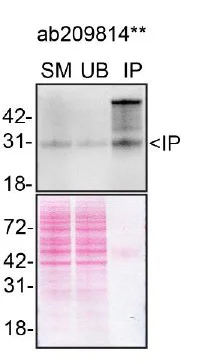
Immunoprecipitation - Anti-TREM2 antibody [EPR20243] - BSA and Azide free (AB232470)
This data was developed using ab209814, the same antibody clone in a different buffer formulation.
Immunoprecipitation of TREM2 in THP-1 cells. Lysates were prepared and immunoprecipitation was performed using 2μg of ab209814 pre-coupled to Protein A beads. Samples were then washed and processed for western blot.
This data was provided by YCharOS Inc., an open science company with the mission of characterizing commercially available antibody reagents for all human proteins. Abcam and YCharOS are working together to help address the reproducibility crisis by enabling the life science community to better evaluate commercially available antibodies.
All lanes:
Immunoprecipitation - Anti-TREM2 antibody [EPR20243] (<a href='/en-us/products/primary-antibodies/trem2-antibody-epr20243-ab209814'>ab209814</a>) at 2 µg
All lanes:
THP-1 cell lysates
Observed band size: 31 kDa
false

- IP
Supplier Data
Immunoprecipitation - Anti-TREM2 antibody [EPR20243] - BSA and Azide free (AB232470)
TREM2 was immunoprecipitated from 0.35 mg of THP-1 (Human monocytic leukemia cell line) whole cell lysate with ab209814 at 1/40 dilution. Western blot was performed from the immunoprecipitate using ab209814 at 1/1000 dilution. VeriBlot for IP Detection Reagent (HRP) (ab131366), was used for detection at 1/10000 dilution.
Lane 1 : THP-1 whole cell lysate, 10 μg (Input).
Lane 2 : ab209814 IP in THP-1 whole cell lysate.
Lane 3 : Rabbit monoclonal IgG (ab172730) instead of ab209814 in THP-1 whole cell lysate.
Blocking and dilution buffer and concentration : 5% NFDM/TBST.
Exposure time : 3 minutes.
This data was developed using the same antibody clone in a different buffer formulation containing PBS, BSA, glycerol, and sodium azide (ab209814).
All lanes:
Immunoprecipitation - Anti-TREM2 antibody [EPR20243] (<a href='/en-us/products/primary-antibodies/trem2-antibody-epr20243-ab209814'>ab209814</a>)
Predicted band size: 25 kDa
Observed band size: 25 kDa
false
- WB
Supplier Data
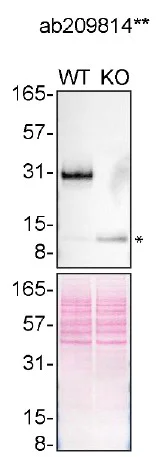
Western blot - Anti-TREM2 antibody [EPR20243] - BSA and Azide free (AB232470)
This data was developed using ab209814, the same antibody clone in a different buffer formulation.
ab209814 was shown to react with TREM2 in wild-type THP-1 cells in Western blot with loss of signal observed in TREM2 knockout cell line ab269489. 10 μg of concentrated culture media from PMA-treated Wild-type THP-1 and TREM2 knockout cell lysates. Wild-type THP-1 and TREM2 knockout cell lysates were subjected to SDS-PAGE. Membranes were blocked in 5% milk in TBST for 1 hr before incubation with ab209814 overnight at 4 °C at a 1/1000 dilution. Blots were incubated with secondary antibodies at 0.2 µg/mL before imaging.
This data was provided by YCharOS Inc., an open science company with the mission of characterizing commercially available antibody reagents for all human proteins. Abcam and YCharOS are working together to help address the reproducibility crisis by enabling the life science community to better evaluate commercially available antibodies.
All lanes:
Western blot - Anti-TREM2 antibody [EPR20243] (<a href='/en-us/products/primary-antibodies/trem2-antibody-epr20243-ab209814'>ab209814</a>) at 1/1000 dilution
Lane 1:
10 μg of concentrated culture media from PMA-treated Wild-type THP-1 lysate at 20 µg
Lane 2:
10 μg of concentrated culture media from PMA-treated TREM2 knock-out THP-1 lysate at 20 µg
Lane 2:
Western blot - Human TREM2 knockout THP-1 cell line (<a href='/en-us/products/cell-lines/human-trem2-knockout-thp-1-cell-line-ab269489'>ab269489</a>)
Observed band size: 31 kDa
false

- WB
Lab
Western blot - Anti-TREM2 antibody [EPR20243] - BSA and Azide free (AB232470)
This data was developed using the same antibody clone in a different buffer formulation (ab209814).
Lanes 1 - 3 : Merged signal (red and green). Green - ab209814 observed at 30 kDa. Red - loading control ab7291 (Mouse anti-Alpha Tubulin [DM1A]) observed at 55 kDa.
ab209814 was shown to react with TREM2 in wild-type THP-1 cells in Western blot with loss of signal observed in TREM2 knockout cell line ab269489 (TREM2 knockout cell lysate ab269652). Wild-type THP-1 and TREM2 knockout cell lysates were subjected to SDS-PAGE. Membranes were blocked in 3 % milk in TBS-T (0.1 % Tween®) before incubation with ab209814 and ab7291 (Mouse anti-Alpha Tubulin [DM1A]) overnight at 4 °C at a 1 in 1000 dilution and a 1 in 20000 dilution respectively. Blots were incubated with Goat anti-Rabbit IgG H&L (IRDye® 800CW) preabsorbed (ab216773) and Goat anti-Mouse IgG H&L (IRDye® 680RD) preabsorbed (ab216776) secondary antibodies at 1 in 20000 dilution for 1 h at room temperature before imaging.
All lanes:
Western blot - Anti-TREM2 antibody [EPR20243] (<a href='/en-us/products/primary-antibodies/trem2-antibody-epr20243-ab209814'>ab209814</a>) at 1/1000 dilution
Lane 1:
Wild-type THP-1 cell lysate at 20 µg
Lane 2:
Western blot - Human TREM2 knockout THP-1 cell lysate (<a href='/en-us/products/cell-lysates/human-trem2-knockout-thp-1-cell-lysate-ab269652'>ab269652</a>) at 20 µg
Lane 3:
HL-60 cell lysate at 20 µg
Predicted band size: 25 kDa
Observed band size: 30 kDa
false
Related conjugates and formulations (1)
-
Anti-TREM2 antibody [EPR20243]
Alternative Products

Primary Antibodies
AB245227
Anti-TREM2 antibody [EPR23177-106]
20ul selling size|RabMAb|Recombinant
- 0
- 0
Primary Antibodies
AB269868
Anti-TREM2 antibody [EPR23177-106] - BSA and Azide free
RabMAb|Recombinant

- 0
- 0
Complementary Products

Sample Prep & Detection Kits
AB270703
5’ Feature Barcode Antibody Conjugation Kit - Lightning-Link® - Oligos 1-10
- 0
- 0
Primary Antibodies
AB178846
Anti-Iba1 antibody [EPR16588] - Microglia marker
20ul selling size|BOND RX™ Validated|RabMAb|Recombinant|Lab Essentials
- 5
- 50
Primary Antibodies
AB8227
Anti-beta Actin antibody - Loading Control
BOND RX™ Validated|Lab Essentials
- 5
- 104
Primary Antibodies
AB177487
Anti-NeuN antibody [EPR12763] - Neuronal Marker
BOND RX™ Validated|RabMAb|Recombinant|Lab Essentials|20ul selling size|Advanced Validation
- 5
- 76
Reactivity data
Product details
ab232470 is the carrier-free version of ab209814.
Patented technology
Our RabMAb® technology is a patented hybridoma-based technology for making rabbit monoclonal antibodies. For details on our patents, please refer to RabMAb® patents.
What are the advantages of a recombinant monoclonal antibody?
This product is a recombinant monoclonal antibody, which offers several advantages including:
- - High batch-to-batch consistency and reproducibility
- - Improved sensitivity and specificity
- - Long-term security of supply
- - Animal-free batch production
For more information, read more on recombinant antibodies.
Conjugation ready
Our carrier-free antibodies are typically supplied in a PBS-only formulation, purified and free of BSA, sodium azide and glycerol. This conjugation-ready format is designed for use with fluorochromes, metal isotopes, oligonucleotides, and enzymes, which makes them ideal for antibody labelling, functional and cell-based assays, flow-based assays (e.g. mass cytometry) and Multiplex Imaging applications.
Use our conjugation kits for antibody conjugates that are ready-to-use in as little as 20 minutes with 1 minute hands-on-time and 100% antibody recovery: available for fluorescent dyes, HRP, biotin and gold.
Compatibility
This product is compatible with the Maxpar® Antibody Labeling Kit from Fluidigm, without the need for antibody preparation. Maxpar® is a trademark of Fluidigm Canada Inc.
Properties and storage information
Form
Purification technique
Storage buffer
Shipped at conditions
Appropriate short-term storage conditions
Appropriate long-term storage conditions
Storage information
Product protocols
- Visit the General protocols
- Visit the Troubleshooting
Target data
Alternative Names
Publications (1)
Recent publications for all applications. Explore the full listand refine your search
Open medicine (Warsaw, Poland) 17:2062-2071 PubMed36568515
2022
Applications
Unspecified application
Species
Unspecified reactive species
Product promise
Please note: All products are 'FOR RESEARCH USE ONLY. NOT FOR USE IN DIAGNOSTIC OR THERAPEUTIC PROCEDURES'.
For licensing inquiries, please contact partnerships@abcam.com