JavaScript is disabled in your browser. Please enable JavaScript to view this website.
AB227613

Anti-TRRAP antibody - N-terminal

2

(1 Review)

|

(1 Publication)
Rabbit Polyclonal TRRAP antibody. N-terminal. Suitable for IP, ChIP, WB, ICC/IF and reacts with Human samples. Cited in 1 publication. Immunogen corresponding to Recombinant Fragment Protein within Human TRRAP.
5 Images
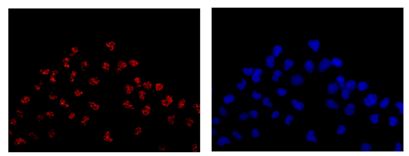
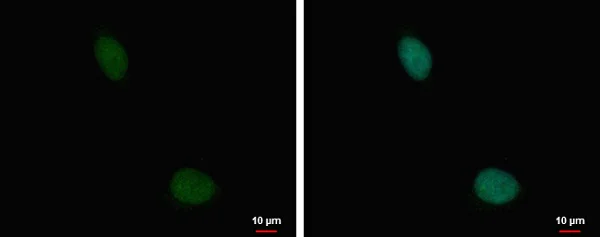
Immunocytochemistry/ Immunofluorescence - Anti-TRRAP antibody - N-terminal (AB227613)
  • ICC/IF

Supplier Data

Immunocytochemistry/ Immunofluorescence - Anti-TRRAP antibody - N-terminal (AB227613)

4% paraformaldehyde fixed HeLa (human epithelial cell line from cervix adenocarcinoma) cells stained for TRRAP (green) using ab227613 at 1/1000 dilution in ICC/IF.

Blue : Hoechst 33342 staining.
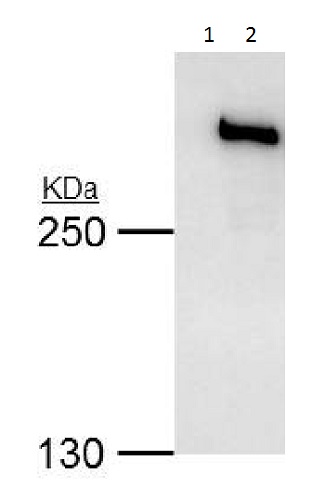
Immunoprecipitation - Anti-TRRAP antibody - N-terminal (AB227613)
  • IP

Supplier Data

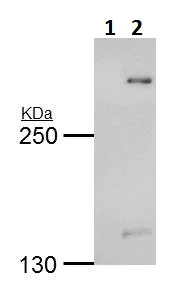
Immunoprecipitation - Anti-TRRAP antibody - N-terminal (AB227613)

TRRAP was immunoprecipitated from HEK-293T (human epithelial cell line from embryonic kidney transformed with large T antigen) whole cell extract with 4 μg ab227613. Western blot was performed from the immunoprecipitate using ab227613 at 1/500 dilution. Anti-rabbit IgG was used as secondary antibody.

Lane 1 : Control IP in HEK-293T whole cell extract with 4 μg of preimmune Rabbit IgG.

Lane 2 : ab227613 IP in HEK-293T whole cell extract.

All lanes:

Immunoprecipitation - Anti-TRRAP antibody - N-terminal (ab227613)

Predicted band size: 438 kDa

false
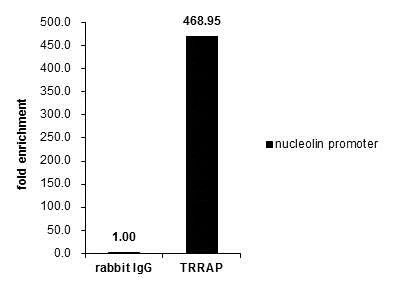
ChIP - Anti-TRRAP antibody - N-terminal (AB227613)
  • ChIP

Supplier Data

ChIP - Anti-TRRAP antibody - N-terminal (AB227613)

Cross-linked ChIP was performed with HeLa (human epithelial cell line from cervix adenocarcinoma) chromatin extract and 5 μg of either control rabbit IgG or ab227613. The precipitated DNA was detected by PCR with primer set targeting to nucleolin promoter.

ChIP experiment and primer designs are based on EMBO J. 2007 Jul 25;26(14) : 3332-45.
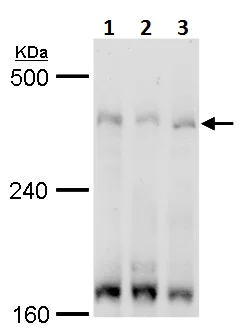
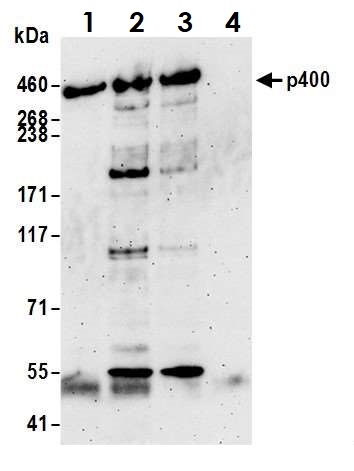
Western blot - Anti-TRRAP antibody - N-terminal (AB227613)
  • WB

Supplier Data

Western blot - Anti-TRRAP antibody - N-terminal (AB227613)

5 % SDS-PAGE gel.

All lanes:

Western blot - Anti-TRRAP antibody - N-terminal (ab227613) at 1/500 dilution

Lane 1:

Jurkat (human T cell leukemia cell line from peripheral blood) whole cell lysate at 30 µg

Lane 2:

Raji (human Burkitt's lymphoma cell line) whole cell lysate at 30 µg

Lane 3:

NCI-H929 whole cell lysate at 30 µg

Predicted band size: 438 kDa

false
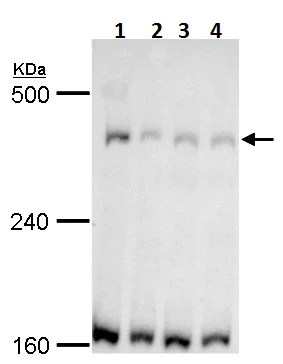
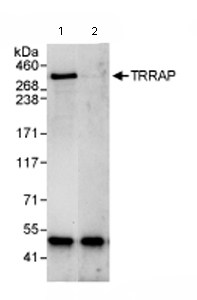
Western blot - Anti-TRRAP antibody - N-terminal (AB227613)
  • WB

Supplier Data

Western blot - Anti-TRRAP antibody - N-terminal (AB227613)

5 % SDS-PAGE gel.

All lanes:

Western blot - Anti-TRRAP antibody - N-terminal (ab227613) at 1/500 dilution

Lane 1:

HEK-293T (human epithelial cell line from embryonic kidney transformed with large T antigen) whole cell lysate at 30 µg

Lane 2:

A431 (human epidermoid carcinoma cell line) whole cell lysate at 30 µg

Lane 3:

HeLa (human epithelial cell line from cervix adenocarcinoma) whole cell lysate at 30 µg

Lane 4:

HepG2 (human liver hepatocellular carcinoma cell line) whole cell lysate at 30 µg

Predicted band size: 438 kDa

false

Key facts

Host species

Rabbit

Clonality

Polyclonal

Isotype

IgG

Carrier free

No

Reacts with

Human

Applications

IP, WB, ChIP, ICC/IF

applications

Immunogen

Recombinant Fragment Protein within Human TRRAP. The exact immunogen used to generate this antibody is proprietary information.

Q9Y4A5

Reactivity data

{ "title": "Reactivity Data", "filters": { "stats": ["", "Species", "Dilution Info", "Notes"], "tabs": { "all-applications": {"fullname" : "All Applications", "shortname": "All Applications"}, "IP" : {"fullname" : "Immunoprecipitation", "shortname":"IP"}, "ChIP" : {"fullname" : "ChIP", "shortname":"ChIP"}, "WB" : {"fullname" : "Western blot", "shortname":"WB"}, "ICCIF" : {"fullname" : "Immunocytochemistry/ Immunofluorescence", "shortname":"ICC/IF"} }, "product-promise": { "all": "all", "testedAndGuaranteed": "tested", "guaranteed": "expected", "predicted": "predicted", "notRecommended": "not-recommended" } }, "values": { "Human": { "IP-species-checked": "testedAndGuaranteed", "IP-species-dilution-info": "1/100 - 1/500", "IP-species-notes": "<p></p>", "ChIP-species-checked": "testedAndGuaranteed", "ChIP-species-dilution-info": "", "ChIP-species-notes": "<p></p>", "WB-species-checked": "testedAndGuaranteed", "WB-species-dilution-info": "1/500 - 1/3000", "WB-species-notes": "<p></p>", "ICCIF-species-checked": "testedAndGuaranteed", "ICCIF-species-dilution-info": "1/100 - 1/1000", "ICCIF-species-notes": "<p></p>" }, "Mouse": { "IP-species-checked": "predicted", "IP-species-dilution-info": "", "IP-species-notes": "", "ChIP-species-checked": "predicted", "ChIP-species-dilution-info": "", "ChIP-species-notes": "", "WB-species-checked": "predicted", "WB-species-dilution-info": "", "WB-species-notes": "", "ICCIF-species-checked": "predicted", "ICCIF-species-dilution-info": "", "ICCIF-species-notes": "" }, "Rat": { "IP-species-checked": "predicted", "IP-species-dilution-info": "", "IP-species-notes": "", "ChIP-species-checked": "predicted", "ChIP-species-dilution-info": "", "ChIP-species-notes": "", "WB-species-checked": "predicted", "WB-species-dilution-info": "", "WB-species-notes": "", "ICCIF-species-checked": "predicted", "ICCIF-species-dilution-info": "", "ICCIF-species-notes": "" }, "Cow": { "IP-species-checked": "predicted", "IP-species-dilution-info": "", "IP-species-notes": "", "ChIP-species-checked": "predicted", "ChIP-species-dilution-info": "", "ChIP-species-notes": "", "WB-species-checked": "predicted", "WB-species-dilution-info": "", "WB-species-notes": "", "ICCIF-species-checked": "predicted", "ICCIF-species-dilution-info": "", "ICCIF-species-notes": "" } } }

Properties and storage information

Form
Liquid
Purification technique
Affinity purification Immunogen
Storage buffer
pH: 7 Preservative: 0.025% Proclin 300 Constituents: PBS, 20% Glycerol (glycerin, glycerine)
Shipped at conditions
Blue Ice
Appropriate short-term storage duration
1-2 weeks
Appropriate short-term storage conditions
+4°C
Appropriate long-term storage conditions
-20°C
Aliquoting information
Upon delivery aliquot
Storage information
Avoid freeze / thaw cycle

Supplementary information

This supplementary information is collated from multiple sources and compiled automatically.

The TRRAP (Transformation/Transcription Domain-Associated Protein) also known simply as TRAAP acts as an adaptor protein with a molecular weight of approximately 434 kDa. TRRAP is widely expressed across different tissue types playing a significant role in cellular processes. As part of a larger family of proteins linked to phosphoinositide 3-kinase-related kinases TRRAP does not perform any kinase activity despite having a structure similar to these kinases. Its primary function involves facilitating chromatin remodeling and histone acetylation.
Biological function summary

TRRAP functions as part of several multiprotein acetyltransferase complexes notably the Tip60 and SAGA complexes. These complexes modify chromatin structures affecting transcription by acetylating histone proteins which allows genes to be more accessible for transcription. This role is important for regulating gene expression making TRRAP important in cellular differentiation and proliferation. By interacting with specific compartments of the cell it participates in large chromatin-modifying machines that influence cellular outcomes.

Pathways

You will find TRRAP involved in pivotal biological routes such as the DNA damage response and Wnt signaling. In the DNA damage response pathway TRRAP interacts with Histone H4 and influences DNA repair mechanisms. TRRAP also collaborates with proteins like c-MYC in these signaling networks impacting both gene transcription and cell cycle progression. Through its associations with these pathways TRRAP assists in processes that maintain genome stability contributing to normal and pathological cellular states.

TRRAP demonstrates a notable connection to cancer and neurological disorders. Mutations and aberrations in TRRAP expression levels have associations with various cancers including breast and colorectal tumors likely due to its influence on cell proliferation and survival. In the context of neurological disorders deficient TRRAP activity might relate to problems in neural development further highlighting its interaction with c-MYC in maintaining proper cellular growth balance. Understanding TRRAP's function and interactions can offer valuable insights into its role in disease mechanisms.

Product protocols

For this product, it's our understanding that no specific protocols are required. You can visit:

Target data

Adapter protein, which is found in various multiprotein chromatin complexes with histone acetyltransferase activity (HAT), which gives a specific tag for epigenetic transcription activation. Component of the NuA4 histone acetyltransferase complex which is responsible for acetylation of nucleosomal histones H4 and H2A. Plays a central role in MYC transcription activation, and also participates in cell transformation by MYC. Required for p53/TP53-, E2F1- and E2F4-mediated transcription activation. Also involved in transcription activation mediated by the adenovirus E1A, a viral oncoprotein that deregulates transcription of key genes. Probably acts by linking transcription factors such as E1A, MYC or E2F1 to HAT complexes such as STAGA thereby allowing transcription activation. Probably not required in the steps following histone acetylation in processes of transcription activation. May be required for the mitotic checkpoint and normal cell cycle progression. Component of a SWR1-like complex that specifically mediates the removal of histone H2A.Z/H2AZ1 from the nucleosome. May play a role in the formation and maintenance of the auditory system (By similarity).
See full target information TRRAP

Alternative Names

PAF400, TRRAP, Transformation/transcription domain-associated protein, 350/400 kDa PCAF-associated factor, STAF40, Tra1 homolog, PAF350/400

Publications (1)

Recent publications for all applications. Explore the full listand refine your search

IUBMB life 71:1916-1928 PubMed31317664

2019

MicroRNA-155 inhibition up-regulates LEPR to inhibit osteoclast activation and bone resorption via activation of AMPK in alendronate-treated osteoporotic mice.

Applications

Unspecified application

Species

Unspecified reactive species

Zhongxuan Mao,Yihai Zhu,Weimin Hao,Chao Chu,Hongmin Su
View all publications

Product promise

We are committed to supporting your work with high-quality reagents, and we're here for you every step of the way. In the unlikely event that one of our products does not perform as expected, you're protected by our Product Promise.
For full details, please see our Terms & Conditions

Please note: All products are 'FOR RESEARCH USE ONLY. NOT FOR USE IN DIAGNOSTIC OR THERAPEUTIC PROCEDURES'.

For licensing inquiries, please contact partnerships@abcam.com