Anti-Ubiquitin (phospho S65) antibody [41H1/41K3] - BSA and Azide free
- BOND RX™ Validated
- Recombinant
- What is this?
Be the first to review this product! Submit a review
|
(0 Publication)
- IHC-P
Supplier Data
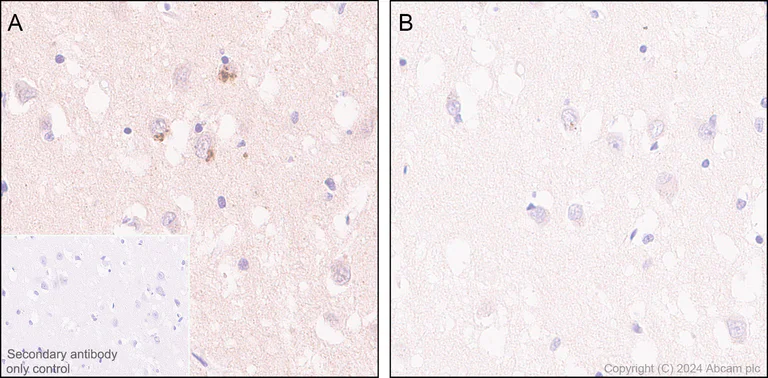
Immunohistochemistry (Formalin/PFA-fixed paraffin-embedded sections) - Anti-Ubiquitin (phospho S65) antibody [41H1/41K3] - BSA and Azide free (AB314904)
This data was developed using ab314903 the same antibody clone in a different buffer formulation.
Immunohistochemical analysis of paraffin-embedded Human Alzheimer's Disease brain tissue labeling Ubiquitin (phospho S65) with ab314903 at 1/5000 (0.192 ug/ml) dilution followed by a ready to use LeicaDS9800 (Bond™ Polymer Refine Detection). Positive staining on human Alzheimer's Disease brain without alkaline phosphatase treatment (image A). No signal was detected when tissues were treated with alkaline phosphatase (image B). The section was incubated with ab314903 for 30 mins at room temperature. The immunostaining was performed on a Leica Biosystems BOND® RX instrument. Counterstained with Hematoxylin.
Secondary antibody only control : Secondary antibody is a ready to use LeicaDS9800 (Bond™ Polymer Refine Detection).
Heat mediated antigen retrieval was performed with Tris-EDTA buffer (pH 9.0, Epitope Retrieval Solution2) for 20 mins.
- IHC-P
Supplier Data
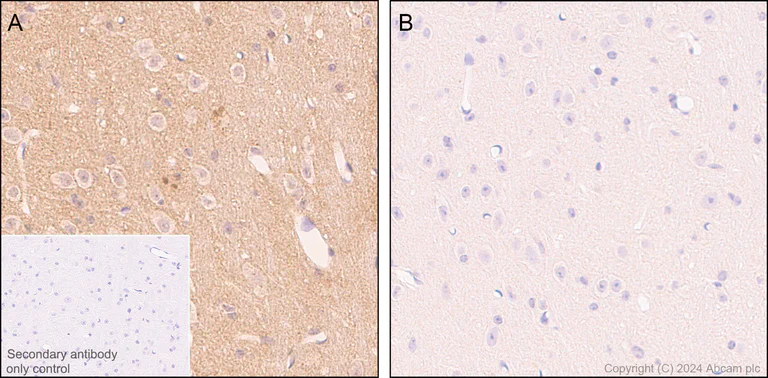
Immunohistochemistry (Formalin/PFA-fixed paraffin-embedded sections) - Anti-Ubiquitin (phospho S65) antibody [41H1/41K3] - BSA and Azide free (AB314904)
This data was developed using ab314903 the same antibody clone in a different buffer formulation.
Immunohistochemical analysis of paraffin-embedded Mouse Alzheimer's Disease brain tissue labeling Ubiquitin (phospho S65) with ab314903 at 1/5000 (0.192 ug/ml) dilution followed by a ready to use LeicaDS9800 (Bond™ Polymer Refine Detection). Positive staining on mouse Alzheimer's Disease brain without alkaline phosphatase treatment (image A). No signal was detected when tissues were treated with alkaline phosphatase (image B). The section was incubated with ab314903 for 30 mins at room temperature. The immunostaining was performed on a Leica Biosystems BOND® RX instrument. Counterstained with Hematoxylin.
Secondary antibody only control : Secondary antibody is a ready to use LeicaDS9800 (Bond™ Polymer Refine Detection).
Heat mediated antigen retrieval was performed with Tris-EDTA buffer (pH 9.0, Epitope Retrieval Solution2) for 20 mins.
- IHC-P
Supplier Data
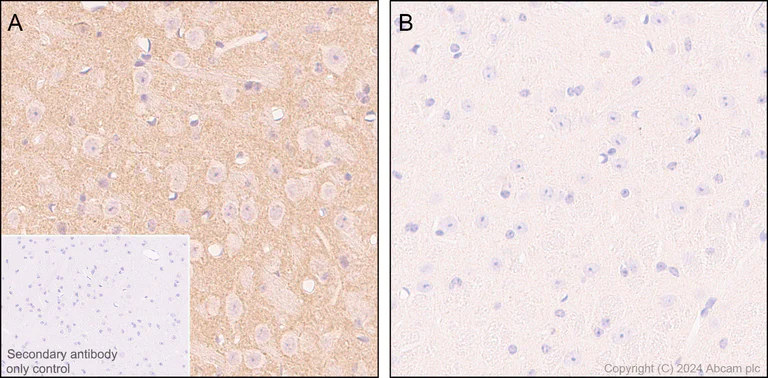
Immunohistochemistry (Formalin/PFA-fixed paraffin-embedded sections) - Anti-Ubiquitin (phospho S65) antibody [41H1/41K3] - BSA and Azide free (AB314904)
This data was developed using ab314903 the same antibody clone in a different buffer formulation.
Immunohistochemical analysis of paraffin-embedded Mouse cerebrum tissue labeling Ubiquitin (phospho S65) with ab314903 at 1/5000 (0.192 ug/ml) dilution followed by a ready to use LeicaDS9800 (Bond™ Polymer Refine Detection). Positive staining on mouse cerebrum without alkaline phosphatase treatment (image A). No signal was detected when tissues were treated with alkaline phosphatase (image B). The section was incubated with ab314903 for 30 mins at room temperature. The immunostaining was performed on a Leica Biosystems BOND® RX instrument. Counterstained with Hematoxylin.
Secondary antibody only control : Secondary antibody is a ready to use LeicaDS9800 (Bond™ Polymer Refine Detection).
Heat mediated antigen retrieval was performed with Tris-EDTA buffer (pH 9.0, Epitope Retrieval Solution2) for 20 mins.
Related conjugates and formulations (3)
-
Anti-Ubiquitin (phospho S65) antibody [41H1/41K3]
-
Anti-Ubiquitin (phospho S65) antibody [41H1/41K3] - Rat IgG2a (Chimeric)
-
Anti-Ubiquitin (phospho S65) antibody [41H1/41K3] - Rat IgG2a (Chimeric) - BSA and Azide free
Complementary Products
Primary Antibodies
AB186735
Anti-TOMM20 antibody [EPR15581-54] - Mitochondrial Marker
RabMAb|Recombinant|Lab Essentials|20ul selling size

- 5
- 16
Primary Antibodies
AB216144
Anti-PINK1 antibody [EPR20730]
RabMAb|Recombinant|KO Validated|20ul selling size
- 4
- 4
Primary Antibodies
AB140601
Anti-Ubiquitin (linkage-specific K48) antibody [EP8589]
20ul selling size|RabMAb|Recombinant

- 5
- 10
Reactivity data
Product details
ab314904 is the carrier-free version of ab314903.
What are the advantages of a recombinant monoclonal antibody?
This product is a recombinant monoclonal antibody, which offers several advantages including:
- - High batch-to-batch consistency and reproducibility
- - Improved sensitivity and specificity
- - Long-term security of supply
- - Animal-free batch production
For more information, read more on recombinant antibodies.
Conjugation ready
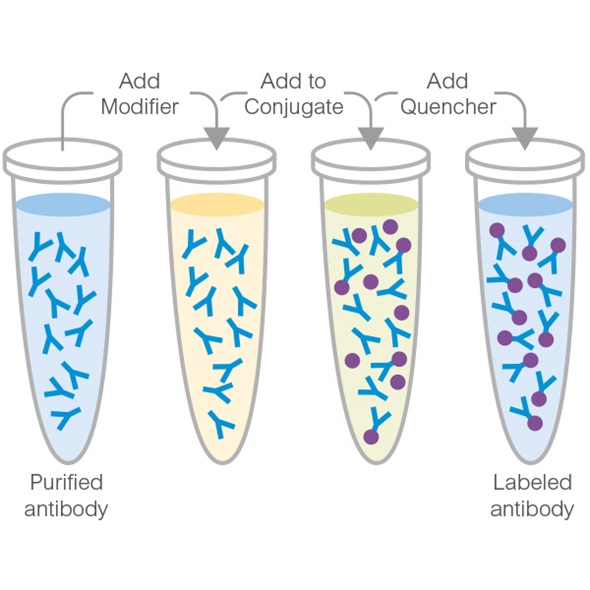
Our carrier-free antibodies are typically supplied in a PBS-only formulation, purified and free of BSA, sodium azide and glycerol. This conjugation-ready format is designed for use with fluorochromes, metal isotopes, oligonucleotides, and enzymes, which makes them ideal for antibody labelling, functional and cell-based assays, flow-based assays (e.g. mass cytometry) and Multiplex Imaging applications.
Use our conjugation kits for antibody conjugates that are ready-to-use in as little as 20 minutes with 1 minute hands-on-time and 100% antibody recovery: available for fluorescent dyes, HRP, biotin and gold.
Compatibility
This product is compatible with the Maxpar® Antibody Labeling Kit from Fluidigm, without the need for antibody preparation. Maxpar® is a trademark of Fluidigm Canada Inc.
Want a custom formulation?
This antibody clone is manufactured by Abcam. If you require a custom buffer formulation or conjugation for your experiments, please contact orders@abcam.com
Collaborations
This antibody was developed with support from The Michael J. Fox Foundation.

Properties and storage information
Form
Purification technique
Storage buffer
Shipped at conditions
Appropriate short-term storage conditions
Appropriate long-term storage conditions
Supplementary information
This supplementary information is collated from multiple sources and compiled automatically.
Biological function summary
The ubiquitin system plays a critical role in regulating protein turnover and quality control within cells. It is part of a larger complex known as the ubiquitin-proteasome system (UPS) which is responsible for degrading proteins that need to be turned over. This process is essential for cell cycle control response to oxidative stress and DNA repair. Ubiquitin's role in tagging proteins for degradation or signaling allows cells to respond quickly to changes in their environment and maintain balance.
Pathways
Ubiquitin functions in several important biological pathways including the Wnt and NF-kB pathways. In the Wnt signaling pathway ubiquitination modulates the stability of key components thereby affecting the pathway's overall activity. In the NF-kB signaling pathway ubiquitin labels inhibitor proteins for degradation which releases and activates NF-kB. These pathways highlight ubiquitin's interaction with proteins such as beta-catenin in Wnt and IkB in NF-kB illustrating how it regulates diverse cellular processes.
Product protocols
- Visit the General protocols
- Visit the Troubleshooting
Target data
Alternative Names
Product promise
Please note: All products are 'FOR RESEARCH USE ONLY. NOT FOR USE IN DIAGNOSTIC OR THERAPEUTIC PROCEDURES'.
For licensing inquiries, please contact partnerships@abcam.com