Anti-UCHL5IP antibody [EPR15341]
- RabMAb
- Recombinant
- What is this?
Be the first to review this product! Submit a review
|
(1 Publication)
- WB
Supplier Data
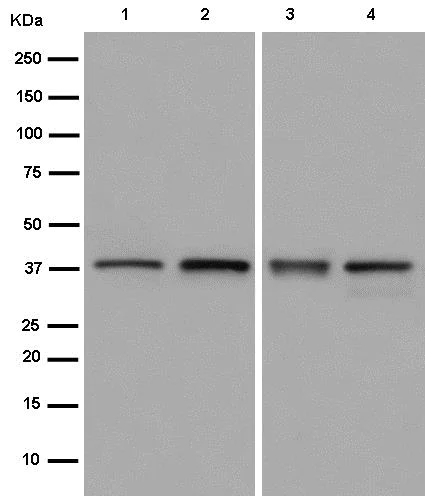
Western blot - Anti-UCHL5IP antibody [EPR15341] (AB186420)
All lanes:
Western blot - Anti-UCHL5IP antibody [EPR15341] (ab186420) at 1/20000 dilution
Lane 1:
HeLa cell lysate at 20 µg
Lane 2:
Jurkat cell lysate at 20 µg
Lane 3:
MCF7 cell lysate at 20 µg
Lane 4:
HT29 cell lysate at 20 µg
Secondary
All lanes:
Goat Anti-Rabbit IgG, (H+L), Peroxidase conjugate at 1/1000 dilution
Predicted band size: 40 kDa
Observed band size: 41 kDa
false
Related conjugates and formulations (1)
-
Anti-UCHL5IP antibody [EPR15341] - BSA and Azide free
Alternative Products

Complementary Products

Primary Antibodies
AB191217
Anti-PARP1 antibody [EPR18461]
KO Validated|RabMAb|Recombinant|Lab Essentials|20ul selling size

- 4
- 6


Reactivity data
Product details
Patented technology
Our RabMAb® technology is a patented hybridoma-based technology for making rabbit monoclonal antibodies. For details on our patents, please refer to RabMAb® patents.
What are the advantages of a recombinant monoclonal antibody?
This product is a recombinant monoclonal antibody, which offers several advantages including:
- - High batch-to-batch consistency and reproducibility
- - Improved sensitivity and specificity
- - Long-term security of supply
- - Animal-free batch production
For more information, read more on recombinant antibodies.
Properties and storage information
Form
Purification technique
Storage buffer
Shipped at conditions
Appropriate short-term storage duration
Appropriate short-term storage conditions
Appropriate long-term storage conditions
Aliquoting information
Storage information
Supplementary information
This supplementary information is collated from multiple sources and compiled automatically.
Biological function summary
UCHL5IP regulates protein turnover by assisting the function of UCHL5. It forms part of a complex with the proteasome which is important for maintaining protein homeostasis. This interaction helps the proteasome properly degrade misfolded or excessive proteins enhancing cellular regulation. The involvement of UCHL5IP in maintaining protein quality control underlines its significance in cellular integrity and function.
Pathways
Scientists recognize UCHL5IP's participation in the ubiquitin-proteasome pathway a major cellular mechanism controlling protein degradation. It interacts with UCHL5 a component of the protease interacting with the proteasome. The pathway is responsible for regulating protein levels and maintaining cellular balance. Additionally UCHL5IP might have connections to signaling pathways through roles in modulating protein levels linking it to broader networks of cellular communication and response.
Product protocols
- Visit the General protocols
- Visit the Troubleshooting
Target data
Alternative Names
Publications (1)
Recent publications for all applications. Explore the full listand refine your search
Cancer research communications 4:2203-2214 PubMed39087378
2024
Applications
Unspecified application
Species
Unspecified reactive species
Product promise
Please note: All products are 'FOR RESEARCH USE ONLY. NOT FOR USE IN DIAGNOSTIC OR THERAPEUTIC PROCEDURES'.
For licensing inquiries, please contact partnerships@abcam.com