Anti-USP19 antibody [EPR14816]
- RabMAb
- Recombinant
- KO Validated
- What is this?
3
(1 Review)
|
(3 Publications )
Rabbit Recombinant Monoclonal USP19 antibody. Suitable for WB, Flow Cyt (Intra) and reacts with Human samples. Cited in 3 publications.
View Alternative Names
KIAA0891, ZMYND9, USP19, Ubiquitin carboxyl-terminal hydrolase 19, Deubiquitinating enzyme 19, Ubiquitin thioesterase 19, Ubiquitin-specific-processing protease 19, Zinc finger MYND domain-containing protein 9
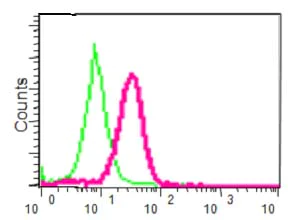
- Flow Cyt (Intra)
Supplier Data
Flow Cytometry (Intracellular) - Anti-USP19 antibody [EPR14816] (AB189518)
Intracellular flow cytometric analysis of Jurkat cells (left histogram) labeling USP19 with ab189518 at 1/250 dilution compared to negative control cells (right histogram). Secondary antibody FITC-conjugated goat-anti-rabbit IgG used at 1/150 diution.
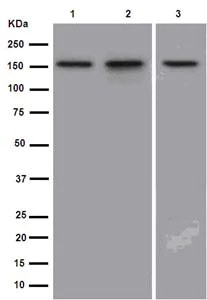
- WB
Supplier Data
Western blot - Anti-USP19 antibody [EPR14816] (AB189518)
All lanes:
Western blot - Anti-USP19 antibody [EPR14816] (ab189518) at 1/10000 dilution
Lane 1:
Jurkat lysate at 10 µg
Lane 2:
293T lysate at 10 µg
Lane 3:
HeLa lysate at 10 µg
Secondary
All lanes:
Goat Anti-Rabbit IgG, (H+L), Peroxidase conjugated at 1/1000 dilution
Predicted band size: 146 kDa
true
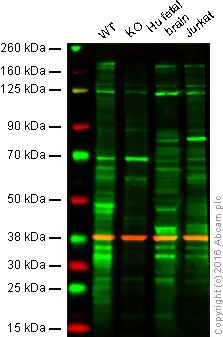
- WB
Lab
Western blot - Anti-USP19 antibody [EPR14816] (AB189518)
Lane 1 : Wild-type HAP1 cell lysate (40 μg)
Lane 2 : USP19 knockout HAP1 cell lysate (40 μg)
Lane 3 : Jurkat cell lysate (40 μg)
Lane 4 : HeLa cell lysate (40 μg)
Lanes 1 - 4 : Merged signal (red and green). Green - ab189518 observed at 160 kDa. Red - loading control, ab8245, observed at 37 kDa.
ab189518 was shown to recognize USP19 when USP19 knockout samples were used, along with additional cross-reactive bands. Wild-type and USP19 knockout samples were subjected to SDS-PAGE. ab189518 and ab8245 (loading control to GAPDH) were diluted at 1/1000 and 1/10000 dilution respectively and incubated overnight at 4C. Blots were developed with Goat anti-Rabbit IgG H&L (IRDye® 800CW) preadsorbed ab216773 and Goat anti-Mouse IgG H&L (IRDye® 680RD) preadsorbed ab216776 secondary antibodies at 1/10000 dilution for 1 hour at room temperature before imaging.
All lanes:
Western blot - Anti-USP19 antibody [EPR14816] (ab189518)
Predicted band size: 146 kDa
false
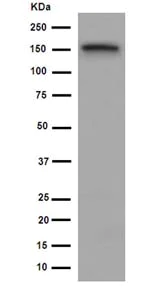
- WB
Supplier Data
Western blot - Anti-USP19 antibody [EPR14816] (AB189518)
All lanes:
Western blot - Anti-USP19 antibody [EPR14816] (ab189518) at 1/5000 dilution
All lanes:
Human fetal brain lysate at 20 µg
Secondary
All lanes:
Goat Anti-Rabbit IgG, (H+L), Peroxidase conjugated at 1/1000 dilution
Predicted band size: 146 kDa
true
Related conjugates and formulations (1)
-
Anti-USP19 antibody [EPR14816] - BSA and Azide free
Alternative Products

Complementary Products
Primary Antibodies
AB179434
Anti-Ubiquitin (linkage-specific K63) antibody [EPR8590-448]
20ul selling size|RabMAb|Recombinant

- 5
- 6
Primary Antibodies
AB124964
Anti-alpha smooth muscle Actin antibody [EPR5368]
BOND RX™ Validated|RabMAb|Recombinant|KO Validated|20ul selling size

- 5
- 19
Primary Antibodies
AB207612
Anti-Beclin 1 antibody [EPR19662]
20ul selling size|KO Validated|RabMAb|Recombinant|Trial Size
- 5
- 10
Primary Antibodies
AB140601
Anti-Ubiquitin (linkage-specific K48) antibody [EP8589]
20ul selling size|RabMAb|Recombinant

- 5
- 10
Reactivity data
Product details
Patented technology
Our RabMAb® technology is a patented hybridoma-based technology for making rabbit monoclonal antibodies. For details on our patents, please refer to RabMAb® patents.
What are the advantages of a recombinant monoclonal antibody?
This product is a recombinant monoclonal antibody, which offers several advantages including:
- - High batch-to-batch consistency and reproducibility
- - Improved sensitivity and specificity
- - Long-term security of supply
- - Animal-free batch production
For more information, read more on recombinant antibodies.
Properties and storage information
Form
Purification technique
Storage buffer
Shipped at conditions
Appropriate short-term storage duration
Appropriate short-term storage conditions
Appropriate long-term storage conditions
Aliquoting information
Storage information
Supplementary information
This supplementary information is collated from multiple sources and compiled automatically.
Biological function summary
The regulation of protein turnover and cellular stress responses involves USP19. As a standalone enzyme it participates independently rather than as part of a larger protein complex. By deubiquitinating target proteins USP19 influences their stability and function affecting a variety of cellular processes such as protein synthesis cell cycle progression and stress response through modulation of ubiquitin chains on substrates.
Pathways
The modulation of protein degradative pathways involves USP19 specifically impacting the ubiquitin-proteasome system (UPS) and chaperone-mediated autophagy (CMA). It interacts with key proteins in these pathways such as ubiquitin-conjugating enzymes and proteasomal subunits to maintain cellular homeostasis. By regulating pathways like UPS USP19 plays a role in controlling protein quality and preventing aggregation which is critical for cell function.
Product protocols
- Visit the General protocols
- Visit the Troubleshooting
Target data
Publications (3)
Recent publications for all applications. Explore the full list and refine your search
Theranostics 15:9819-9837 PubMed41041071
2025
Applications
Unspecified application
Species
Unspecified reactive species
The Journal of clinical investigation 134: PubMed39480513
2024
Applications
Unspecified application
Species
Unspecified reactive species
Cellular and molecular life sciences : CMLS 80:43 PubMed36646950
2023
Applications
Unspecified application
Species
Unspecified reactive species
Product promise
Please note: All products are 'FOR RESEARCH USE ONLY. NOT FOR USE IN DIAGNOSTIC OR THERAPEUTIC PROCEDURES'.
For licensing inquiries, please contact partnerships@abcam.com