JavaScript is disabled in your browser. Please enable JavaScript to view this website.
AB244290

Anti-USP5 antibody

Be the first to review this product! Submit a review

|

(5 Publications )

Rabbit Polyclonal USP5 antibody. Suitable for IHC-P, WB, ICC/IF and reacts with Human, Rat, Mouse samples. Cited in 5 publications. Immunogen corresponding to Recombinant Fragment Protein within Human USP5 aa 350-500.

View Alternative Names

ISOT, USP5, Ubiquitin carboxyl-terminal hydrolase 5, Deubiquitinating enzyme 5, Isopeptidase T, Ubiquitin thioesterase 5, Ubiquitin-specific-processing protease 5
4 Images
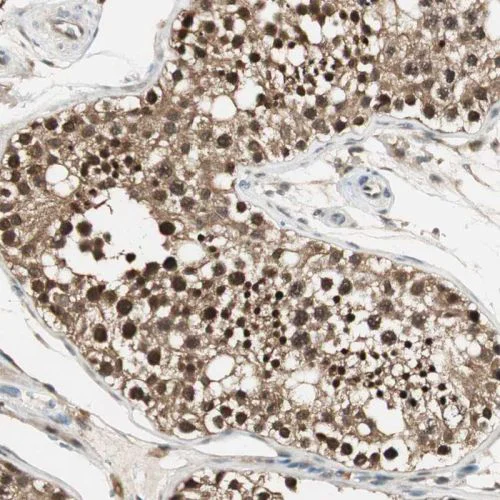
Immunohistochemistry (Formalin/PFA-fixed paraffin-embedded sections) - Anti-USP5 antibody (AB244290)
  • IHC-P

Unknown

Immunohistochemistry (Formalin/PFA-fixed paraffin-embedded sections) - Anti-USP5 antibody (AB244290)

Paraffin-embedded human testis tissue stained for USP5 using ab244290 at 1/50 dilution in immunohistochemical analysis.
Immunocytochemistry/ Immunofluorescence - Anti-USP5 antibody (AB244290)
  • ICC/IF

Unknown

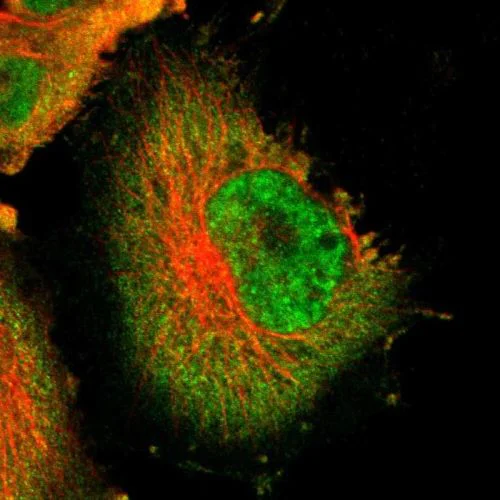
Immunocytochemistry/ Immunofluorescence - Anti-USP5 antibody (AB244290)

PFA-fixed, Triton X-100 permeabilized U-251 MG (human brain glioma cell line) cells stained for USP5 (green) using ab244290 at 4 μg/ml in ICC/IF.
Western blot - Anti-USP5 antibody (AB244290)
  • WB

Unknown

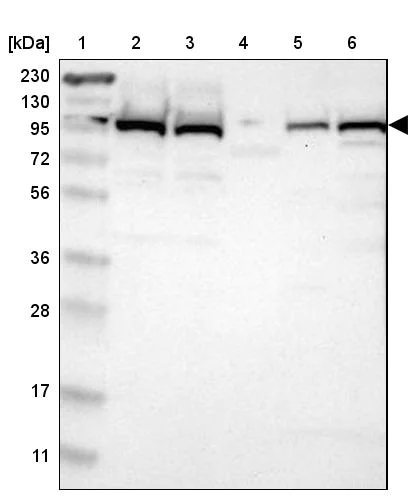
Western blot - Anti-USP5 antibody (AB244290)

All lanes:

Western blot - Anti-USP5 antibody (ab244290) at 0.4 µg/mL

Lane 1:

RT4 (human urinary bladder cancer cell line) cell lysate

Lane 2:

U-251 MG (human brain glioma cell line) cell lysate

Lane 3:

Human plasma (IgG/HSA depleted)

Lane 4:

Human liver lysate

Lane 5:

Human tonsil lysate

Predicted band size: 96 kDa

false
Western blot - Anti-USP5 antibody (AB244290)
  • WB

Unknown

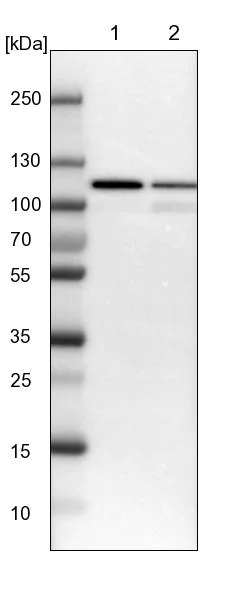
Western blot - Anti-USP5 antibody (AB244290)

All lanes:

Western blot - Anti-USP5 antibody (ab244290) at 0.4 µg/mL

Lane 1:

NIH/3T3 (mouse embyro fibroblast cell line) cell lysate

Lane 2:

NBT-II (rat cell line) cell lysate

Predicted band size: 96 kDa

false

Key facts

Host species

Rabbit

Clonality

Polyclonal

Isotype

IgG

Carrier free

No

Reacts with

Mouse, Rat, Human

Applications

IHC-P, WB, ICC/IF

applications

Immunogen

Recombinant Fragment Protein within Human USP5 aa 350-500. The exact immunogen used to generate this antibody is proprietary information.

P45974

Reactivity data

{ "title": "Reactivity Data", "filters": { "stats": ["", "Species", "Dilution Info", "Notes"], "tabs": { "all-applications": {"fullname" : "All Applications", "shortname": "All Applications"}, "IHCP" : {"fullname" : "Immunohistochemistry (Formalin/PFA-fixed paraffin-embedded sections)", "shortname":"IHC-P"}, "WB" : {"fullname" : "Western blot", "shortname":"WB"}, "ICCIF" : {"fullname" : "Immunocytochemistry/ Immunofluorescence", "shortname":"ICC/IF"} }, "product-promise": { "all": "all", "testedAndGuaranteed": "tested", "guaranteed": "expected", "predicted": "predicted", "notRecommended": "not-recommended" } }, "values": { "Human": { "IHCP-species-checked": "testedAndGuaranteed", "IHCP-species-dilution-info": "1/50 - 1/200", "IHCP-species-notes": "<p></p> Perform heat-mediated antigen retrieval with citrate buffer pH 6 before commencing with IHC staining protocol.", "WB-species-checked": "testedAndGuaranteed", "WB-species-dilution-info": "0.04-0.4 µg/mL", "WB-species-notes": "<p></p>", "ICCIF-species-checked": "testedAndGuaranteed", "ICCIF-species-dilution-info": "0.25-2 µg/mL", "ICCIF-species-notes": "<p>Fixation/Permeabilization: PFA/Triton X-100.</p>" }, "Mouse": { "IHCP-species-checked": "guaranteed", "IHCP-species-dilution-info": "", "IHCP-species-notes": "", "WB-species-checked": "testedAndGuaranteed", "WB-species-dilution-info": "0.04-0.4 µg/mL", "WB-species-notes": "<p></p>", "ICCIF-species-checked": "guaranteed", "ICCIF-species-dilution-info": "", "ICCIF-species-notes": "" }, "Rat": { "IHCP-species-checked": "guaranteed", "IHCP-species-dilution-info": "", "IHCP-species-notes": "", "WB-species-checked": "testedAndGuaranteed", "WB-species-dilution-info": "0.04-0.4 µg/mL", "WB-species-notes": "<p></p>", "ICCIF-species-checked": "guaranteed", "ICCIF-species-dilution-info": "", "ICCIF-species-notes": "" }, "Orangutan": { "IHCP-species-checked": "predicted", "IHCP-species-dilution-info": "", "IHCP-species-notes": "", "WB-species-checked": "predicted", "WB-species-dilution-info": "", "WB-species-notes": "", "ICCIF-species-checked": "predicted", "ICCIF-species-dilution-info": "", "ICCIF-species-notes": "" } } }

Properties and storage information

Form
Liquid
Purification technique
Affinity purification Immunogen
Storage buffer
pH: 7.2 Preservative: 0.02% Sodium azide Constituents: PBS, 40% Glycerol (glycerin, glycerine)
Shipped at conditions
Blue Ice
Appropriate short-term storage duration
1-2 weeks
Appropriate short-term storage conditions
+4°C
Appropriate long-term storage conditions
-20°C
Aliquoting information
Upon delivery aliquot
Storage information
Avoid freeze / thaw cycle

Supplementary information

This supplementary information is collated from multiple sources and compiled automatically.

The target USP5 also known as ubiquitin-specific protease 5 or isopeptidase T functions as a deubiquitinating enzyme. This protein has a mass of about 169 kDa and plays a critical role in removing ubiquitin moieties from ubiquitin-conjugated protein substrates. USP5 achieves this by cleaving at the ubiquitin C-terminal glycine which releases free ubiquitin and recycles it for future use. Expression of USP5 occurs broadly throughout different tissues indicating its general importance in cellular processes.
Biological function summary

This enzyme helps maintain ubiquitin homeostasis by disassembling unanchored polyubiquitin chains. USP5 is not known to be part of a larger complex but it interacts with components of the ubiquitin-proteasome system contributing to protein quality control. By processing unanchored ubiquitin chains USP5 ensures a sufficient supply of ubiquitin preventing potential cellular stress due to ubiquitin depletion.

Pathways

USP5 integrates into the ubiquitin-proteasome pathway and proteostasis network. It collaborates with other deubiquitinating enzymes like USP14 and UCHL5 modulating the degradation of polyubiquitinated proteins. These pathways play essential roles in regulating protein turnover and disruptions in these processes can impact cell cycle and apoptosis highlighting the importance of USP5 in maintaining cellular homeostasis.

Experimental findings suggest USP5 involvement in several cancers and neurodegenerative diseases such as Alzheimer's disease. In cancer altered USP5 activity can disrupt the balance between protein synthesis and degradation promoting tumor progression. In Alzheimer's its role in ubiquitin homeostasis implicates it in the management of protein aggregates that characterize the disorder. USP5's relationship with other proteins like p53 in cancer and tau in Alzheimer's provides critical insights into its potential as a therapeutic target.

Product protocols

For this product, it's our understanding that no specific protocols are required. You can visit:

Target data

Deubiquitinating enzyme that participates in a wide range of cellular processes by specifically cleaving isopeptide bonds between ubiquitin and substrate proteins or ubiquitin itself. Affects thereby important cellular signaling pathways such as NF-kappa-B, Wnt/beta-catenin, and cytokine production by regulating ubiquitin-dependent protein degradation. Participates in the activation of the Wnt signaling pathway by promoting FOXM1 deubiquitination and stabilization that induces the recruitment of beta-catenin to Wnt target gene promoter (PubMed : 26912724). Regulates the assembly and disassembly of heat-induced stress granules by mediating the hydrolysis of unanchored ubiquitin chains (PubMed : 29567855). Promotes lipopolysaccharide-induced apoptosis and inflammatory response by stabilizing the TXNIP protein (PubMed : 37534934). Affects T-cell biology by stabilizing the inhibitory receptor on T-cells PDC1 (PubMed : 37208329). Acts as a negative regulator of autophagy by regulating ULK1 at both protein and mRNA levels (PubMed : 37607937). Acts also as a negative regulator of type I interferon production by simultaneously removing both 'Lys-48'-linked unanchored and 'Lys-63'-linked anchored polyubiquitin chains on the transcription factor IRF3 (PubMed : 39761299). Modulates the stability of DNA mismatch repair protein MLH1 and counteracts the effect of the ubiquitin ligase UBR4 (PubMed : 39032648). Upon activation by insulin, it gets phosphorylated through mTORC1-mediated phosphorylation to enhance YTHDF1 stability by removing 'Lys-11'-linked polyubiquitination (PubMed : 39900921). May also deubiquitinate other substrates such as the calcium channel CACNA1H (By similarity).
See full target information USP5

Publications (5)

Recent publications for all applications. Explore the full list and refine your search

Nature communications 16:1313 PubMed39900921

2025

USP5 stabilizes YTHDF1 to control cancer immune surveillance through mTORC1-mediated phosphorylation.

Applications

Unspecified application

Species

Unspecified reactive species

Na Shao,Lei Xi,Yangfan Lv,Muhammad Idris,Lin Zhang,Ya Cao,Jingyi Xiang,Xi Xu,Belinda X Ong,Qiongyi Zhang,Xu Peng,Xiaoyan Yue,Feng Xu,Chungang Liu

Nature communications 13:7799 PubMed36528652

2022

USP5-Beclin 1 axis overrides p53-dependent senescence and drives Kras-induced tumorigenicity.

Applications

Unspecified application

Species

Unspecified reactive species

Juan Li,Yang Wang,Yue Luo,Yang Liu,Yong Yi,Jinsong Li,Yang Pan,Weiyuxin Li,Wanbang You,Qingyong Hu,Zhiqiang Zhao,Yujun Zhang,Yang Cao,Lingqiang Zhang,Junying Yuan,Zhi-Xiong Jim Xiao

Bioscience reports 41: PubMed34505628

2021

Identification of CCT3 as a prognostic factor and correlates with cell survival and invasion of head and neck squamous cell carcinoma.

Applications

Unspecified application

Species

Unspecified reactive species

Yan Wang,Peicheng Liu,Ziwei Zhang,Jiulong Wang,Zhigang Cheng,Chengchao Fan

FASEB journal : official publication of the Federation of American Societies for Experimental Biology 35:e21332 PubMed34423867

2021

Macrophage-derived extracellular vesicles regulates USP5-mediated HDAC2/NRF2 axis to ameliorate inflammatory pain.

Applications

Unspecified application

Species

Unspecified reactive species

Yao Qu,Yunhe Xu,Yuncheng Jiang,Dehai Yu,Xi Jiang,Ling Zhao

Journal of cellular and molecular medicine 24:1370-1382 PubMed31845546

2019

Deubiquitinase inhibitor degrasyn suppresses metastasis by targeting USP5-WT1-E-cadherin signalling pathway in pancreatic ductal adenocarcinoma.

Applications

Unspecified application

Species

Unspecified reactive species

Jiajia Li,Haiying Li,Weijian Zhu,Bin Zhou,Jianchao Ying,Jiansheng Wu,Huxiang Zhang,Hongwei Sun,Shenmeng Gao
View all publications

Product promise

We are committed to supporting your work with high-quality reagents, and we're here for you every step of the way. In the unlikely event that one of our products does not perform as expected, you're protected by our Product Promise.
For full details, please see our Terms & Conditions

Please note: All products are 'FOR RESEARCH USE ONLY. NOT FOR USE IN DIAGNOSTIC OR THERAPEUTIC PROCEDURES'.

For licensing inquiries, please contact partnerships@abcam.com