Anti-Wee1 (phospho S642) antibody [RP23040150]
- Recombinant
- What is this?
Be the first to review this product! Submit a review
|
(0 Publication)
- ICC/IF
Supplier Data
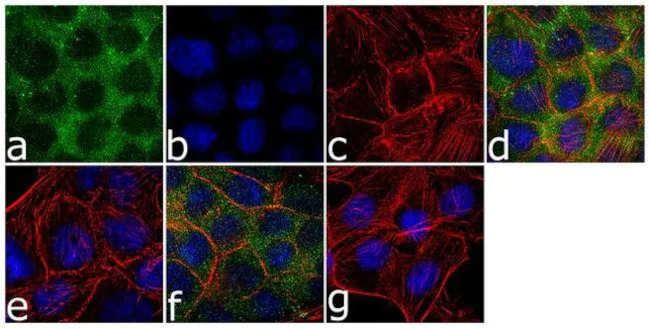
Immunocytochemistry/ Immunofluorescence - Anti-Wee1 (phospho S642) antibody [RP23040150] (AB313544)
Immunofluorescent analysis of A-431 cells fixed using 4% formaldehyde (reconstituted in 1X PBS) for 10 min at room temperature and permeabilized using 0.1 % Triton X-100 in PBS for 15 min at room temperature labeling Wee1 (pS642) with ab313544 at 2 µg/mL dilution followed by Goat anti-Rabbit IgG (H+L) Secondary Antibody, Alexa Fluor 488 conjugate at 1/2000 dilution. Panel a) shows representative cells that were stained for detection and localization of Wee1 (pS642) protein (green), Panel b) is stained for nuclei (blue) using DAPI. Panel c) represents cytoskeletal F-actin staining using Alexa Fluor 555 Rhodamine Phalloidin at 1/300 dilution. Panel d) is a composite image of Panels a, b and c clearly demonstrating cytoplasmic localization of Wee1 (pS642). Panel e) shows loss of signal by competition with the Wee1 (pS642) phosphopeptide, demonstrating antibody specificity, and panel f) demonstrates no competition with the non-phospho peptide. Panel g) represents control cells with no primary antibody to assess background. The images were captured at 60X magnification.
Complementary Products
Primary Antibodies
AB288727
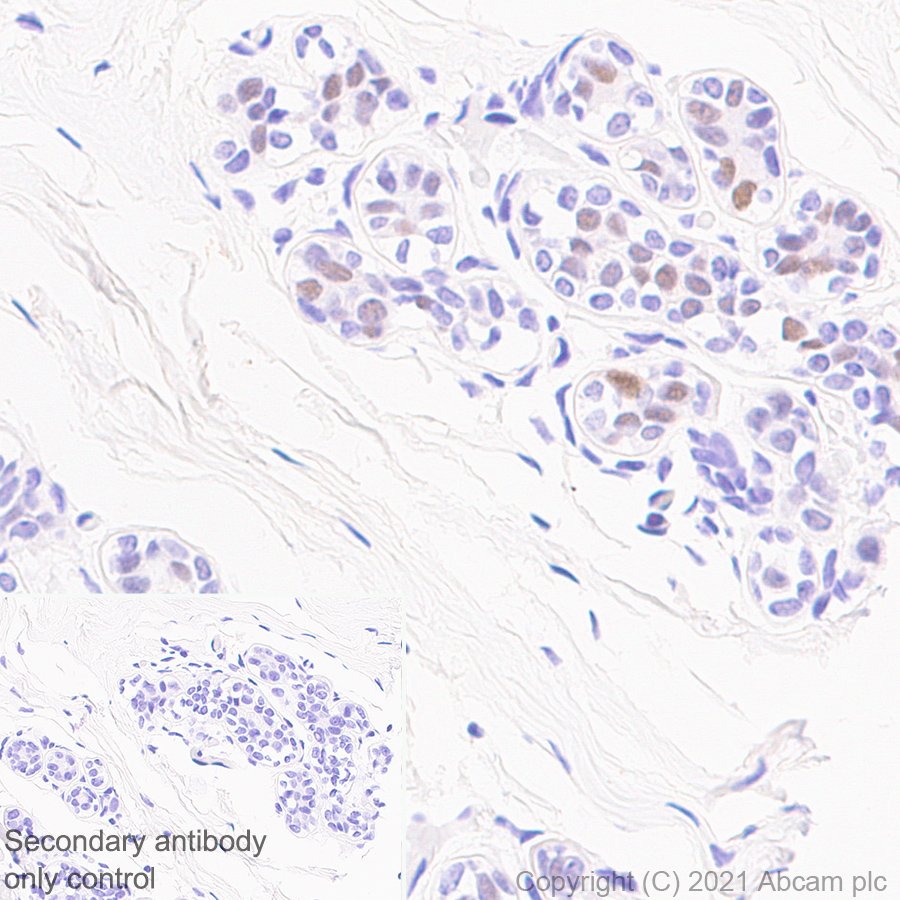
Anti-Wee1 antibody [EPR25070-84]
BOND RX™ Validated|20ul selling size|RabMAb|Recombinant
- 0
- 0
Primary Antibodies
AB307146
Anti-PKMYT1 antibody [EPR27155-51]
20ul selling size|RabMAb|Recombinant

- 0
- 0
Primary Antibodies
AB32053
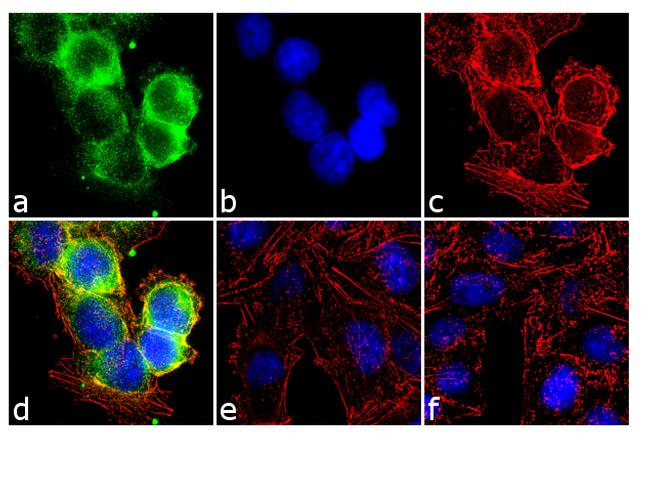
Anti-Cyclin B1 antibody [Y106]
20ul selling size|RabMAb|Recombinant|KO Validated

- 4
- 6
Reactivity data
Product details
What are recombinant multiclonals?
Recombinant multiclonals are a mixture of recombinant antibodies co-expressed from a library of heavy and light chains. They offer several advantages including:
- - The sensitivity of polyclonal antibodies by recognising multiple epitopes
- - High batch-to-batch consistency and reproducibility
- - Improved sensitivity and specificity
- - Long-term security of supply
- - Animal-free batch production
View our range of recombinant multiclonal antibodies.
Properties and storage information
Form
Purification technique
Storage buffer
Shipped at conditions
Appropriate short-term storage duration
Appropriate short-term storage conditions
Appropriate long-term storage conditions
Aliquoting information
Storage information
Supplementary information
This supplementary information is collated from multiple sources and compiled automatically.
Biological function summary
The function of Wee1 extends to its role in maintaining genomic stability. Wee1 operates as part of a regulatory complex and its inhibition results in defective cell cycle arrest potentially leading to DNA damage. The kinase acts to prevent transitions from the G2 to M phase of the cell cycle ensuring cells repair damaged DNA before division. In the context of DNA replication stress Wee1 cooperates with other regulators such as Chk1 to mediate cell cycle arrest therefore safeguarding genomic integrity.
Pathways
The role of Wee1 manifests significantly within the DNA damage checkpoint pathway and the cell cycle control pathway. In the DNA damage checkpoint pathway Wee1 collaborates with other cell cycle regulators such as ATR and Chk1 to control the cell cycle in response to DNA damages. Wee1's influence on the cell cycle pathway also intersects with CDK1 and Cyclin B where Wee1 modulates the activity of these proteins to control cell cycle transitions. This regulatory action allows cells to coordinate DNA repair and replication with cell division events.
Product protocols
- Visit the General protocols
- Visit the Troubleshooting
Target data
Alternative Names
Product promise
Please note: All products are 'FOR RESEARCH USE ONLY. NOT FOR USE IN DIAGNOSTIC OR THERAPEUTIC PROCEDURES'.
For licensing inquiries, please contact partnerships@abcam.com