Anti-YTHDC2 antibody
3
(2 Reviews)
|
(15 Publications )
Rabbit Polyclonal YTHDC2 antibody. Suitable for IP, WB and reacts with Human samples. Cited in 15 publications. Immunogen corresponding to Synthetic Peptide within Human YTHDC2 aa 1200-1250.
View Alternative Names
3'-5' RNA helicase YTHDC2, YTH domain-containing protein 2, hYTHDC2, YTHDC2
- IP
Supplier Data
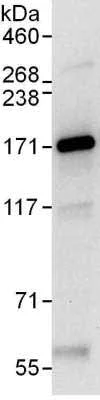
Immunoprecipitation - Anti-YTHDC2 antibody (AB176846)
Detection of YTHDC2 by Western Blot of Immunoprecipitate.
ab176846 at 0.4 μg/ml labeling YTHDC2 in HeLa whole cell lysate immunoprecipitated using ab176846 at 6 μg/mg lysate (1 mg/IP; 20% of IP loaded/lane).
Detection : Chemiluminescence with exposure time of 10 seconds.
All lanes:
Immunoprecipitation - Anti-YTHDC2 antibody (ab176846)
Predicted band size: 160 kDa
false
- WB
Supplier Data
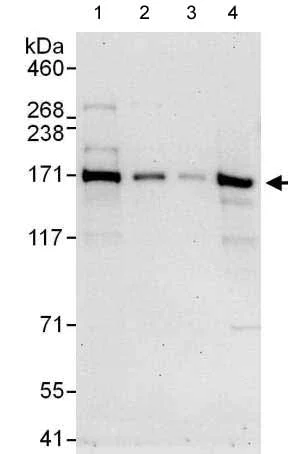
Western blot - Anti-YTHDC2 antibody (AB176846)
All lanes:
Western blot - Anti-YTHDC2 antibody (ab176846) at 0.04 µg/mL
Lane 1:
HeLa whole cell lysates at 50 µg
Lane 2:
HeLa whole cell lysates at 15 µg
Lane 3:
HeLa whole cell lysates at 5 µg
Lane 4:
293T whole cell lysates at 50 µg
Predicted band size: 160 kDa
true
Exposure time: 30s
- WB
CiteAb
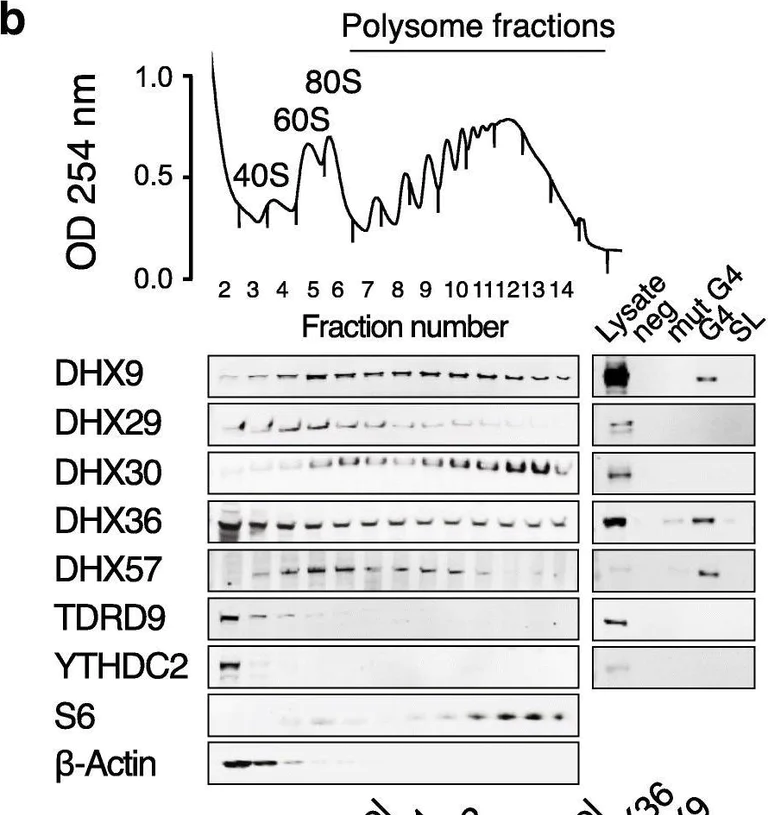
Western blot - Anti-YTHDC2 antibody (AB176846)
YTHDC2 western blot using anti-YTHDC2 antibody ab176846. Publication image and figure legend from Murat, P., Marsico, G., et al., 2018, Genome Biol, PubMed 30591072.
ab176846 was used in this publication in western blot. This may not be the same as the application(s) guaranteed by Abcam. For a full list of applications guaranteed by Abcam for ab176846 please see the product overview.
Polysome and ribosome profiling defines the role of DHX36 and DHX9 on translation. a Polysome profiling of HeLa cytoplasmic extract coupled with mass spectrometry allowed estimating the enrichment of different helicases in monosome or polysome fractions. Duplicates were used to quantitatively estimate the presence of a given helicase in each fraction. A hierarchical cluster analysis reporting the distribution of human helicases within mono/polysomes is shown. b Immunoblots of a polysome profile probing for members of the DEAH-box/RHA helicase family (left blot) confirmed the presence of DHX36 and DHX9 in both light and heavy polysomes. On the right is reported the result of affinity purifications using indicated biotinylated nucleic acids probes showing the presence of DHX9, DHX36, and DHX57 in rG4/ribonucleoprotein complexes. Lysate : 30 μg of total protein, Neg : empty beads, mut G4 : mutated rG4-forming sequences, rG4 : rG4-forming sequences, SL : stem-loop forming sequence. c Immunoblots of siRNA-treated cells probing DHX36 and DHX9 show that siRNA depletion of both helicases is reproducible and selective. Rep : replicate. Ribosome profiling allowed assessing change in TE upon depletion of d DHX36 and e DHX9. Are reported the frequency distributions of the ratio of TE in DHX36 (top) and DHX9 (bottom) depleted cells over TE in control (n = 3 replicates). f Comparison of fold changes of TE upon DHX36 and DHX9 depletion. Q values were calculated by combining P values using Fisher's method. g Anticorrelation between fold changes of TE and fold changes of RPFdist upon depletion of DHX36 (red) or DHX9 (blue) for transcripts showing significant change in TE (Q value < 0.05)
false
Alternative Products

Primary Antibodies
AB259277
Anti-YTHDC2 antibody [EPR21820-49] - BSA and Azide free
RabMAb|Recombinant|KO Validated
- 0
- 0
Complementary Products
Primary Antibodies
AB195352
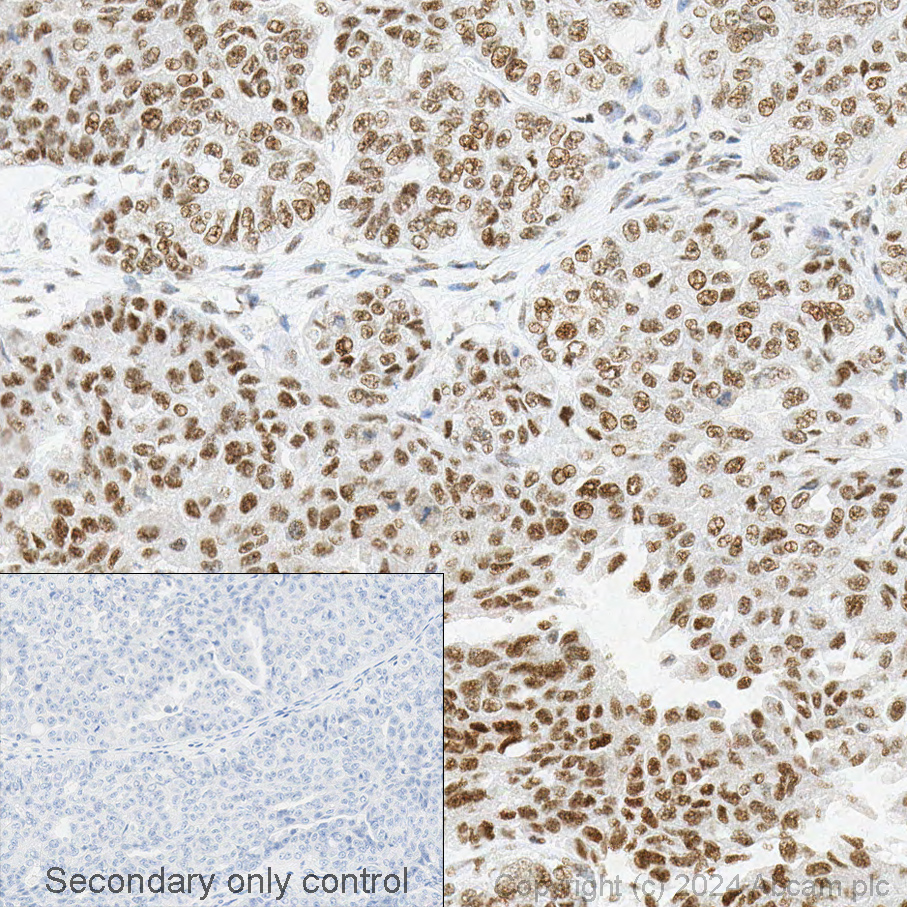
Anti-METTL3 antibody [EPR18810]
BOND RX™ Validated|RabMAb|Recombinant|KO Validated|20ul selling size
- 5
- 8
Primary Antibodies
AB259990
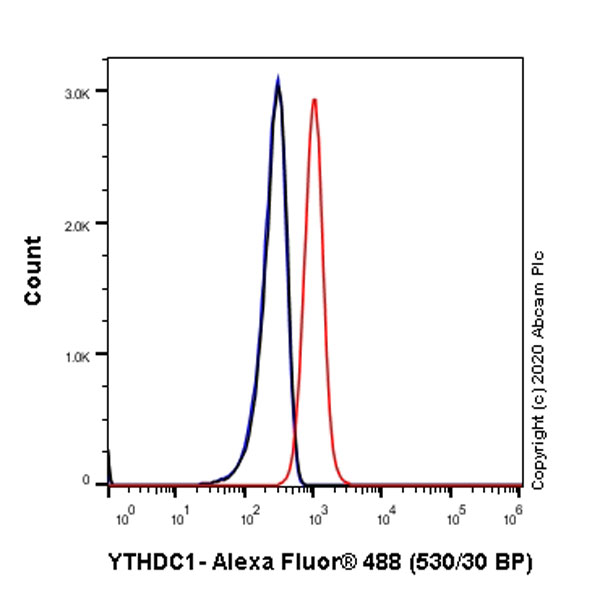
Anti-YTHDC1 antibody [EPR21821-213]
BOND RX™ Validated|20ul selling size|RabMAb|Recombinant|KO Validated
- 0
- 0
Primary Antibodies
AB220163
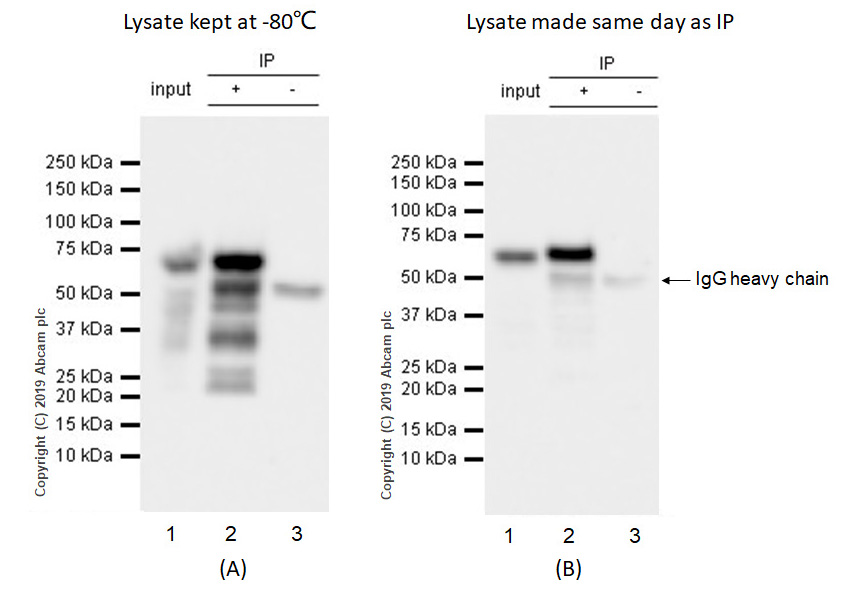
Anti-YTHDF2 antibody [EPR20318]
20ul selling size|RabMAb|Recombinant|KO Validated
- 5
- 3
Reactivity data
Properties and storage information
Form
Purification technique
Purification notes
Storage buffer
Shipped at conditions
Appropriate short-term storage duration
Appropriate short-term storage conditions
Appropriate long-term storage conditions
Aliquoting information
Storage information
Supplementary information
This supplementary information is collated from multiple sources and compiled automatically.
Biological function summary
YTHDC2 contributes to the regulation of mRNA stability and turnover within the cell. It may operate as part of a complex involved in post-transcriptional control. Through these actions YTHDC2 influences processes such as meiosis and the differentiation of germ cells supported by its association with m6A reader proteins. This association plays a role in the recognition of specific m6A marks critical for RNA dynamics.
Pathways
YTHDC2 integrates into the m6A-dependent RNA decay and translation machinery. One important pathway involving this protein is the m6A-mediated gene expression regulation pathway. Within this context YTHDC2 interacts closely with other m6A machinery components such as METTL3 and bridges mRNA modification with subsequent cellular outcomes. Another related pathway is spermatogenesis where the precise control by YTHDC2 is necessary for successful meiosis via interaction with various meiotic proteins.
Product protocols
- Visit the General protocols
- Visit the Troubleshooting
Target data
Publications (15)
Recent publications for all applications. Explore the full list and refine your search
Life science alliance 8: PubMed39626965
2024
Applications
Unspecified application
Species
Unspecified reactive species
The Journal of biological chemistry 300:107783 PubMed39303913
2024
Applications
Unspecified application
Species
Unspecified reactive species
Molecular therapy : the journal of the American Society of Gene Therapy 31:1615-1635 PubMed36566349
2022
Applications
Unspecified application
Species
Unspecified reactive species
Science advances 8:eabq2945 PubMed36001654
2022
Applications
Unspecified application
Species
Unspecified reactive species
Genes & development 36:180-194 PubMed35058317
2022
Applications
Unspecified application
Species
Unspecified reactive species
Free radical biology & medicine 168:25-43 PubMed33785413
2021
Applications
Unspecified application
Species
Unspecified reactive species
Redox biology 38:101801 PubMed33232910
2020
Applications
Unspecified application
Species
Unspecified reactive species
RNA biology 18:131-143 PubMed32746693
2020
Applications
Unspecified application
Species
Unspecified reactive species
Molecular cancer 19:46 PubMed32111213
2020
Applications
Unspecified application
Species
Unspecified reactive species
Nature communications 10:5332 PubMed31767846
2019
Applications
Unspecified application
Species
Unspecified reactive species
Product promise
Please note: All products are 'FOR RESEARCH USE ONLY. NOT FOR USE IN DIAGNOSTIC OR THERAPEUTIC PROCEDURES'.
For licensing inquiries, please contact partnerships@abcam.com