AB16101
Human Histone H2B peptide is a Synthetic blocking peptide. >90% and suitable for BL.
1 Images
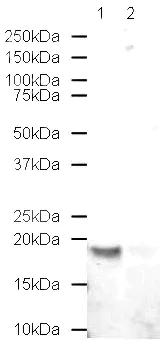
- WB
Unknown
Western blot - Human Histone H2B peptide (AB16101)
All lanes:
Western blot - Anti-Histone H2B antibody - ChIP Grade (<a href='/en-us/products/primary-antibodies/histone-h2b-antibody-chip-grade-ab1790'>ab1790</a>) at 0.1 µg/mL
Lane 1:
Calf thymus histone prep at 20 µg
Lane 2:
Calf thymus histone prep at 20 µg with Human Histone H2B peptide (ab16101)
Secondary
All lanes:
Alexa fluor Goat polyclonal anti-Rabbit IgG at 1/10000 dilution
Predicted band size: 14 kDa
Observed band size: 17 kDa
false
Complementary Products

Primary Antibodies
AB211033
Anti-SIRT2 antibody [EPR20411-105]
20ul selling size|RabMAb|Recombinant|KO Validated
- 4
- 8

Reactivity data
{ "title": "Reactivity Data", "filters": { "stats": ["", "Reactivity", "Dilution Info", "Notes"] }, "values": { "BL": { "reactivity":"TESTED_AND_REACTS", "dilution-info":"1 µg/mL", "notes":"<p></p>" } } }
Product details
- First try to dissolve a small amount of peptide in either water or buffer. The more charged residues on a peptide, the more soluble it is in aqueous solutions.
- If the peptide doesn't dissolve try an organic solvent e.g. DMSO, then dilute using water or buffer.
- Consider that any solvent used must be compatible with your assay. If a peptide does not dissolve and you need to recover it, lyophilise to remove the solvent.
- Gentle warming and sonication can effectively aid peptide solubilisation. If the solution is cloudy or has gelled the peptide may be in suspension rather than solubilised.
- Peptides containing cysteine are easily oxidised, so should be prepared in solution just prior to use.
Sequence info
[{"linker":null,"sequence":null,"proteinLength":null,"predictedMolecularWeight":null,"actualMolecularWeight":null,"aminoAcidEnd":0,"aminoAcidStart":0,"nature":"Synthetic","expressionSystem":null,"accessionNumber":"P57053","tags":[]}]
Properties and storage information
Form
Liquid
Shipped at conditions
Blue Ice
Appropriate short-term storage duration
1-2 weeks
Appropriate short-term storage conditions
+4°C
Appropriate long-term storage conditions
-20°C
Aliquoting information
Upon delivery aliquot
Storage information
Avoid freeze / thaw cycle
False
Target data
Core component of nucleosome. Nucleosomes wrap and compact DNA into chromatin, limiting DNA accessibility to the cellular machineries which require DNA as a template. Histones thereby play a central role in transcription regulation, DNA repair, DNA replication and chromosomal stability. DNA accessibility is regulated via a complex set of post-translational modifications of histones, also called histone code, and nucleosome remodeling.. Has broad antibacterial activity. May contribute to the formation of the functional antimicrobial barrier of the colonic epithelium, and to the bactericidal activity of amniotic fluid.
Alternative Names
H2BFS, H2BS1, H2BC12L, Histone H2B type F-S, H2B-clustered histone 12 like, H2B.S histone 1, Histone H2B.s, H2B/s
Product promise
We are committed to supporting your work with high-quality reagents, and we're here for you every step of the way. In the unlikely event that one of our products does not perform as expected, you're protected by our Product Promise.
For full details, please see our Terms & Conditions
Please note: All products are 'FOR RESEARCH USE ONLY. NOT FOR USE IN DIAGNOSTIC OR THERAPEUTIC PROCEDURES'.
For licensing inquiries, please contact partnerships@abcam.com