JavaScript is disabled in your browser. Please enable JavaScript to view this website.
AB310800

Recombinant Human Adiponectin protein

Be the first to review this product! Submit a review

|

(0 Publication)
Recombinant Human Adiponectin protein is a Human Fragment protein, in the 19 to 244 aa range, expressed in HEK 293 cells, with >95%, <0.005 EU/µg endotoxin level, suitable for SDS-PAGE, Mass Spec, HPLC.
4 Images
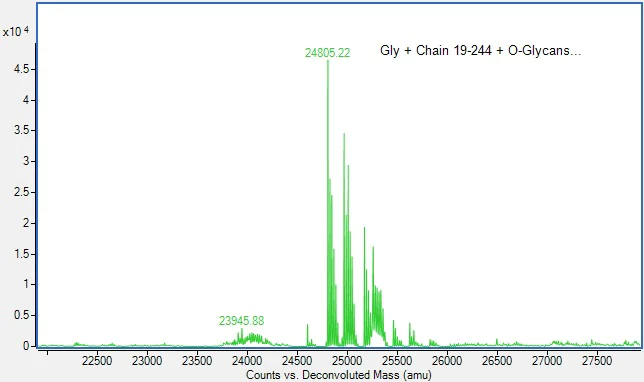
Mass Spectrometry - Recombinant Human Adiponectin protein (AB310800)
  • Mass Spec

Lab

Mass Spectrometry - Recombinant Human Adiponectin protein (AB310800)

Mass determination by ESI-TOF. Predicted MW is 24601.56538 (+/- 10Da by ESI-TOF). Observed MW is 24805.22.
SDS-PAGE - Recombinant Human Adiponectin protein (AB310800)
  • SDS-PAGE

Supplier Data

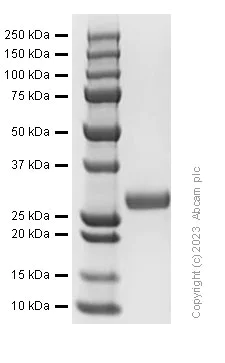
SDS-PAGE - Recombinant Human Adiponectin protein (AB310800)

SDS-PAGE analysis of ab310800
SDS-PAGE - Recombinant Human Adiponectin protein (AB310800)
  • SDS-PAGE

Lab

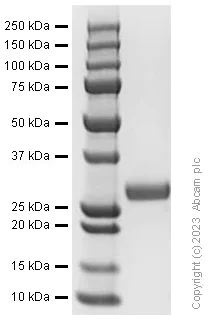
SDS-PAGE - Recombinant Human Adiponectin protein (AB310800)

SDS-PAGE analysis of ab310800
HPLC - Recombinant Human Adiponectin protein (AB310800)
  • HPLC

Lab

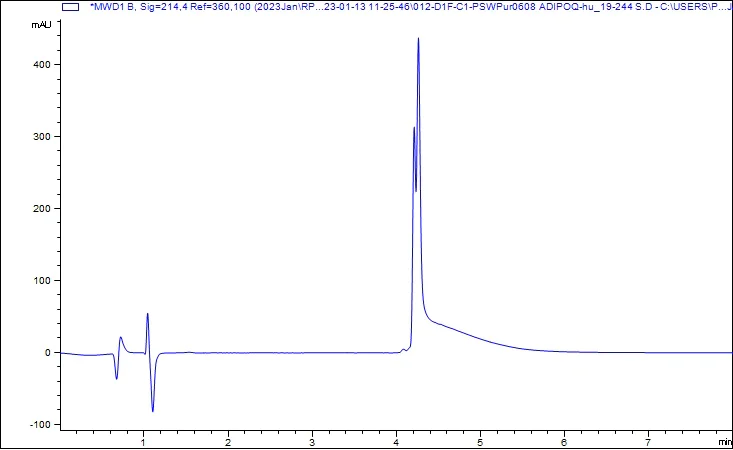
HPLC - Recombinant Human Adiponectin protein (AB310800)

HPLC analysis of ab310800

Key facts

Purity

>95% HPLC

SDS-PAGE >= 95%

Endotoxin level

<0.005 EU/µg

Expression system

HEK 293 cells

Tags

Tag free

Applications

SDS-PAGE, Mass Spec, HPLC

applications

Biologically active

No

Accession

Q15848-1

Animal free

Yes

Carrier free

No

Species

Human

Reconstitution

Lyophilized contents may appear as either a translucent film or a white powder. This variance does not affect the quality of the product. Store lyophilized form at room temperature. Reconstitute in phosphate buffered saline, aliquot and store at -80°C for 12 months or +4°C for 1 week. Avoid repeated freeze-thaw.

Storage buffer

pH: 7.4 Constituents: 10.26% Trehalose, 0.727% Dibasic monohydrogen potassium phosphate, 0.248% Potassium phosphate monobasic

storage-buffer

Reactivity data

{ "title": "Reactivity Data", "filters": { "stats": ["", "Reactivity", "Dilution Info", "Notes"] }, "values": { "SDS-PAGE": { "reactivity":"TESTED_AND_REACTS", "dilution-info":"", "notes":"<p></p>" }, "Mass Spec": { "reactivity":"TESTED_AND_REACTS", "dilution-info":"", "notes":"<p></p>" }, "HPLC": { "reactivity":"TESTED_AND_REACTS", "dilution-info":"", "notes":"<p></p>" } } }

Sequence info

[{"linker":null,"sequence":"ETTTQGPGVLLPLPKGACTGWMAGIPGHPGHNGAPGRDGRDGTPGEKGEKGDPGLIGPKGDIGETGVPGAEGPRGFPGIQGRKGEPGEGAYVYRSAFSVGLETYVTIPNMPIRFTKIFYNQQNHYDGSTGKFHCNIPGLYYFAYHITVYMKDVKVSLFKKDKAMLFTYDQYQENNVDQASGSVLLHLEVGDQVWLQVYGEGERNGLYADNDNDSTFTGFLLYHDTN","proteinLength":"Fragment","predictedMolecularWeight":"24.6 kDa","actualMolecularWeight":"24.8 kDa","aminoAcidEnd":244,"aminoAcidStart":19,"nature":"Recombinant","expressionSystem":"HEK 293 cells","accessionNumber":"Q15848","tags":[]}]

Properties and storage information

Form
Lyophilized
Shipped at conditions
Blue Ice
Appropriate short-term storage conditions
Ambient
Appropriate long-term storage conditions
Ambient
False

Supplementary information

This supplementary information is collated from multiple sources and compiled automatically.

Adiponectin also known as ADIPOQ or adipocyte complement-related protein of 30 kDa (Acrp30) is a 30 kDa protein that plays a significant mechanical role in energy homeostasis. Adiponectin is secreted predominantly by adipose tissue and circulates in the blood. This protein forms various multimeric structures including low-molecular-weight medium-molecular-weight and high-molecular-weight forms each with distinct biological functions. Its expression in adipose tissue links it closely to metabolic processes and functions related to fat storage and energy balance.
Biological function summary

Adiponectin influences glucose regulation and fatty acid oxidation. It acts as a hormone with several metabolic roles including anti-diabetic anti-atherogenic and anti-inflammatory properties. Adiponectin participates in forming a complex with other proteins such as AdipoR1 and AdipoR2 which are receptors facilitating signal transduction. The interaction of adiponectin with its receptors leads to the induction of several lipid and glucose metabolism pathways important for maintaining cellular energy balance.

Pathways

Many regulatory cascades are influenced by adiponectin. This protein is integral to the AMPK signaling pathway and the PPAR signaling pathway. In the AMPK pathway adiponectin enhances insulin sensitivity and stimulates oxidation of fatty acids in muscle tissue. Through the PPAR pathway it influences lipid metabolism and storage. Adiponectin interacts with key proteins such as leptin and resistin coordinating various metabolic pathways to balance energy and glucose levels making it a critical factor in metabolic regulation.

Reduced levels of adiponectin associate with conditions like type 2 diabetes and cardiovascular disease. Lower circulating adiponectin concentrations correlate with obesity leading to increased insulin resistance and higher risk of type 2 diabetes. In cardiovascular disease this protein's role links to its anti-inflammatory properties and ability to decrease the proliferation of vascular smooth muscle cells. Adiponectin also interacts with proteins like cytokines that play a role in these conditions affecting the body's inflammatory responses and metabolic processes highlighting its importance in health and disease management.

Product protocols

Target data

Important adipokine involved in the control of fat metabolism and insulin sensitivity, with direct anti-diabetic, anti-atherogenic and anti-inflammatory activities. Stimulates AMPK phosphorylation and activation in the liver and the skeletal muscle, enhancing glucose utilization and fatty-acid combustion. Antagonizes TNF by negatively regulating its expression in various tissues such as liver and macrophages, and also by counteracting its effects. Inhibits endothelial NF-kappa-B signaling through a cAMP-dependent pathway. May play a role in cell growth, angiogenesis and tissue remodeling by binding and sequestering various growth factors with distinct binding affinities, depending on the type of complex, LMW, MMW or HMW.
See full target information ADIPOQ

Alternative Names

ACDC, ACRP30, APM1, GBP28, ADIPOQ, Adiponectin, 30 kDa adipocyte complement-related protein, Adipocyte complement-related 30 kDa protein, Adipose most abundant gene transcript 1 protein, Gelatin-binding protein, apM-1

Product promise

We are committed to supporting your work with high-quality reagents, and we're here for you every step of the way. In the unlikely event that one of our products does not perform as expected, you're protected by our Product Promise.
For full details, please see our Terms & Conditions

Please note: All products are 'FOR RESEARCH USE ONLY. NOT FOR USE IN DIAGNOSTIC OR THERAPEUTIC PROCEDURES'.

For licensing inquiries, please contact partnerships@abcam.com