JavaScript is disabled in your browser. Please enable JavaScript to view this website.
AB276316

Recombinant Human Asialoglycoprotein Receptor 1/HL-1 (His tag)

Be the first to review this product! Submit a review

|

(0 Publication)
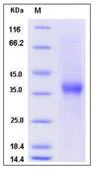
Recombinant Human Asialoglycoprotein Receptor 1/HL-1 (His tag) is a Human Fragment protein, in the 62 to 291 aa range, expressed in HEK 293 cells, with >90%, < 1 EU/µg endotoxin level, suitable for SDS-PAGE.
1 Images
SDS-PAGE - Recombinant Human Asialoglycoprotein Receptor 1/HL-1 (His tag) (AB276316)
  • SDS-PAGE

Supplier Data

SDS-PAGE - Recombinant Human Asialoglycoprotein Receptor 1/HL-1 (His tag) (AB276316)

SDS-PAGE analysis of ab276316

Key facts

Purity

>90% SDS-PAGE

Endotoxin level

< 1 EU/µg

Expression system

HEK 293 cells

Tags

His tag N-Terminus

Applications

SDS-PAGE

applications

Biologically active

No

Accession

P07306-1

Animal free

No

Carrier free

No

Species

Human

Storage buffer

pH: 7.4 Constituents: PBS

storage-buffer

Reactivity data

{ "title": "Reactivity Data", "filters": { "stats": ["", "Reactivity", "Dilution Info", "Notes"] }, "values": { "SDS-PAGE": { "reactivity":"TESTED_AND_REACTS", "dilution-info":"", "notes":"<p></p>" } } }

Sequence info

[{"linker":null,"sequence":"QNSQLQEELRGLRETFSNFTASTEAQVKGLSTQGGNVGRKMKSLESQLEKQQKDLSEDHSSLLLHVKQFVSDLRSLSCQMAALQGNGSERTCCPVNWVEHERSCYWFSRSGKAWADADNYCRLEDAHLVVVTSWEEQKFVQHHIGPVNTWMGLHDQNGPWKWVDGTDYETGFKNWRPEQPDDWYGHGLGGGEDCAHFTDDGRWNDDVCQRPYRWVCETELDKASQEPPLL","proteinLength":"Fragment","predictedMolecularWeight":"28.8 kDa","actualMolecularWeight":null,"aminoAcidEnd":291,"aminoAcidStart":62,"nature":"Recombinant","expressionSystem":"HEK 293 cells","accessionNumber":"P07306","tags":[{"tag":"His","terminus":"N-Terminus"}]}]

Properties and storage information

Form
Lyophilized
Shipped at conditions
Ambient - Can Ship with Ice
Appropriate short-term storage conditions
-20°C
Appropriate long-term storage conditions
-20°C
Aliquoting information
Upon delivery aliquot
Storage information
Avoid freeze / thaw cycle
False

Supplementary information

This supplementary information is collated from multiple sources and compiled automatically.

The Asialoglycoprotein Receptor 1 (ASGR1) also known as ASGPR 1 or asialoglycoprotein receptor is a well-known protein with a critical role in the mechanism of recognizing and binding to asialoglycoproteins. It has a molecular mass of approximately 46 kDa. ASGR1 is expressed mostly in liver cells specifically hepatocytes. The unique characteristic of this receptor is its lectin-like nature which allows it to bind to specific sugar moieties present on desialylated glycoproteins. Through receptor-mediated endocytosis it facilitates their removal from the bloodstream.
Biological function summary

The function of ASGR1 extends significantly. It operates as part of the asialoglycoprotein receptor complex interfacing directly with the ligand proteins to mediate endocytosis. This process is essential in most mammalian systems for maintaining serum glycoprotein homeostasis. By clearing desialylated glycoproteins from circulation ASGR1 helps prevent potential adverse effects these molecules might cause like immune activation or interference with other biological functions.

Pathways

ASGR1 is integral to glycoprotein clearance pathways. It actively participates in the hepatic clearance pathway ensuring the regulation of serum glycoprotein levels. The removal of asialoglycoproteins involves interactions with several other hepatic proteins such as GalNAc transferase which can further facilitate the remodeling of glycoconjugates. Understanding these interactions is key for comprehending how the liver maintains overall metabolic balance.

ASGR1 is linked to certain liver-related conditions. Dysfunction or aberrant expression of the ASGR1 receptor can relate to elevated levels of serum glycoproteins which might be observed in liver cirrhosis. Elevated glycoproteins can exacerbate the progression of liver diseases. Furthermore ASGR1 protein interaction with viral glycoproteins has implications in hepatitis infections where it may inadvertently facilitate viral entry into hepatocytes affecting liver function and contributing to disease pathology.

Product protocols

Target data

Transmembrane protein predominantly expressed on hepatocytes that plays a key role in endocytosis of plasma glycoproteins that lack terminal sialic acid residues. Specifically recognizes terminal galactose and N-acetylgalactosamine residues, facilitating the clearance of desialylated glycoproteins from circulation. Plays thereby a role in a variety of physiological processes, such as removal of desialylated platelets, elimination of activated lymphocytes and maintenance of serum glycoprotein homeostasis (PubMed : 25485912). Plays a role in the removal of desialylated platelets by activating a feedback loop regulating thrombopoietin (TPO) expression via the JAK2-STAT3 signaling pathway (PubMed : 25485912). Contributes also to recognition and elimination of activated lymphocytes by hepatocytes that can act as cytotoxic effectors (PubMed : 21656538). May also play a physiological role in the regulatory network of lipid homeostasis (By similarity). Upon ligand binding, the receptor-ligand complex is internalized and trafficked to a sorting organelle, where dissociation occurs. The receptor is then recycled back to the cell surface.. (Microbial infection) Plays an essential role in ACE2-independent SARS-CoV-2 entry by acting as alternate receptor.
See full target information ASGR1

Alternative Names

CLEC4H1, ASGR1, Asialoglycoprotein receptor 1, ASGP-R 1, ASGPR 1, C-type lectin domain family 4 member H1, Hepatic lectin H1, HL-1

Product promise

We are committed to supporting your work with high-quality reagents, and we're here for you every step of the way. In the unlikely event that one of our products does not perform as expected, you're protected by our Product Promise.
For full details, please see our Terms & Conditions

Please note: All products are 'FOR RESEARCH USE ONLY. NOT FOR USE IN DIAGNOSTIC OR THERAPEUTIC PROCEDURES'.

For licensing inquiries, please contact partnerships@abcam.com