JavaScript is disabled in your browser. Please enable JavaScript to view this website.
AB240858

Recombinant Human Cathepsin F protein (His tag)

Be the first to review this product! Submit a review

|

(2 Publications )
Recombinant Human Cathepsin F protein (His tag) is a Human Fragment protein, in the 273 to 484 aa range, expressed in Escherichia coli, with >90%, suitable for SDS-PAGE, Mass Spec.
3 Images
Mass Spectrometry - Recombinant Human Cathepsin F protein (His tag) (AB240858)
  • Mass Spec

Supplier Data

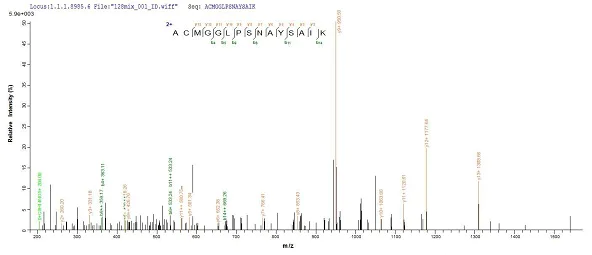
Mass Spectrometry - Recombinant Human Cathepsin F protein (His tag) (AB240858)

Based on the SEQUEST from database of E.coli host and target protein, the LC-MS/MS Analysis result of ab240858 could indicate that this peptide derived from E.coli-expressed Homo sapiens (Human) CTSF.
Mass Spectrometry - Recombinant Human Cathepsin F protein (His tag) (AB240858)
  • Mass Spec

Supplier Data

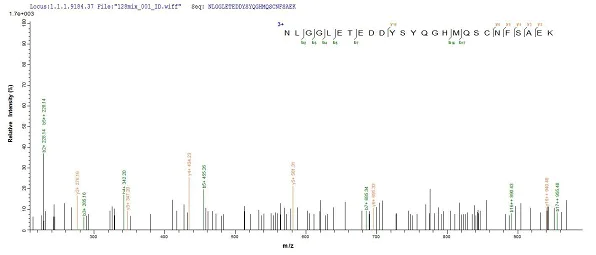
Mass Spectrometry - Recombinant Human Cathepsin F protein (His tag) (AB240858)

Based on the SEQUEST from database of E.coli host and target protein, the LC-MS/MS Analysis result of ab240858 could indicate that this peptide derived from E.coli-expressed Homo sapiens (Human) CTSF.
SDS-PAGE - Recombinant Human Cathepsin F protein (His tag) (AB240858)
  • SDS-PAGE

Supplier Data

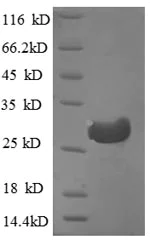
SDS-PAGE - Recombinant Human Cathepsin F protein (His tag) (AB240858)

Analysis of ab240858 by (Tris-Glycine gel) Discontinuous SDS-PAGE (reduced) with 5% enrichment gel and 15% separation gel.

Key facts

Purity

>90% SDS-PAGE

Expression system

Escherichia coli

Tags

His tag N-Terminus

Applications

Mass Spec, SDS-PAGE

applications

Biologically active

No

Accession

Q9UBX1-1

Animal free

No

Carrier free

No

Species

Human

Storage buffer

pH: 7.2 - 7.4 Constituents: Tris buffer, 50% Glycerol (glycerin, glycerine)

storage-buffer

Reactivity data

{ "title": "Reactivity Data", "filters": { "stats": ["", "Reactivity", "Dilution Info", "Notes"] }, "values": { "SDS-PAGE": { "reactivity":"TESTED_AND_REACTS", "dilution-info":"", "notes":"<p></p>" }, "Mass Spec": { "reactivity":"TESTED_AND_REACTS", "dilution-info":"", "notes":"<p></p>" } } }

Sequence info

[{"linker":null,"sequence":"PEWDWRSKGAVTKVKDQGMCGSCWAFSVTGNVEGQWFLNQGTLLSLSEQELLDCDKMDKACMGGLPSNAYSAIKNLGGLETEDDYSYQGHMQSCNFSAEKAKVYINDSVELSQNEQKLAAWLAKRGPISVAINAFGMQFYRHGISRPLRPLCSPWLIDHAVLLVGYGNRSDVPFWAIKNSWGTDWGEKGYYYLHRGSGACGVNTMASSAVVD","proteinLength":"Fragment","predictedMolecularWeight":"27.4 kDa","actualMolecularWeight":null,"aminoAcidEnd":484,"aminoAcidStart":273,"nature":"Recombinant","expressionSystem":"Escherichia coli","accessionNumber":"Q9UBX1","tags":[{"tag":"His","terminus":"N-Terminus"}]}]

Properties and storage information

Form
Liquid
Shipped at conditions
Blue Ice
Appropriate short-term storage conditions
-20°C
Appropriate long-term storage conditions
-20°C
Storage information
Avoid freeze / thaw cycle
False

Supplementary information

This supplementary information is collated from multiple sources and compiled automatically.

Cathepsin F also known as CTSF is a cysteine protease enzyme with a molecular mass of approximately 44 kDa. It belongs to the papain-like protease family and exhibits proteolytic activity. This protein localizes to the lysosomes where it participates in protein degradation. Cathepsin F shows expression in various tissues including liver kidney and spleen suggesting a broad role in protein catabolism.
Biological function summary

Cathepsin F functions in protein breakdown processes within the lysosomal compartment. It actively participates in the formation and maturation of the autophagosomes. This protease is not known to be a component of a multi-protein complex but it works in concert with other lysosomal enzymes to ensure efficient catabolic activity. Its activity helps in the turnover of intracellular proteins maintaining cellular homeostasis.

Pathways

Cathepsin F contributes significantly to the lysosomal degradation pathway. It assists in proteolytic cascades that help in breaking down proteins into amino acids. This degradation pathway is important for the recycling of cellular components and energy production. Moreover Cathepsin F shares functional relationships with other proteases like Cathepsin B and Cathepsin L as they often have overlapping substrate specificities and contribute to a similar biological pathway.

Cathepsin F has links to neurodegenerative diseases such as Alzheimer's disease and certain types of cancer. In Alzheimer's disease Cathepsin F's altered activity affects protein clearance associated with amyloid beta aggregation. This protease also relates to Cancer Progression through its role in matrix remodeling. In neurodegenerative conditions and cancer Cathepsin F's interaction with proteins like Cathepsin S has implications for disease progression. Understanding these connections highlights Cathepsin F’s importance in diagnosing and potentially targeting therapeutic interventions.

Product protocols

Target data

Thiol protease which is believed to participate in intracellular degradation and turnover of proteins. Has also been implicated in tumor invasion and metastasis.
See full target information CTSF

Alternative Names

Cathepsin F, CATSF, CTSF

Publications (2)

Recent publications for all applications. Explore the full listand refine your search

Molecular neurodegeneration 18:29 PubMed37131250

2023

Mutations in α-synuclein, TDP-43 and tau prolong protein half-life through diminished degradation by lysosomal proteases.

Applications

Unspecified application

Species

Unspecified reactive species

Paul J Sampognaro,Shruti Arya,Giselle M Knudsen,Emma L Gunderson,Angelica Sandoval-Perez,Molly Hodul,Kathryn Bowles,Charles S Craik,Matthew P Jacobson,Aimee W Kao

Molecular neurodegeneration 16:51 PubMed34344440

2021

Processing of progranulin into granulins involves multiple lysosomal proteases and is affected in frontotemporal lobar degeneration.

Applications

Unspecified application

Species

Unspecified reactive species

Swetha Mohan,Paul J Sampognaro,Andrea R Argouarch,Jason C Maynard,Mackenzie Welch,Anand Patwardhan,Emma C Courtney,Jiasheng Zhang,Amanda Mason,Kathy H Li,Eric J Huang,William W Seeley,Bruce L Miller,Alma Burlingame,Mathew P Jacobson,Aimee W Kao
View all publications

Product promise

We are committed to supporting your work with high-quality reagents, and we're here for you every step of the way. In the unlikely event that one of our products does not perform as expected, you're protected by our Product Promise.
For full details, please see our Terms & Conditions

Please note: All products are 'FOR RESEARCH USE ONLY. NOT FOR USE IN DIAGNOSTIC OR THERAPEUTIC PROCEDURES'.

For licensing inquiries, please contact partnerships@abcam.com