JavaScript is disabled in your browser. Please enable JavaScript to view this website.
AB316643

Recombinant Human CD66b Protein Standard (His tag)

Be the first to review this product! Submit a review

|

(0 Publication)
Recombinant Human CD66b Protein Standard (His tag) is a Human Fragment protein, expressed in HEK 293 cells, with >80%, suitable for SDS-PAGE, sELISA.
2 Images
Sandwich ELISA - Recombinant Human CD66b Protein Standard (His tag) (AB316643)
  • sELISA

Supplier Data

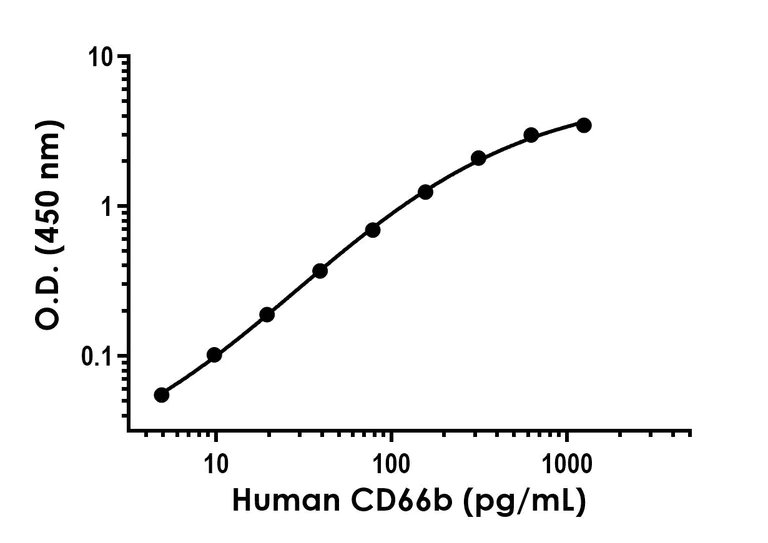
Sandwich ELISA - Recombinant Human CD66b Protein Standard (His tag) (AB316643)

Sandwich ELISA with the capture antibody ab281146 dilution at 2 μg/mL and detector antibody ab280996 dilution at 0.5 μg/mL after biotin conjugation.

SDS-PAGE - Recombinant Human CD66b Protein Standard (His tag) (AB316643)
  • SDS-PAGE

Supplier Data

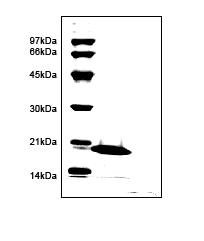
SDS-PAGE - Recombinant Human CD66b Protein Standard (His tag) (AB316643)

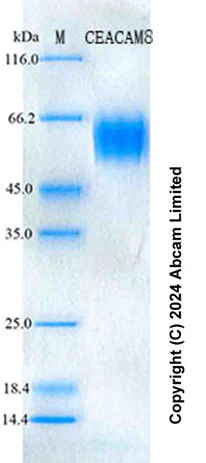
SDS-PAGE analysis of ab316643 under reducing conditions for 2ug protein.

Key facts

Purity

>80% SDS-PAGE

Expression system

HEK 293 cells

Tags

His tag C-Terminus

Applications

SDS-PAGE, sELISA

applications

Biologically active

No

Accession

P31997-1

Animal free

Yes

Carrier free

No

Species

Human

Storage buffer

pH: 7.3 - 7.5 Constituents: 2.922% Sodium chloride, 0.64107% disodium;hydrogen phosphate;dodecahydrate, 0.02858% Potassium phosphate monobasic

storage-buffer

Reactivity data

{ "title": "Reactivity Data", "filters": { "stats": ["", "Reactivity", "Dilution Info", "Notes"] }, "values": { "SDS-PAGE": { "reactivity":"TESTED_AND_REACTS", "dilution-info":"", "notes":"<p></p>" }, "sELISA": { "reactivity":"TESTED_AND_REACTS", "dilution-info":"", "notes":"<p></p>" } } }

Product details

While the standard is the same as the one provided in the corresponding SimpleStep ELISA Kit, it cannot be treated as the consumable provided with our SimpleStep ELISA Kit due to differences in its concentration calibration.

Abcam guarantee that this protein standard is suitable for use in a sandwich ELISA. Individual results may vary due to differences in technique, laboratory equipment, buffers, and other experimental factors. The detection range provided for this protein standard is based on initial sandwich ELISA validation data.

The protein concentration is the concentration after validation on our sandwich ELISA platform. This Standard protein is guaranteed to work with our Capture and Detector antibodies in sELISA. Please contact our Scientific Supportteam to know which antibody pair is suitable for this protein.

Sequence info

[{"linker":null,"sequence":null,"proteinLength":"Fragment","predictedMolecularWeight":"33.6 kDa","actualMolecularWeight":null,"aminoAcidEnd":0,"aminoAcidStart":0,"nature":"Recombinant","expressionSystem":"HEK 293 cells","accessionNumber":"P31997","tags":[{"tag":"His","terminus":"C-Terminus"}]}]

Properties and storage information

Form
Liquid
Purification technique
Affinity purification His Tag
Shipped at conditions
Dry Ice
Appropriate short-term storage conditions
-80°C
Appropriate long-term storage conditions
-80°C
Aliquoting information
Upon delivery aliquot
Storage information
Avoid freeze / thaw cycle
False

Supplementary information

This supplementary information is collated from multiple sources and compiled automatically.

CD66b also known as carcinoembryonic antigen-related cell adhesion molecule 8 (CEACAM8) is a glycoprotein with a molecular weight around 95 kDa. It is primarily expressed on the surface of granulocytes specifically on neutrophils—its expression on these cells makes it a useful marker in distinguishing stages of granulocyte maturation. The protein localizes to the cell membrane and serves as a cell adhesion molecule playing roles in intercellular interactions. Researchers often use CD66b-specific antibodies such as CD66b FITC for detecting and analyzing neutrophil populations commonly in flow cytometry applications.
Biological function summary

CD66b contributes to immune responses by facilitating leukocyte activation and migration during inflammation. It does not form part of a multi-protein complex but interacts with other cellular components. CD66b promotes neutrophil adhesion and transmigration to sites of infection or injury supporting their role in innate immunity. Additionally it participates in signaling pathways that influence cell survival proliferation and apoptosis in response to environmental cues.

Pathways

CD66b operates within neutrophil-related processes like the immune response and cell adhesion pathways. In the immune response pathway it collaborates with integrins to assist neutrophil extravasation through the endothelium. During inflammatory responses CD66b interaction with integrins and other adhesion molecules influences the intensity and duration of activity at inflammation sites. This interaction highlights its involvement with proteins such as ICAM-1 in mediating firm adhesion necessary for neutrophil migration.

CD66b levels and activity correlate with conditions involving inflammation such as chronic obstructive pulmonary disease (COPD) and rheumatoid arthritis. During COPD the altered expression and regulation of CD66b contribute to neutrophil-driven inflammation exacerbating disease symptoms. Similarly rheumatoid arthritis involves inflammatory pathways where aberrant CD66b activity enhances synovial inflammation often linked with other inflammatory markers like TNF-alpha. Understanding CD66b's role in such diseases aids the development of therapeutic strategies targeting neutrophil-mediated pathology.

Product protocols

Target data

Cell surface glycoprotein that plays a role in cell adhesion in a calcium-independent manner (PubMed : 11590190, PubMed : 2022629, PubMed : 8776764). Mediates heterophilic cell adhesion with other carcinoembryonic antigen-related cell adhesion molecules, such as CEACAM6 (PubMed : 11590190, PubMed : 2022629, PubMed : 8776764). Heterophilic interaction with CEACAM8 occurs in activated neutrophils (PubMed : 8776764).
See full target information CEACAM8

Alternative Names

CD66b, CGM6, CEACAM8, Cell adhesion molecule CEACAM8, CD67 antigen, Carcinoembryonic antigen CGM6, Carcinoembryonic antigen-related cell adhesion molecule 8, Non-specific cross-reacting antigen NCA-95, CEA cell adhesion molecule 8

Product promise

We are committed to supporting your work with high-quality reagents, and we're here for you every step of the way. In the unlikely event that one of our products does not perform as expected, you're protected by our Product Promise.
For full details, please see our Terms & Conditions

Please note: All products are 'FOR RESEARCH USE ONLY. NOT FOR USE IN DIAGNOSTIC OR THERAPEUTIC PROCEDURES'.

For licensing inquiries, please contact partnerships@abcam.com