JavaScript is disabled in your browser. Please enable JavaScript to view this website.
AB316708

Recombinant Human CD86 Protein Standard (His tag)

Be the first to review this product! Submit a review

|

(0 Publication)
Recombinant Human CD86 Protein Standard (His tag) is a Human Fragment protein, expressed in HEK 293 cells, with >80%, suitable for SDS-PAGE, sELISA.
2 Images
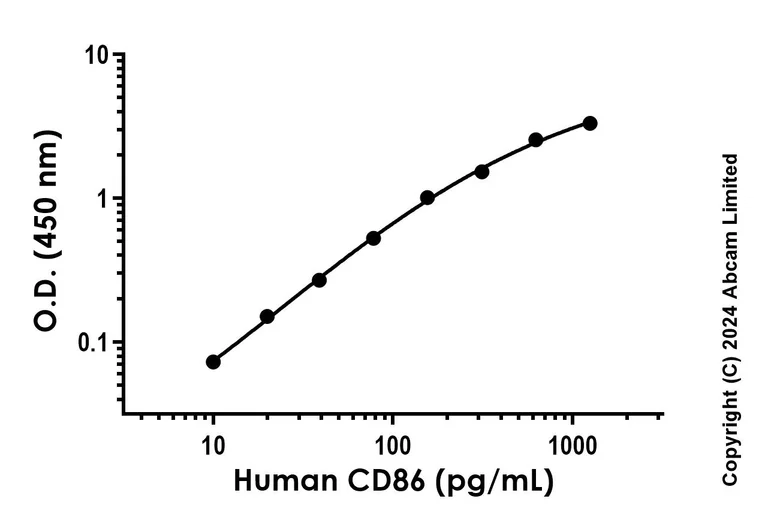
Sandwich ELISA - Recombinant Human CD86 Protein Standard (His tag) (AB316708)
  • sELISA

Lab

Sandwich ELISA - Recombinant Human CD86 Protein Standard (His tag) (AB316708)

Sandwich ELISA with the capture antibody ab259477 dilution at 2 μg/mL and detector antibody ab259478 dilution at 0.5 μg/mL after biotin conjugation.

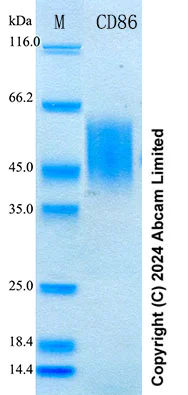
SDS-PAGE - Recombinant Human CD86 Protein Standard (His tag) (AB316708)
  • SDS-PAGE

Supplier Data

SDS-PAGE - Recombinant Human CD86 Protein Standard (His tag) (AB316708)

SDS-PAGE analysis of ab316708 under reducing conditions for 2ug protein.

Key facts

Purity

>80% SDS-PAGE

Expression system

HEK 293 cells

Tags

His tag C-Terminus

Applications

sELISA, SDS-PAGE

applications

Biologically active

No

Accession

P42081-1

Animal free

Yes

Carrier free

No

Species

Human

Storage buffer

pH: 7.3 - 7.5 Constituents: 2.922% Sodium chloride, 0.64107% disodium;hydrogen phosphate;dodecahydrate, 0.02858% Potassium phosphate monobasic

storage-buffer

Reactivity data

{ "title": "Reactivity Data", "filters": { "stats": ["", "Reactivity", "Dilution Info", "Notes"] }, "values": { "SDS-PAGE": { "reactivity":"TESTED_AND_REACTS", "dilution-info":"", "notes":"<p></p>" }, "sELISA": { "reactivity":"TESTED_AND_REACTS", "dilution-info":"", "notes":"<p></p>" } } }

Product details

While the standard is the same as the one provided in the corresponding SimpleStep ELISA Kit, it cannot be treated as the consumable provided with our SimpleStep ELISA Kit due to differences in its concentration calibration.

Abcam guarantee that this protein standard is suitable for use in a sandwich ELISA. Individual results may vary due to differences in technique, laboratory equipment, buffers, and other experimental factors. The detection range provided for this protein standard is based on initial sandwich ELISA validation data.

The protein concentration is the concentration after validation on our sandwich ELISA platform. This Standard protein is guaranteed to work with our Capture and Detector antibodies in sELISA. Please contact our Scientific Supportteam to know which antibody pair is suitable for this protein.

Sequence info

[{"linker":null,"sequence":null,"proteinLength":"Fragment","predictedMolecularWeight":"27.1 kDa","actualMolecularWeight":null,"aminoAcidEnd":0,"aminoAcidStart":0,"nature":"Recombinant","expressionSystem":"HEK 293 cells","accessionNumber":"P42081","tags":[{"tag":"His","terminus":"C-Terminus"}]}]

Properties and storage information

Form
Liquid
Purification technique
Affinity purification His Tag
Shipped at conditions
Dry Ice
Appropriate short-term storage conditions
-80°C
Appropriate long-term storage conditions
-80°C
Aliquoting information
Upon delivery aliquot
Storage information
Avoid freeze / thaw cycle
False

Supplementary information

This supplementary information is collated from multiple sources and compiled automatically.

CD86 also known as B7-2 is a protein involved in the regulation of the immune response. It has an approximate mass of 70 kDa and is expressed on antigen-presenting cells like dendritic cells monocytes and macrophages. Notably CD86 is present on macrophages including those in tissues such as skin and lymphoid organs. Expressed on these cells CD86 serves as a vital mediator in the co-stimulatory signals necessary for T cell activation and survival.
Biological function summary

CD86 plays a significant role in the immune system by providing secondary signals for T cell activation and differentiation. It is a part of the B7 protein family and forms a complex with CD28 and CTLA-4 on T cells. When CD86 binds to CD28 it sends positive co-stimulatory signals which promote T cell proliferation and cytokine production. On the other hand interaction with CTLA-4 transmits an inhibitory signal which reduces immune response. This dual interaction helps to balance immune activation and tolerance.

Pathways

CD86 takes part in important immune-related signaling pathways particularly the T cell receptor signaling pathway and the PI3K-Akt signaling pathway. Both pathways are fundamental for initiating immune responses. CD86's interaction with CD28 activates downstream signaling cascades including PI3K-Akt which is important for cell survival and growth. Additionally CD86 collaborates with other proteins such as CD80 another co-stimulatory molecule to amplify T cell activation within these pathways.

CD86 is associated with autoimmune diseases and transplant rejection. In autoimmune diseases like rheumatoid arthritis the overexpression or dysregulation of CD86 can lead to excessive T cell activation causing immune system attacks on the body's own tissues. Similarly in transplant rejection CD86 may contribute by enhancing immune response against transplanted organs. The engagement between CD86 and CD28 is a critical factor in these conditions and therapies targeting this interaction are under exploration to mitigate the immune response.

Product protocols

Target data

Costimulatory molecule that belongs to the immunoglobulin superfamily that plays an important role in T-lymphocyte activation (PubMed : 12196291, PubMed : 7694363). Acts as the primary auxiliary signal augmenting the MHC/TCR signal in naive T-cells by acting as a ligand for the CD28 receptor which is constitutively expressed on the cell surface of T-cells (PubMed : 12196291, PubMed : 7694363). May play a critical role in the early events of T-cell activation and costimulation of naive T-cells, such as deciding between immunity and anergy that is made by T-cells within 24 hours after activation (PubMed : 7527824). Also involved in the regulation of B cells function, plays a role in regulating the level of IgG(1) produced. Upon CD40 engagement, activates NF-kappa-B signaling pathway via phospholipase C and protein kinase C activation (By similarity). Also acts as an inhibitor of T-cell activation by acting as a ligand for CTLA4, a decoy receptor, thereby blocking CD28-mediated T-cell priming (PubMed : 11279501).. Isoform 2. Interferes with the formation of CD86 clusters, and thus acts as a negative regulator of T-cell activation.. (Microbial infection) Acts as a receptor for adenovirus subgroup B.
See full target information CD86

Alternative Names

CD86, CD28LG2, T-lymphocyte activation antigen CD86, Activation B7-2 antigen, B70, BU63, CTLA-4 counter-receptor B7.2, FUN-1

Product promise

We are committed to supporting your work with high-quality reagents, and we're here for you every step of the way. In the unlikely event that one of our products does not perform as expected, you're protected by our Product Promise.
For full details, please see our Terms & Conditions

Please note: All products are 'FOR RESEARCH USE ONLY. NOT FOR USE IN DIAGNOSTIC OR THERAPEUTIC PROCEDURES'.

For licensing inquiries, please contact partnerships@abcam.com