Recombinant human Cdk4 + Cyclin D1 protein (GST tag N-Terminus)
Be the first to review this product! Submit a review
|
(8 Publications )
- FuncS
Unknown
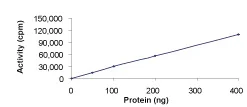
Functional Studies - Recombinant human Cdk4 + Cyclin D1 protein (GST tag N-Terminus) (AB55695)
Kinase assay using ab55695 using protein substrate Rb. The specific activity of CDK4/CyclinD1 is 14 nmol/min/mg.
- SDS-PAGE
Unknown
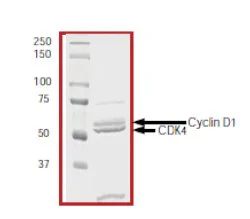
SDS-PAGE - Recombinant human Cdk4 + Cyclin D1 protein (GST tag N-Terminus) (AB55695)
SDS-PAGE analysis of ab55695 with molecular weight markers. Approximate molecular weights : 57kDa (CDK4)/61kDa (CyclinD1).
Complementary Products
Reagents, Controls & Accessories
AB116028
Prestained Protein Ladder - Broad molecular weight (10 - 245 kDa)

- 5
- 3
Primary Antibodies
AB108357
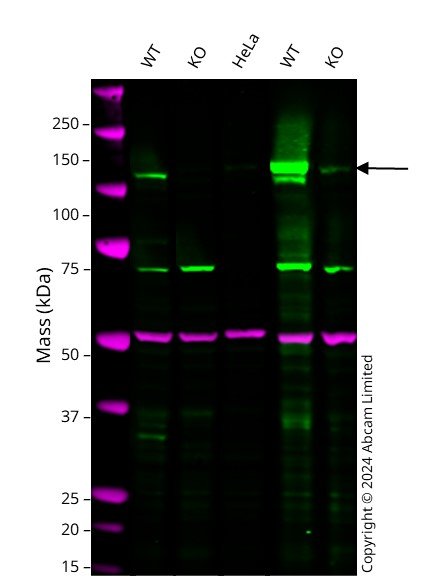
Anti-Cdk4 antibody [EPR4513-32-7]
20ul selling size|RabMAb|Recombinant|KO Validated

- 5
- 1
Primary Antibodies
AB181616
20ul selling size|KO Validated|RabMAb|Recombinant|Advanced Validation
- 0
- 0
Reactivity data
Product details
Sequence info
Properties and storage information
Form
Purification technique
Shipped at conditions
Appropriate short-term storage conditions
Appropriate long-term storage conditions
Aliquoting information
Storage information
Supplementary information
This supplementary information is collated from multiple sources and compiled automatically.
Biological function summary
Cyclin D1 and Cdk4 are important for progression of the cell cycle from G1 to S phase. The Cyclin D1 + Cdk4 protein complex acts by phosphorylating Rb releasing E2F transcription factors which initiate DNA replication. This complex therefore serves as a regulatory node controlling cell cycle entry and is influenced by mitogenic signals. Its activity is tightly regulated in response to extracellular signals aligning cell cycle progress with growth conditions making it a pivotal player in cell division.
Pathways
Cyclin D1 and Cdk4 play important roles within the signaling pathways that control cell proliferation. They are integral to the MAPK/ERK pathway which links external growth signals to cell cycle entry and the PI3K/AKT pathway which provides additional control over cell survival and metabolism. Through these pathways Cyclin D1 and Cdk4 interact with other proteins like p21 and p27 which modulate their activity and ensure proper cell cycle transitions.
General info
Function
Ser/Thr-kinase component of cyclin D-CDK4 (DC) complexes that phosphorylate and inhibit members of the retinoblastoma (RB) protein family including RB1 and regulate the cell-cycle during G(1)/S transition. Phosphorylation of RB1 allows dissociation of the transcription factor E2F from the RB/E2F complexes and the subsequent transcription of E2F target genes which are responsible for the progression through the G(1) phase. Hypophosphorylates RB1 in early G(1) phase. Cyclin D-CDK4 complexes are major integrators of various mitogenenic and antimitogenic signals. Also phosphorylates SMAD3 in a cell-cycle-dependent manner and represses its transcriptional activity. Component of the ternary complex, cyclin D/CDK4/CDKN1B, required for nuclear translocation and activity of the cyclin D-CDK4 complex.
Sequence similarities
Belongs to the protein kinase superfamily. CMGC Ser/Thr protein kinase family. CDC2/CDKX subfamily.
Post-translational modifications
Phosphorylation at Thr-172 is required for enzymatic activity. Phosphorylated, in vitro, at this site by CCNH-CDK7, but, in vivo, appears to be phosphorylated by a proline-directed kinase. In the cyclin D-CDK4-CDKN1B complex, this phosphorylation and consequent CDK4 enzyme activity, is dependent on the tyrosine phosphorylation state of CDKN1B. Thus, in proliferating cells, CDK4 within the complex is phosphorylated on Thr-172 in the T-loop. In resting cells, phosphorylation on Thr-172 is prevented by the non-tyrosine-phosphorylated form of CDKN1B.
Subcellular localisation
Nucleus
Target data
Additional targets
Alternative Names
Publications (8)
Recent publications for all applications. Explore the full list and refine your search
Nature communications 15:3220 PubMed38622115
2024
Applications
Unspecified application
Species
Unspecified reactive species
The Journal of biological chemistry 299:105407 PubMed38152849
2023
Applications
Unspecified application
Species
Unspecified reactive species
The Journal of biological chemistry 294:12099-12111 PubMed31217276
2019
Applications
Unspecified application
Species
Unspecified reactive species
Bioorganic & medicinal chemistry 26:3491-3501 PubMed29853338
2018
Applications
Unspecified application
Species
Unspecified reactive species
Nature 546:426-430 PubMed28607489
2017
Applications
Unspecified application
Species
Unspecified reactive species
Nature communications 3:951 PubMed22805558
2012
Applications
Unspecified application
Species
Unspecified reactive species
Neoplasia (New York, N.Y.) 14:476-86 PubMed22787429
2012
Applications
Unspecified application
Species
Unspecified reactive species
Development (Cambridge, England) 138:1771-82 PubMed21447557
2011
Applications
Unspecified application
Species
Unspecified reactive species
Product promise
Please note: All products are 'FOR RESEARCH USE ONLY. NOT FOR USE IN DIAGNOSTIC OR THERAPEUTIC PROCEDURES'.
For licensing inquiries, please contact partnerships@abcam.com