JavaScript is disabled in your browser. Please enable JavaScript to view this website.
AB259376

Recombinant human GM-CSF protein (Active)

Be the first to review this product! Submit a review

|

(0 Publication)

Recombinant human GM-CSF protein (Active) is a Human Full Length protein, in the 18 to 144 aa range, expressed in HEK 293 cells, with >95%, <0.005 EU/µg endotoxin level, suitable for SDS-PAGE, FuncS, Mass Spec, HPLC, Cell Culture.

View Alternative Names

GMCSF, CSF2, Granulocyte-macrophage colony-stimulating factor, GM-CSF, Colony-stimulating factor, Molgramostin, Sargramostim, CSF
4 Images
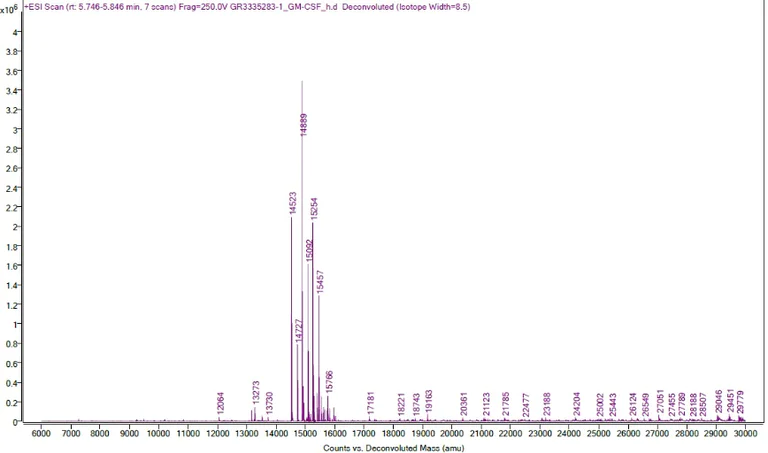
Mass Spectrometry - Recombinant human GM-CSF protein (Active) (AB259376)
  • Mass Spec

Supplier Data

Mass Spectrometry - Recombinant human GM-CSF protein (Active) (AB259376)

M+/- 0 Da, pass (additional mass signals from glycan modifiactions : +203 Da HexNAc, +162 Da Hex)). Calc MW 14523.00 Da.
Functional Studies - Recombinant human GM-CSF protein (Active) (AB259376)
  • FuncS

Supplier Data

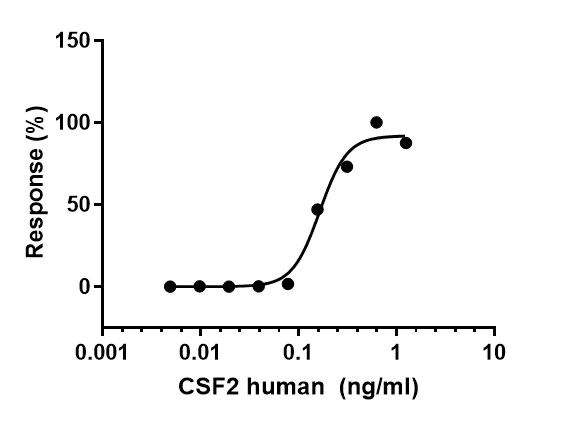
Functional Studies - Recombinant human GM-CSF protein (Active) (AB259376)

Fully biologicaly active as determined by dose-depended proliferation of TF-1 Cells.

ED50 is ≤ 0.1ng/mL, corresponding to a specific activity of 1.00 x 10⁷ units/mg.
SDS-PAGE - Recombinant human GM-CSF protein (Active) (AB259376)
  • SDS-PAGE

Supplier Data

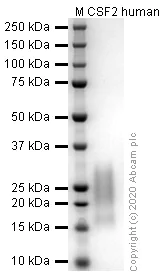
SDS-PAGE - Recombinant human GM-CSF protein (Active) (AB259376)

SDS-PAGE analysis of ab259376.

The protein is heavily glycosylated and therefore runs as a smear.

HPLC - Recombinant human GM-CSF protein (Active) (AB259376)
  • HPLC

Supplier Data

HPLC - Recombinant human GM-CSF protein (Active) (AB259376)

Purity 95% (sample was deglycosylated prior HPLC analysis; signal at RT 6.7 min corresponds to deglycosylation mix).

Key facts

Purity

>95% SDS-PAGE

Purity by HPLC >=95%.

Endotoxin level

<0.005 EU/µg

Expression system

HEK 293 cells

Tags

Tag free

Applications

SDS-PAGE, Cell Culture, HPLC, Mass Spec, FuncS

applications

Biologically active

Yes

Biological activity

Fully biologicaly active as determined by dose-depended proliferation of TF-1 Cells.

ED50 is ≤ 0.1ng/mL, corresponding to a specific activity of 1.00 x 10⁷ units/mg.

Accession

Animal free

Yes

Carrier free

No

Species

Human

Reconstitution

Reconstitute with phosphate buffered saline.Store lyophilized form at room temperature. Reconstitute, aliquot and store at -80°C for 12 months or +4°C for 1 week.Avoid repeated freeze-thaw. Lyophilized contents may appear as either a translucent film or a white powder. This variance does not affect the quality of the product.

Storage buffer

pH: 6 - 8 Constituents: 10.26% Trehalose, 0.727% Dibasic monohydrogen potassium phosphate, 0.248% Potassium phosphate monobasic

storage-buffer

Reactivity data

{ "title": "Reactivity Data", "filters": { "stats": ["", "Reactivity", "Dilution Info", "Notes"] }, "values": { "SDS-PAGE": { "reactivity":"TESTED_AND_REACTS", "dilution-info":"", "notes":"<p></p>" }, "FuncS": { "reactivity":"TESTED_AND_REACTS", "dilution-info":"", "notes":"<p></p>" }, "Mass Spec": { "reactivity":"TESTED_AND_REACTS", "dilution-info":"", "notes":"<p></p>" }, "HPLC": { "reactivity":"TESTED_AND_REACTS", "dilution-info":"", "notes":"<p></p>" }, "Cell Culture": { "reactivity":"TESTED_AND_REACTS", "dilution-info":"", "notes":"<p></p>" } } }

Product details

This protein is filter sterilised prior to aliquoting and lyophilisation. All aliquoting and lyophilisation steps are performed in a sterile environment.

Sequence info

[{"linker":null,"sequence":"APARSPSPSTQPWEHVNAIQEARRLLNLSRDTAAEMNETVEVISEMFDLQEPTCLQTRLELYKQGLRGSLTKLKGPLTMMASHYKQHCPPTPETSCATQTITFESFKENLKDFLLVIPFDCWEPVQE","proteinLength":"Full Length","predictedMolecularWeight":"14.52 kDa","actualMolecularWeight":"14.52 kDa","aminoAcidEnd":144,"aminoAcidStart":18,"nature":"Recombinant","expressionSystem":"HEK 293 cells","accessionNumber":"P04141","tags":[]}]

Properties and storage information

Form
Lyophilized
Shipped at conditions
Ambient - Can Ship with Ice
Appropriate short-term storage conditions
Ambient
Appropriate long-term storage conditions
Ambient|-20°C
Storage information
Avoid freeze / thaw cycle
True

Supplementary information

This supplementary information is collated from multiple sources and compiled automatically.

GM-CSF also known as Granulocyte-Macrophage Colony-Stimulating Factor is a glycoprotein with a mass of approximately 23 kDa. This protein plays a mechanical role in stimulating the differentiation and proliferation of hematopoietic progenitor cells into granulocytes and macrophages. Its expression occurs in various cell types including macrophages T cells endothelial cells and fibroblasts. GM-CSF interacts with its specific receptor known as CSF2 receptor to exert its effects.
Biological function summary

GM-CSF influences the immune system by enhancing the functional capacity of mature neutrophils macrophages and eosinophils. GM-CSF protein acts alone and not as part of a larger protein complex. It is important in regulating immune responses and inflammation. Due to its role in promoting the survival and activation of these immune cells GM-CSF is important for mounting an effective immune defense in response to infections and other challenges.

Pathways

GM-CSF signaling is integral to the JAK-STAT pathway. This pathway is essential for transmitting signals from surface receptors like GM-CSF receptors into the nucleus thereby inducing gene expression that leads to cell survival and proliferation. GM-CSF also intersects with the ERK1/ERK2 MAPK pathway which is involved in regulating cellular processes such as division and differentiation. The GM-CSF receptor shares similarities with other cytokine receptors involved in these pathways making it related to various cytokines through its downstream signaling effects.

GM-CSF has a well-established connection to diseases like rheumatoid arthritis and multiple sclerosis. In rheumatoid arthritis overproduction of GM-CSF is linked to chronic inflammation and joint damage. In multiple sclerosis GM-CSF might contribute to the pathological immune responses against the central nervous system. Antibodies targeting GM-CSF or its receptor represent a therapeutic strategy for these autoimmune diseases. By modulating GM-CSF activity therapeutic approaches aim to reduce inflammation and autoimmunity highlighting the protein's importance in disease progression.

General info

Function

Cytokine that stimulates the growth and differentiation of hematopoietic precursor cells from various lineages, including granulocytes, macrophages, eosinophils and erythrocytes.

Sequence similarities

Belongs to the GM-CSF family.

Product protocols

Target data

Cytokine that stimulates the growth and differentiation of hematopoietic precursor cells from various lineages, including granulocytes, macrophages, eosinophils and erythrocytes.
See full target information CSF2

Product promise

We are committed to supporting your work with high-quality reagents, and we're here for you every step of the way. In the unlikely event that one of our products does not perform as expected, you're protected by our Product Promise.
For full details, please see our Terms & Conditions

Please note: All products are 'FOR RESEARCH USE ONLY. NOT FOR USE IN DIAGNOSTIC OR THERAPEUTIC PROCEDURES'.

For licensing inquiries, please contact partnerships@abcam.com