JavaScript is disabled in your browser. Please enable JavaScript to view this website.
AB276697

Recombinant Human GPR133 protein (His tag)

Be the first to review this product! Submit a review

|

(0 Publication)

Recombinant Human GPR133 protein (His tag) is a Human Fragment protein, in the 1 to 570 aa range, expressed in HEK 293 cells, with >90%, < 1 EU/µg endotoxin level, suitable for SDS-PAGE.

View Alternative Names

GPR133, PGR25, ADGRD1, Adhesion G-protein coupled receptor D1, G-protein coupled receptor 133, G-protein coupled receptor PGR25
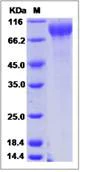
1 Images
SDS-PAGE - Recombinant Human GPR133 protein (His tag) (AB276697)
  • SDS-PAGE

Supplier Data

SDS-PAGE - Recombinant Human GPR133 protein (His tag) (AB276697)

SDS-PAGE analysis of ab276697

Key facts

Purity

>90% SDS-PAGE

Endotoxin level

< 1 EU/µg

Expression system

HEK 293 cells

Tags

His tag C-Terminus

Applications

SDS-PAGE

applications

Biologically active

No

Accession

Animal free

No

Carrier free

No

Species

Human

Storage buffer

pH: 7.4 Constituents: PBS

storage-buffer

Reactivity data

{ "title": "Reactivity Data", "filters": { "stats": ["", "Reactivity", "Dilution Info", "Notes"] }, "values": { "SDS-PAGE": { "reactivity":"TESTED_AND_REACTS", "dilution-info":"", "notes":"<p></p>" } } }

Sequence info

[{"linker":null,"sequence":"MEKLLRLCCWYSWLLLFYYNFQVRGVYSRSQDHPGFQVLASASHYWPLENVDGIHELQDTTGDIVEGKVNKGIYLKEEKGVTLLYYGRYNSSCISKPEQCGPEGVTFSFFWKTQGEQSRPIPSAYGGQVISNGFKVCSSGGRGSVELYTRDNSMTWEASFSPPGPYWTHVLFTWKSKEGLKVYVNGTLSTSDPSGKVSRDYGESNVNLVIGSEQDQAKCYENGAFDEFIIWERALTPDEIAMYFTAAIGKHALLSSTLPSLFMTSTASPVMPTDAYHPIITNLTEERKTFQSPGVILSYLQNVSLSLPSKSLSEQTALNLTKTFLKAVGEILLLPGWIALSEDSAVVLSLIDTIDTVMGHVSSNLHGSTPQVTVEGSSAMAEFSVAKILPKTVNSSHYRFPAHGQSFIQIPHEAFHRHAWSTVVGLLYHSMHYYLNNIWPAHTKIAEAMHHQDCLLFATSHLISLEVSPPPTLSQNLSGSPLITVHLKHRLTRKQHSEATNSSNRVFVYCAFLDFSSGEGVWSNHGCALTRGNLTYSVCRCTHLTNFAILMQVVPLELARGHQVALSSIS","proteinLength":"Fragment","predictedMolecularWeight":"61.5 kDa","actualMolecularWeight":null,"aminoAcidEnd":570,"aminoAcidStart":1,"nature":"Recombinant","expressionSystem":"HEK 293 cells","accessionNumber":"Q6QNK2","tags":[{"tag":"His","terminus":"C-Terminus"}]}]

Properties and storage information

Form
Lyophilized
Shipped at conditions
Ambient - Can Ship with Ice
Appropriate short-term storage conditions
-20°C
Appropriate long-term storage conditions
-20°C
Aliquoting information
Upon delivery aliquot
Storage information
Avoid freeze / thaw cycle
False

Supplementary information

This supplementary information is collated from multiple sources and compiled automatically.

GPR133 also known as ADGRD1 is a member of the adhesion G protein-coupled receptor (GPCR) family. It possesses a large extracellular domain and a characteristic seven-transmembrane domain typical of GPCRs with a molecular mass approximately 100 kDa. GPR133 expresses broadly in the central nervous system and several peripheral tissues including the lung and heart. This pattern of expression suggests its involvement in various physiological functions.
Biological function summary

Adhesion G protein-coupled receptor GPR133 has roles in cellular signaling and communication. It participates in the regulation of processes such as cell adhesion and migration. GPR133 does not act alone; it associates with other proteins to affect physiological functions though it is not strictly part of a larger protein complex. Its broad expression in several tissues indicates its functional versatility.

Pathways

Research links GPR133 to significant signaling pathways like the Wnt signaling pathway and the G-protein signaling pathway. It interacts with the proteins involved in these pathways to modulate their downstream effects impacting cellular processes such as proliferation and differentiation. Partner proteins such as heterotrimeric G proteins directly associate with GPR133 playing roles in the signal transduction processes initiated by this receptor.

GPR133 associates with conditions such as glioblastoma and asthma. It often operates alongside other proteins involved in these conditions such as EGFR in glioblastoma and the IL-4 receptor in asthma. Alterations in the expression or function of GPR133 may contribute to the pathogenesis of these diseases by affecting cell signaling pathways presenting it as a potential therapeutic target for intervention.

General info

Function

Adhesion G-protein coupled receptor (aGPCR) for androgen hormone 5alpha-dihydrotestosterone (5alpha-DHT), also named 17beta-hydroxy-5alpha-androstan-3-one, the most potent hormone among androgens (PubMed : 39884271). Also activated by methenolone drug (PubMed : 39884271). Ligand binding causes a conformation change that triggers signaling via guanine nucleotide-binding proteins (G proteins) and modulates the activity of downstream effectors, such as adenylate cyclase (PubMed : 39884271). ADGRD1 is coupled to G(s) G proteins and mediates activation of adenylate cyclase activity (PubMed : 22025619, PubMed : 22575658, PubMed : 35447113, PubMed : 39884271). Acts as a 5alpha-DHT receptor in muscle cells, thereby increasing intracellular cyclic AMP (cAMP) levels and enhancing muscle strength (PubMed : 39884271).

Sequence similarities

Belongs to the G-protein coupled receptor 2 family. Adhesion G-protein coupled receptor (ADGR) subfamily.

Post-translational modifications

Autoproteolytically processed at the GPS region of the GAIN-B domain; this cleavage modulates receptor activity (By similarity) (PubMed:34022221, PubMed:35418678, PubMed:35447113). Cleavage takes place early in the secretory pathway before N-glycosylation (PubMed:35418678).

Product protocols

Target data

Adhesion G-protein coupled receptor (aGPCR) for androgen hormone 5alpha-dihydrotestosterone (5alpha-DHT), also named 17beta-hydroxy-5alpha-androstan-3-one, the most potent hormone among androgens (PubMed : 39884271). Also activated by methenolone drug (PubMed : 39884271). Ligand binding causes a conformation change that triggers signaling via guanine nucleotide-binding proteins (G proteins) and modulates the activity of downstream effectors, such as adenylate cyclase (PubMed : 39884271). ADGRD1 is coupled to G(s) G proteins and mediates activation of adenylate cyclase activity (PubMed : 22025619, PubMed : 22575658, PubMed : 35447113, PubMed : 39884271). Acts as a 5alpha-DHT receptor in muscle cells, thereby increasing intracellular cyclic AMP (cAMP) levels and enhancing muscle strength (PubMed : 39884271).
See full target information ADGRD1

Product promise

We are committed to supporting your work with high-quality reagents, and we're here for you every step of the way. In the unlikely event that one of our products does not perform as expected, you're protected by our Product Promise.
For full details, please see our Terms & Conditions

Please note: All products are 'FOR RESEARCH USE ONLY. NOT FOR USE IN DIAGNOSTIC OR THERAPEUTIC PROCEDURES'.

For licensing inquiries, please contact partnerships@abcam.com