JavaScript is disabled in your browser. Please enable JavaScript to view this website.
AB101660

Recombinant human HDAC7 protein (GST tag N-Terminus)

Be the first to review this product! Submit a review

|

(1 Publication)
Recombinant human HDAC7 protein (GST tag N-Terminus) is a Human Fragment protein, in the 501 to 952 aa range, expressed in Baculovirus infected insect cells, with >90%, suitable for WB, FuncS.
4 Images
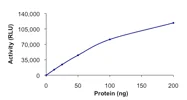
Functional Studies - Recombinant human HDAC7 protein (GST tag N-Terminus) (AB101660)
  • FuncS

Unknown

Functional Studies - Recombinant human HDAC7 protein (GST tag N-Terminus) (AB101660)

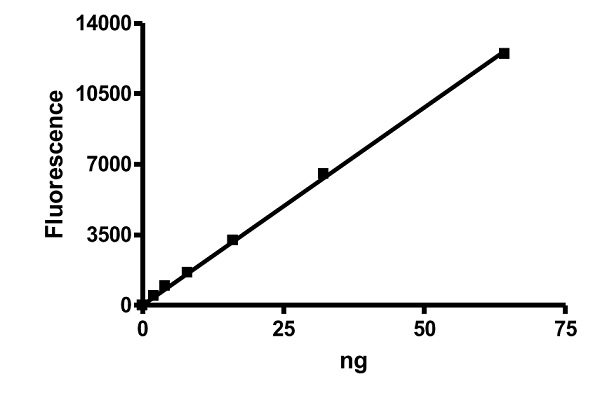
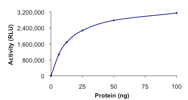
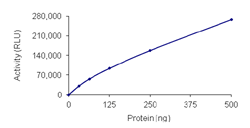
The Specific activity of ab101660 was determined to be 80 RLU/min/ng.
Functional Studies - Recombinant human HDAC7 protein (GST tag N-Terminus) (AB101660)
  • FuncS

Unknown

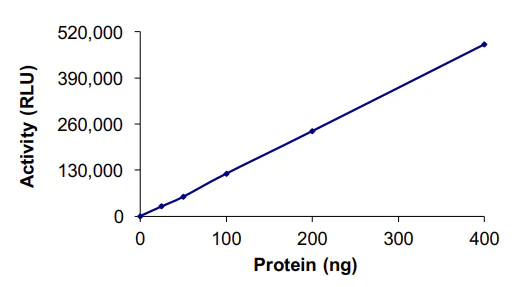
Functional Studies - Recombinant human HDAC7 protein (GST tag N-Terminus) (AB101660)

The specific activity of HDAC7 (ab101660) was determined to be 80 RLU/min/mg as per activity assay protocol
SDS-PAGE - Recombinant human HDAC7 protein (GST tag N-Terminus) (AB101660)
  • SDS-PAGE

Unknown

SDS-PAGE - Recombinant human HDAC7 protein (GST tag N-Terminus) (AB101660)

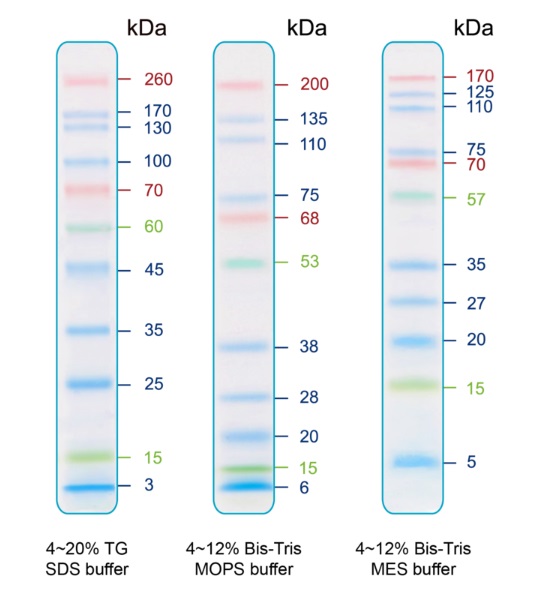
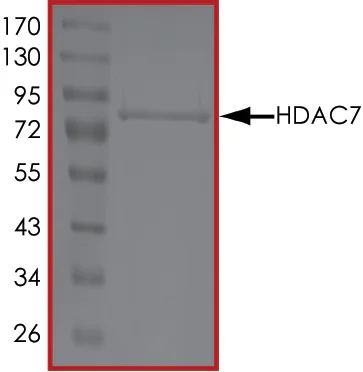
SDS PAGE analysis of ab101660

SDS-PAGE - Recombinant human HDAC7 protein (GST tag N-Terminus) (AB101660)
  • SDS-PAGE

Unknown

SDS-PAGE - Recombinant human HDAC7 protein (GST tag N-Terminus) (AB101660)

SDS-PAGE showing ab101660 at approximately 80kDa.

Key facts

Purity

>90% SDS-PAGE

Affinity purified.

Expression system

Baculovirus infected insect cells

Tags

GST tag N-Terminus

Applications

FuncS, WB

applications

Biologically active

Yes

Biological activity

The Specific activity of ab101660 was determined to be 80 RLU/min/ng.

Accession

Q8WUI4-1

Animal free

No

Carrier free

No

Species

Human

Storage buffer

pH: 7.5 Constituents: 25% Glycerol (glycerin, glycerine), 0.87% Sodium chloride, 0.79% Tris HCl, 0.307% Glutathione, 0.00385% (R*,R*)-1,4-Dimercaptobutan-2,3-diol, 0.00292% EDTA, 0.00174% PMSF

storage-buffer

Reactivity data

{ "title": "Reactivity Data", "filters": { "stats": ["", "Reactivity", "Dilution Info", "Notes"] }, "values": { "WB": { "reactivity":"TESTED_AND_REACTS", "dilution-info":"", "notes":"<p></p>" }, "FuncS": { "reactivity":"TESTED_AND_REACTS", "dilution-info":"", "notes":"<p></p>" } } }

Sequence info

[{"linker":null,"sequence":"","proteinLength":"Fragment","predictedMolecularWeight":"80 kDa","actualMolecularWeight":null,"aminoAcidEnd":952,"aminoAcidStart":501,"nature":"Recombinant","expressionSystem":null,"accessionNumber":"Q8WUI4","tags":[{"tag":"GST","terminus":"N-Terminus"}]}]

Properties and storage information

Form
Liquid
Purification technique
Affinity purification
Shipped at conditions
Dry Ice
Appropriate short-term storage conditions
-80°C
Appropriate long-term storage conditions
-80°C
Aliquoting information
Upon delivery aliquot
Storage information
Avoid freeze / thaw cycle
True

Supplementary information

This supplementary information is collated from multiple sources and compiled automatically.

Histone deacetylase 7 (HDAC7) also known as HD7 or HD7A is a part of the class IIa histone deacetylases. It has a mass of approximately 103 kDa. HDAC7 plays a role in regulating gene expression by removing acetyl groups from lysine residues on histones leading to chromatin condensation and gene repression. This protein is expressed in various tissues including the heart skeletal muscle and T-cells where it influences diverse cellular processes.
Biological function summary

HDAC7 modulates transcription and affects cell differentiation and survival. It is a component of a larger protein complex working together with other proteins to influence transcription factor activity and chromatin architecture. It influences the expression of genes involved in immune responses as well as other critical cellular activities. By regulating these processes HDAC7 contributes to the balance between cell proliferation and apoptosis.

Pathways

HDAC7 plays key roles in the Wnt signaling and T-cell receptor (TCR) signaling pathways. It interacts with other proteins such as HDAC3 and the nuclear receptor co-repressor (N-CoR) affecting pathway components and influencing cellular outcomes. In the Wnt pathway HDAC7's activity modifies the transcription of target genes impacting cell fate decisions. During TCR signaling HDAC7 aids in the regulation of T-cell development and function working closely with transcriptional factors involved in these pathways.

HDAC7 has been associated with cancer and cardiovascular diseases. Its dysregulation can contribute to tumorigenesis through aberrant expression of genes controlling cell cycle and apoptosis. In cardiovascular disorders it impacts cardiac hypertrophy and heart failure due to its influence on heart-specific gene expression. HDAC7’s interaction with proteins like RUNX1 in T-cells can also contribute to the development of leukemia. These links highlight the importance of HDAC7 in both disease development and progression.

Product protocols

Target data

Responsible for the deacetylation of lysine residues on the N-terminal part of the core histones (H2A, H2B, H3 and H4) (By similarity). Histone deacetylation gives a tag for epigenetic repression and plays an important role in transcriptional regulation, cell cycle progression and developmental events (By similarity). Histone deacetylases act via the formation of large multiprotein complexes (By similarity). Involved in muscle maturation by repressing transcription of myocyte enhancer factors such as MEF2A, MEF2B and MEF2C (By similarity). During muscle differentiation, it shuttles into the cytoplasm, allowing the expression of myocyte enhancer factors (By similarity). May be involved in Epstein-Barr virus (EBV) latency, possibly by repressing the viral BZLF1 gene (PubMed : 12239305). Positively regulates the transcriptional repressor activity of FOXP3 (PubMed : 17360565). Serves as a corepressor of RARA, causing its deacetylation and inhibition of RARE DNA element binding (PubMed : 28167758). In association with RARA, plays a role in the repression of microRNA-10a and thereby in the inflammatory response (PubMed : 28167758). Also acetylates non-histone proteins, such as ALKBH5 (PubMed : 37369679).
See full target information HDAC7

Alternative Names

HDAC7A, HDAC7, Histone deacetylase 7, HD7, Histone deacetylase 7A, Protein deacetylase HDAC7, HD7a

Publications (1)

Recent publications for all applications. Explore the full listand refine your search

Journal of enzyme inhibition and medicinal chemistry 38:2201408 PubMed37096557

2023

Discovery of novel benzohydroxamate-based histone deacetylase 6 (HDAC6) inhibitors with the ability to potentiate anti-PD-L1 immunotherapy in melanoma.

Applications

Unspecified application

Species

Unspecified reactive species

Xiaopeng Peng,Ziwen Yu,Goverdhan Surineni,Bulian Deng,Meizhu Zhang,Chuan Li,Zhiqiang Sun,Wanyi Pan,Yao Liu,Shenglan Liu,Bin Yu,Jianjun Chen
View all publications

Product promise

We are committed to supporting your work with high-quality reagents, and we're here for you every step of the way. In the unlikely event that one of our products does not perform as expected, you're protected by our Product Promise.
For full details, please see our Terms & Conditions

Please note: All products are 'FOR RESEARCH USE ONLY. NOT FOR USE IN DIAGNOSTIC OR THERAPEUTIC PROCEDURES'.

For licensing inquiries, please contact partnerships@abcam.com