JavaScript is disabled in your browser. Please enable JavaScript to view this website.
AB204158

Recombinant human HIPK4 protein (His tag N-Terminus)

Be the first to review this product! Submit a review

|

(0 Publication)
Recombinant human HIPK4 protein (His tag N-Terminus) is a Human Full Length protein, in the 1 to 616 aa range, expressed in Baculovirus infected Sf9 cells, with >85%, suitable for SDS-PAGE, FuncS.
2 Images
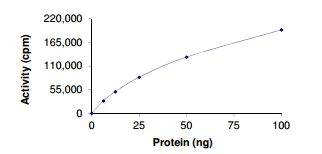
Functional Studies - Recombinant human HIPK4 protein (His tag N-Terminus) (AB204158)
  • FuncS

Supplier Data

Functional Studies - Recombinant human HIPK4 protein (His tag N-Terminus) (AB204158)

The specific activity of ab204158 was determined to be 220 nmol/min/mg.
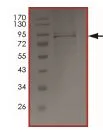
SDS-PAGE - Recombinant human HIPK4 protein (His tag N-Terminus) (AB204158)
  • SDS-PAGE

Supplier Data

SDS-PAGE - Recombinant human HIPK4 protein (His tag N-Terminus) (AB204158)

SDS-PAGE analysis of ab204158 which was determined to be >85% pure by densitometry.

Key facts

Purity

>85% Densitometry

Affinity purified.

Expression system

Baculovirus infected Sf9 cells

Tags

His tag N-Terminus

Applications

SDS-PAGE, FuncS

applications

Biologically active

Yes

Biological activity

The specific activity of ab204158 was determined to be 220 nmol/min/mg.

Accession

Q8NE63-1

Animal free

No

Carrier free

No

Species

Human

Storage buffer

pH: 7 Preservative: 1.02% Imidazole Constituents: 25% Glycerol (glycerin, glycerine), 1.76% Sodium chloride, 0.82% Sodium dihydrogen phosphate, 0.004% (R*,R*)-1,4-Dimercaptobutan-2,3-diol, 0.002% PMSF

storage-buffer

Reactivity data

{ "title": "Reactivity Data", "filters": { "stats": ["", "Reactivity", "Dilution Info", "Notes"] }, "values": { "SDS-PAGE": { "reactivity":"TESTED_AND_REACTS", "dilution-info":"", "notes":"<p></p>" }, "FuncS": { "reactivity":"TESTED_AND_REACTS", "dilution-info":"", "notes":"<p></p>" } } }

Sequence info

[{"linker":null,"sequence":"MSTIQSETDCYDIIEVLGKGTFGEVAKGWRRSTGEMVAIKILKNDAYRNRIIKNELKLLHCMRGLDPEEAHVIRFLEFFHDALKFYLVFELLEQNLFEFQKENNFAPLPARHIRTVTLQVLTALARLKELAIIHADLKPENIMLVDQTRCPFRVKVIDFGSASIFSEVRYVKEPYIQSRFYRAPEILLGLPFCEKVDVWSLGCVMAELHLGWPLYPGNNEYDQVRYICETQGLPKPHLLHAACKAHHFFKRNPHPDAANPWQLKSSADYLAETKVRPLERRKYMLKSLDQIETVNGGSVASRLTFPDREALAEHADLKSMVELIKRMLTWESHERISPSAALRHPFVSMQQLRSAHETTHYYQLSLRSYRLSLQVEGKPPTPVVAAEDGTPYYCLAEEKEAAGMGSVAGSSPFFREEKAPGMQRAIDQLDDLSLQEAGHGLWGETCTNAVSDMMVPLKAAITGHHVPDSGPEPILAFYSSRLAGRHKARKPPAGSKSDSNFSNLIRLSQVSPEDDRPCRGSSWEEGEHLGASAEPLAILQRDEDGPNIDNMTMEAERPDPELFDPSSCPGEWLSEPDCTLESVRGPRAQGLPPRRSHQHGPPRGATSFLQHVTGHH","proteinLength":"Full Length","predictedMolecularWeight":"85 kDa","actualMolecularWeight":null,"aminoAcidEnd":616,"aminoAcidStart":1,"nature":"Recombinant","expressionSystem":"Baculovirus infected Sf9 cells","accessionNumber":"Q8NE63","tags":[{"tag":"His","terminus":"N-Terminus"}]}]

Properties and storage information

Form
Liquid
Purification technique
Affinity purification
Shipped at conditions
Dry Ice
Appropriate short-term storage conditions
-80°C
Appropriate long-term storage conditions
-80°C
Aliquoting information
Upon delivery aliquot
Storage information
Avoid freeze / thaw cycle
True

Supplementary information

This supplementary information is collated from multiple sources and compiled automatically.

HIPK4 known as Homeodomain Interacting Protein Kinase 4 acts as a serine/threonine-protein kinase. It weighs around 69 kDa. This protein primarily localizes in the nucleus and occasionally the cytoplasm across various tissues. HIPK4 participates in phosphorylation processes modifying the activity of multiple substrates. Researchers often study it for its potential interactions with different transcription factors and regulators.
Biological function summary

This protein plays an important role in regulating cell growth and differentiation. HIPK4 does not function as part of a complex but acts independently to impact these cellular processes. It can influence the expression of genes involved in apoptosis and cell cycle regulation indicating its significant influence on cellular homeostasis.

Pathways

Researchers recognize HIPK4's involvement in the Wnt signaling and JNK pathways. The protein interacts with other kinases such as HIPK2 which also play roles in these pathways. These interactions suggest that HIPK4 might have diverse biological effects including those on development and cancer evolution.

Scientists have linked HIPK4 to cancer and neurodegenerative diseases. It interacts with proteins like p53 which are important in tumor suppression. HIPK4's alteration may contribute to the development of cancer by disturbing the balance of cell proliferation and death. Additionally its dysregulation could potentially connect to neuronal cell death implicating a role in neurodegenerative conditions.

Product protocols

Target data

Protein kinase that phosphorylates human TP53 at Ser-9, and thus induces TP53 repression of BIRC5 promoter (By similarity). May act as a corepressor of transcription factors (Potential).
See full target information HIPK4

Alternative Names

Homeodomain-interacting protein kinase 4, HIPK4

Product promise

We are committed to supporting your work with high-quality reagents, and we're here for you every step of the way. In the unlikely event that one of our products does not perform as expected, you're protected by our Product Promise.
For full details, please see our Terms & Conditions

Please note: All products are 'FOR RESEARCH USE ONLY. NOT FOR USE IN DIAGNOSTIC OR THERAPEUTIC PROCEDURES'.

For licensing inquiries, please contact partnerships@abcam.com