Recombinant human IGF1 Receptor protein
- Bioactive
- What is this?
Be the first to review this product! Submit a review
|
(0 Publication)
Recombinant human IGF1 Receptor protein is a Human Fragment protein, in the 31 to 932 aa range, expressed in HEK 293 cells, with >95%, < 1 EU/µg endotoxin level, suitable for ELISA, SDS-PAGE, FuncS.
View Alternative Names
CD221, Insulin-like growth factor 1 receptor, Insulin-like growth factor I receptor, IGF-I receptor, IGF1R
- FuncS
Unknown
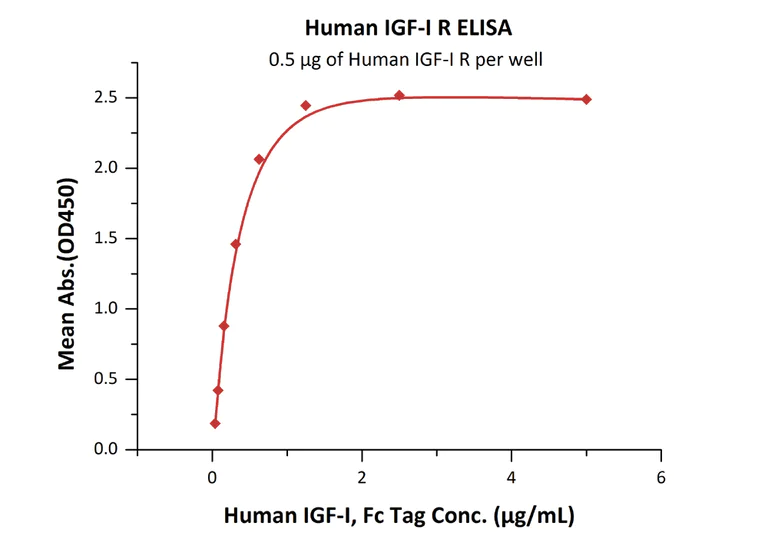
Functional Studies - Recombinant human IGF1 Receptor protein (AB155622)
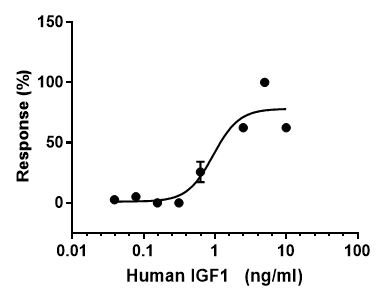
Immobilized Human IGF-I R at 5 µg/mL (100 µL/well) can bind Human IGF-I, Fc Tag with a linear range of 0.04-0.313 µg/mL.
- FuncS
Unknown
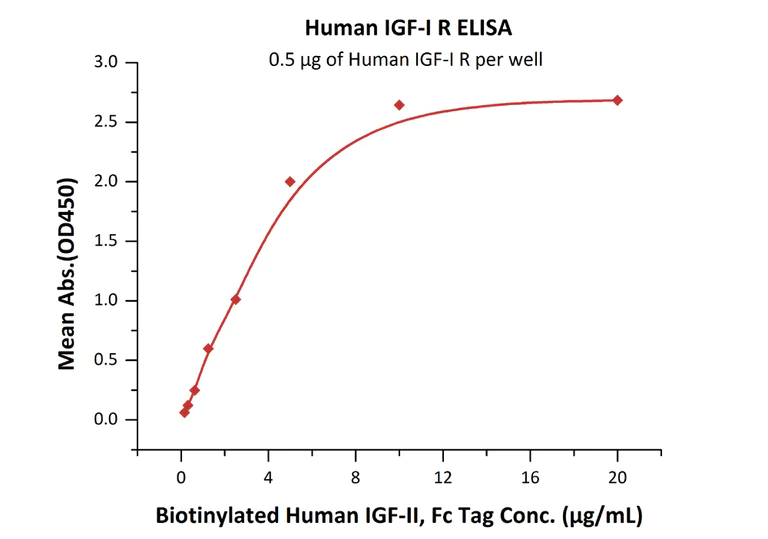
Functional Studies - Recombinant human IGF1 Receptor protein (AB155622)
Immobilized Human IGF-I R at 5 µg/mL (100 µL/well) can bind Biotinylated Human IGF-II, Fc Tag with a linear range of 0.156-5 µg/mL.
- SDS-PAGE
Unknown
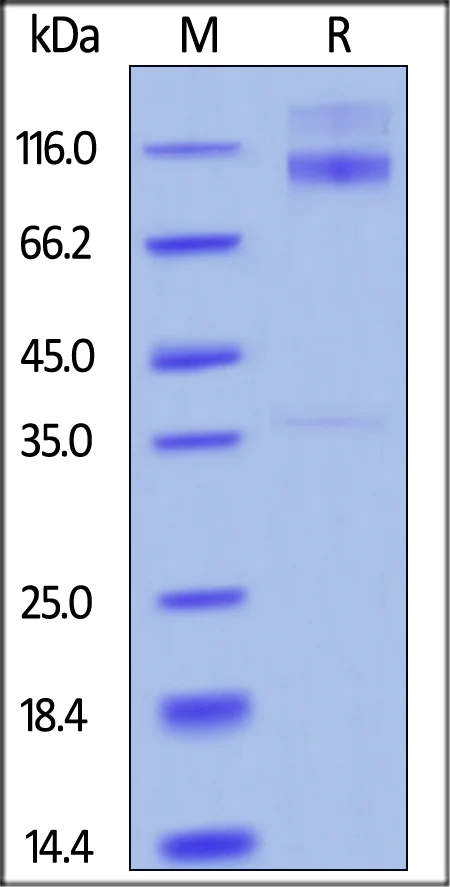
SDS-PAGE - Recombinant human IGF1 Receptor protein (AB155622)
Human IGF-I R on SDS-PAGE under reducing (R) condition. The gel was stained overnight with Coomassie Blue. The purity of the protein is greater than 90%.
- SDS-PAGE
Unknown
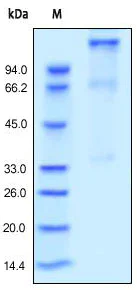
SDS-PAGE - Recombinant human IGF1 Receptor protein (AB155622)
SDS-PAGE analysis of reduced ab155622 stained overnight with Coomassie Blue.
Complementary Products
Reagents, Controls & Accessories
AB116028
Prestained Protein Ladder - Broad molecular weight (10 - 245 kDa)

- 5
- 3
Primary Antibodies
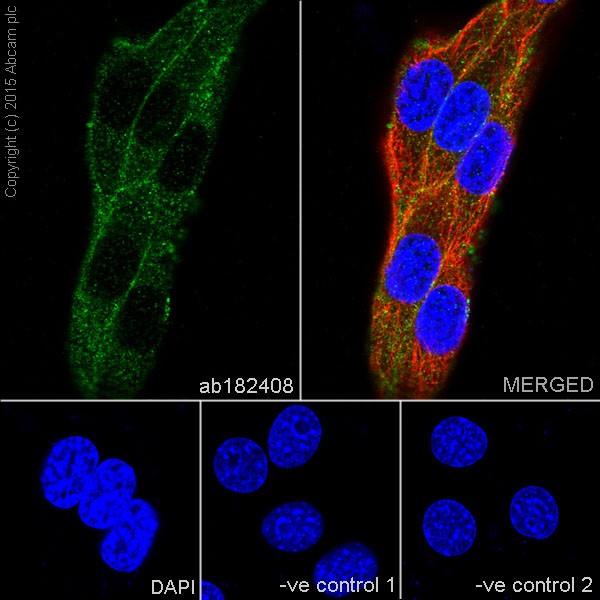
AB182408
Anti-IGF1 Receptor antibody [EPR19322]
RabMAb|Recombinant|KO Validated|20ul selling size
- 4
- 2


Reactivity data
Product details
Sequence info
Properties and storage information
Shipped at conditions
Appropriate short-term storage duration
Appropriate short-term storage conditions
Appropriate long-term storage conditions
Aliquoting information
Storage information
Supplementary information
This supplementary information is collated from multiple sources and compiled automatically.
Biological function summary
IGF1R contributes to several cellular processes including cell proliferation differentiation and survival. This receptor forms a complex upon ligand binding and undergoes autophosphorylation to activate intracellular signaling cascades. IGF1R activation recruits and phosphorylates insulin receptor substrates enabling the downstream signaling pathways that promote cell growth and survival. Its function in cellular responses makes it a focal point in understanding cell biology.
Pathways
IGF1R holds a central position in the PI3K/AKT and MAPK signaling cascades. These pathways play significant roles in cellular growth proliferation and survival. IGF1R phosphorylates various downstream effectors such as IRS-1 and Shc linking it to the activation of AKT and ERK respectively. Therefore it shares pathways with related proteins like the insulin receptor highlighting its importance in mediating similar biological responses.
Specifications
Form
Lyophilized
General info
Function
Receptor tyrosine kinase which mediates actions of insulin-like growth factor 1 (IGF1). Binds IGF1 with high affinity and IGF2 and insulin (INS) with a lower affinity. The activated IGF1R is involved in cell growth and survival control. IGF1R is crucial for tumor transformation and survival of malignant cell. Ligand binding activates the receptor kinase, leading to receptor autophosphorylation, and tyrosines phosphorylation of multiple substrates, that function as signaling adapter proteins including, the insulin-receptor substrates (IRS1/2), Shc and 14-3-3 proteins. Phosphorylation of IRSs proteins lead to the activation of two main signaling pathways : the PI3K-AKT/PKB pathway and the Ras-MAPK pathway. The result of activating the MAPK pathway is increased cellular proliferation, whereas activating the PI3K pathway inhibits apoptosis and stimulates protein synthesis. Phosphorylated IRS1 can activate the 85 kDa regulatory subunit of PI3K (PIK3R1), leading to activation of several downstream substrates, including protein AKT/PKB. AKT phosphorylation, in turn, enhances protein synthesis through mTOR activation and triggers the antiapoptotic effects of IGFIR through phosphorylation and inactivation of BAD. In parallel to PI3K-driven signaling, recruitment of Grb2/SOS by phosphorylated IRS1 or Shc leads to recruitment of Ras and activation of the ras-MAPK pathway. In addition to these two main signaling pathways IGF1R signals also through the Janus kinase/signal transducer and activator of transcription pathway (JAK/STAT). Phosphorylation of JAK proteins can lead to phosphorylation/activation of signal transducers and activators of transcription (STAT) proteins. In particular activation of STAT3, may be essential for the transforming activity of IGF1R. The JAK/STAT pathway activates gene transcription and may be responsible for the transforming activity. JNK kinases can also be activated by the IGF1R. IGF1 exerts inhibiting activities on JNK activation via phosphorylation and inhibition of MAP3K5/ASK1, which is able to directly associate with the IGF1R.. When present in a hybrid receptor with INSR, binds IGF1. PubMed : 12138094 shows that hybrid receptors composed of IGF1R and INSR isoform Long are activated with a high affinity by IGF1, with low affinity by IGF2 and not significantly activated by insulin, and that hybrid receptors composed of IGF1R and INSR isoform Short are activated by IGF1, IGF2 and insulin. In contrast, PubMed : 16831875 shows that hybrid receptors composed of IGF1R and INSR isoform Long and hybrid receptors composed of IGF1R and INSR isoform Short have similar binding characteristics, both bind IGF1 and have a low affinity for insulin.
Sequence similarities
Belongs to the protein kinase superfamily. Tyr protein kinase family. Insulin receptor subfamily.
Post-translational modifications
Autophosphorylated on tyrosine residues in response to ligand binding. Autophosphorylation occurs in trans, i.e. one subunit of the dimeric receptor phosphorylates tyrosine residues on the other subunit. Autophosphorylation occurs in a sequential manner; Tyr-1165 is predominantly phosphorylated first, followed by phosphorylation of Tyr-1161 and Tyr-1166. While every single phosphorylation increases kinase activity, all three tyrosine residues in the kinase activation loop (Tyr-1165, Tyr-1161 and Tyr-1166) have to be phosphorylated for optimal activity. Can be autophosphorylated at additional tyrosine residues (in vitro). Autophosphorylated is followed by phosphorylation of juxtamembrane tyrosines and C-terminal serines. Phosphorylation of Tyr-980 is required for IRS1- and SHC1-binding. Phosphorylation of Ser-1278 by GSK-3beta restrains kinase activity and promotes cell surface expression, it requires a priming phosphorylation at Ser-1282. Dephosphorylated by PTPN1 (By similarity).. Polyubiquitinated at Lys-1168 and Lys-1171 through both 'Lys-48' and 'Lys-29' linkages, promoting receptor endocytosis and subsequent degradation by the proteasome. Ubiquitination is facilitated by pre-existing phosphorylation.. Sumoylated with SUMO1.. Controlled by regulated intramembrane proteolysis (RIP). Undergoes metalloprotease-dependent constitutive ectodomain shedding to produce a membrane-anchored 52 kDa C-Terminal fragment which is further processed by presenilin gamma-secretase to yield an intracellular 50 kDa fragment.
Target data
Product promise
Please note: All products are 'FOR RESEARCH USE ONLY. NOT FOR USE IN DIAGNOSTIC OR THERAPEUTIC PROCEDURES'.
For licensing inquiries, please contact partnerships@abcam.com