JavaScript is disabled in your browser. Please enable JavaScript to view this website.
AB259382

Recombinant human IL-7 protein (Active)

Be the first to review this product! Submit a review

|

(0 Publication)
Recombinant human IL-7 protein (Active) is a Human Full Length protein, in the 26 to 177 aa range, expressed in HEK 293 cells, with >95%, <0.05 EU/µg endotoxin level, suitable for SDS-PAGE, FuncS, Mass Spec, Cell Culture, HPLC.
4 Images
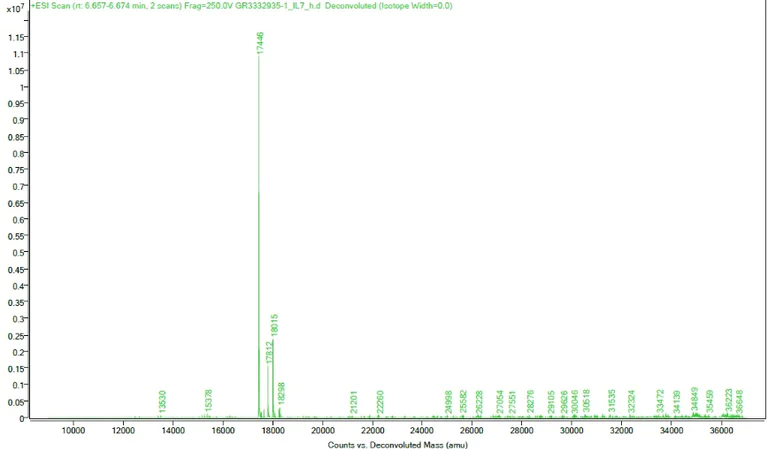
Mass Spectrometry - Recombinant human IL-7 protein (Active) (AB259382)
  • Mass Spec

Supplier Data

Mass Spectrometry - Recombinant human IL-7 protein (Active) (AB259382)

M+1.38 Da (+365 Da : Hex(1)HexNAc(1); +203 Da : HexNAc : +283 Da : s/pGlcNac) (Calc. mass 17444.62 Da).

The spectrum was recorded with a 6545XT AdvanceBio LC/Q-TOF (Agilent Technologies) and a MabPac RP column (42.1x50 mm, 4 μm, Thermo Scientific). 5 μL of purified protein was injected and the gradient run from 85 % water : FA (99.9 : 0.1 v/v) and 15 % acetonitrile : FA (90 : 9.9 : 0.1 v/v/v) to 55 % water : FA (99.9 : 0.1 v/v) and 45 % acetonitrile : FA (90 : 9.9 : 0.1 v/v/v) within 3 minutes followed by an isocratic step for another 2.5 min. Flow rate was 0.4 mL/min and the column compartment temperature was 60 °C. Data was analysed and deconvoluted using the Bioconfirm software (Agilent Technologies).
Functional Studies - Recombinant human IL-7 protein (Active) (AB259382)
  • FuncS

Supplier Data

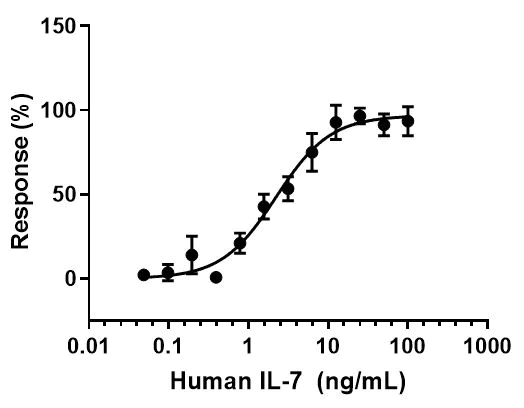
Functional Studies - Recombinant human IL-7 protein (Active) (AB259382)

Fully biologically active determined by the dose dependant proliferation of 2E8 cells.

ED50 is ≤ 2 ng/mL, corresponding to a specific activity of 4.55 x 10⁵ units/mg.
SDS-PAGE - Recombinant human IL-7 protein (Active) (AB259382)
  • SDS-PAGE

Supplier Data

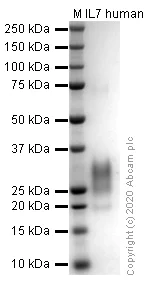
SDS-PAGE - Recombinant human IL-7 protein (Active) (AB259382)

SDS-PAGE analysis of ab259382.
HPLC - Recombinant human IL-7 protein (Active) (AB259382)
  • HPLC

Supplier Data

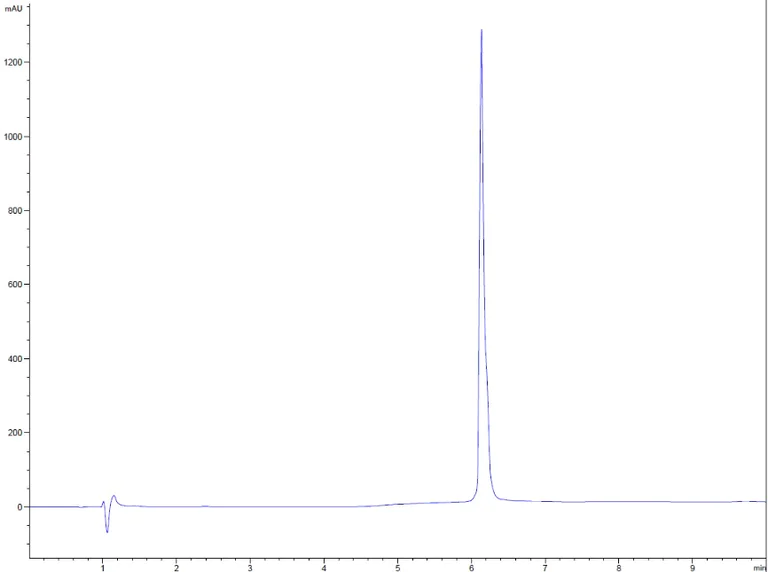
HPLC - Recombinant human IL-7 protein (Active) (AB259382)

Purity = 98.5%.

The spectrum was recorded using a 1260 Infinity II HPLC system with DAD and a MabPac RP column (3.0x100 mm, 4 μm). 5 μL of purified protein was injected and the gradient run from 80 % water : TFA (99.9 : 0.1 v/v) and 20 % acetonitrile : water : TFA (90 : 9.9 : 0.1 v/v/v) to 20 % water : TFA (99.9 : 0.1 v/v) and 80 % acetonitrile : water : TFA (90 : 9.9 : 0.1 v/v/v) within 3 minutes followed by an isocratic step for another 3 min. Flow rate was 0.5 mL/min and the column compartment temperature was 50 °C.

Key facts

Purity

>95% SDS-PAGE

Purity by HPLC >=95%.

Endotoxin level

<0.05 EU/µg

Expression system

HEK 293 cells

Tags

Tag free

Applications

HPLC, Mass Spec, Cell Culture, FuncS, SDS-PAGE

applications

Biologically active

Yes

Biological activity

Fully biologically active determined by the dose dependant proliferation of 2E8 cells. <p>ED<sub>50</sub> is &le; 2 ng/mL, corresponding to a specific activity of 4.55 x 10<sup>5</sup> units/mg.</p>

Accession

P13232-1

Animal free

Yes

Carrier free

No

Species

Human

Reconstitution

Reconstitute in PBS

Storage buffer

pH: 6 - 8 Constituents: 10.26% Trehalose, 0.727% Dibasic monohydrogen potassium phosphate, 0.248% Potassium phosphate monobasic

storage-buffer

Reactivity data

{ "title": "Reactivity Data", "filters": { "stats": ["", "Reactivity", "Dilution Info", "Notes"] }, "values": { "SDS-PAGE": { "reactivity":"TESTED_AND_REACTS", "dilution-info":"", "notes":"<p></p>" }, "FuncS": { "reactivity":"TESTED_AND_REACTS", "dilution-info":"", "notes":"<p></p>" }, "Mass Spec": { "reactivity":"TESTED_AND_REACTS", "dilution-info":"", "notes":"<p></p>" }, "Cell Culture": { "reactivity":"TESTED_AND_REACTS", "dilution-info":"", "notes":"<p></p>" }, "HPLC": { "reactivity":"TESTED_AND_REACTS", "dilution-info":"", "notes":"<p></p>" } } }

Product details

This protein is filter sterilised prior to aliquoting and lyophilisation. All aliquoting and lyophilisation steps are performed in a sterile environment

Sequence info

[{"linker":null,"sequence":"DCDIEGKDGKQYESVLMVSIDQLLDSMKEIGSNCLNNEFNFFKRHICDANKEGMFLFRAARKLRQFLKMNSTGDFDLHLLKVSEGTTILLNCTGQVKGRKPAALGEAQPTKSLEENKSLKEQKKLNDLCFLKRLLQEIKTCWNKILMGTKEH","proteinLength":"Full Length","predictedMolecularWeight":"17.45 kDa","actualMolecularWeight":null,"aminoAcidEnd":177,"aminoAcidStart":26,"nature":"Recombinant","expressionSystem":"HEK 293T cells","accessionNumber":"P13232","tags":[]}]

Properties and storage information

Form
Lyophilized
Shipped at conditions
Ambient - Can Ship with Ice
Appropriate short-term storage conditions
Ambient
Appropriate long-term storage conditions
Ambient
True

Supplementary information

This supplementary information is collated from multiple sources and compiled automatically.

Interleukin-7 (IL-7) also known as IL-7 protein or IL-7 is a cytokine with a critical role in immune system development and function. IL-7 has an approximate molecular mass of 25 kDa and it exhibits expression in several tissues including stromal cells in the bone marrow and thymus. It interacts with its specific receptor IL-7R which consists of the IL-7Rα chain and the common gamma chain (γc) shared with other cytokine receptors. These interactions are important for signaling pathways that support lymphoid tissue homeostasis.
Biological function summary

IL-7 significantly influences lymphocyte development and survival. It is essential for the proliferation and maintenance of T cells particularly thymocytes during T cell maturation and peripheral T cells after they exit the thymus. IL-7 does not form a complex itself but works as a critical single molecule in these processes. IL-7's role is especially noted in the maintenance of naïve and memory T cells important for adaptive immunity.

Pathways

IL-7 activity impacts important immune signaling routes. The cytokine is an important player in the JAK/STAT signaling pathway which gets activated upon IL-7R engagement. This pathway is fundamental in controlling T cell development proliferation and survival. IL-7's interaction with other proteins such as the IL-7R complex and their downstream signaling partners integrates it into networks critical for strengthening the immune response.

IL-7 is significantly linked to immunodeficiencies and cancers affecting immune cells. For instance IL-7's altered signaling is associated with severe combined immunodeficiencies (SCID) where the lack of functional IL-7 or its receptor compromises T cell development. Additionally overexpression of IL-7 has connections to certain leukemias and lymphomas where it may contribute to inappropriate lymphocyte proliferation. In these contexts IL-7 often gets investigated alongside proteins such as the JAK and STAT family involved in tumorigenesis and immune dysregulation.

Product protocols

Target data

Hematopoietic cytokine that plays an essential role in the development, expansion, and survival of naive and memory T-cells and B-cells thereby regulating the number of mature lymphocytes and maintaining lymphoid homeostasis (PubMed : 25870237, PubMed : 7527823). Mechanistically, exerts its biological effects through a receptor composed of IL7RA subunit and the cytokine receptor common subunit gamma/CSF2RG (PubMed : 8128231). Binding to the receptor leads to activation of various kinases including JAK1 or JAK3 depending on the cell type and subsequently propagation of signals through activation of several downstream signaling pathways including the PI3K/Akt/mTOR or the JAK-STAT5 (PubMed : 18523275, PubMed : 20974963).
See full target information IL7

Alternative Names

Interleukin-7, IL-7, IL7

Product promise

We are committed to supporting your work with high-quality reagents, and we're here for you every step of the way. In the unlikely event that one of our products does not perform as expected, you're protected by our Product Promise.
For full details, please see our Terms & Conditions

Please note: All products are 'FOR RESEARCH USE ONLY. NOT FOR USE IN DIAGNOSTIC OR THERAPEUTIC PROCEDURES'.

For licensing inquiries, please contact partnerships@abcam.com