JavaScript is disabled in your browser. Please enable JavaScript to view this website.
AB151846

Recombinant Human ILT-4/CD85d protein

Be the first to review this product! Submit a review

|

(0 Publication)

Recombinant Human ILT-4/CD85d protein is a Human Fragment protein, in the 22 to 458 aa range, expressed in HEK 293 cells, with >95%, < 1 EU/µg endotoxin level, suitable for SDS-PAGE, HPLC.

Key facts

Purity

>95% SDS-PAGE

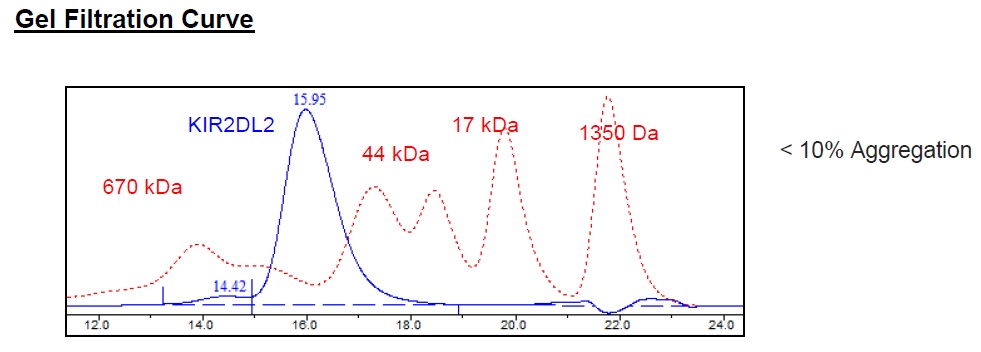
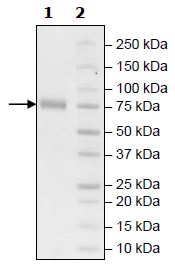
Greater than 95% as determined by SEC-HPLC and reducing SDS-PAGE.

Endotoxin level

< 1 EU/µg

Expression system

HEK 293 cells

Tags

Tag free

Applications

HPLC, SDS-PAGE

applications

Biologically active

No

Accession

Q8N423-1

Animal free

No

Carrier free

No

Species

Human

Reconstitution

Reconstitute in water

Storage buffer

pH: 7.2 Constituents: 99% Phosphate Buffer, 0.88% Sodium chloride

storage-buffer

Reactivity data

{ "title": "Reactivity Data", "filters": { "stats": ["", "Reactivity", "Dilution Info", "Notes"] }, "values": { "SDS-PAGE": { "reactivity":"TESTED_AND_REACTS", "dilution-info":"", "notes":"<p></p>" }, "HPLC": { "reactivity":"TESTED_AND_REACTS", "dilution-info":"", "notes":"<p></p>" } } }

Sequence info

[{"linker":null,"sequence":"QTGTIPKPTLWAEPDSVITQGSPVTLSCQGSLEAQEYRLYREKKSASWITRIRPELVKNGQFHIPSITWEHTGRYGCQYYSRARWSELSDPLVLVMTGAYPKPTLSAQPSPVVTSGGRVTLQCESQVAFGGFILCKEGEDEHPQCLNSQPHARGSSRAIFSVGPVSPNRRWSHRCYGYDLNSPYVWSSPSDLLELLVPGVSKKPSLSVQPGPVVAPGESLTLQCVSDVGYDRFVLYKEGERDLRQLPGRQPQAGLSQANFTLGPVSRSYGGQYRCYGAYNLSSEWSAPSDPLDILITGQIHGTPFISVQPGPTVASGENVTLLCQSWRQFHTFLLTKAGAADAPLRLRSIHEYPKYQAEFPMSPVTSAHAGTYRCYGSLNSDPYLLSHPSEPLELVVSGPSMGSSPPPTGPISTPAGPEDQPLTPTGSDPQSGLGRHVDHHHHHH","proteinLength":"Fragment","predictedMolecularWeight":"48.6 kDa","actualMolecularWeight":null,"aminoAcidEnd":458,"aminoAcidStart":22,"nature":"Recombinant","expressionSystem":"HEK 293 cells","accessionNumber":"Q8N423","tags":[{"tag":"His","terminus":"C-Terminus"}]}]

Properties and storage information

Form
Lyophilized
Shipped at conditions
Blue Ice
Appropriate short-term storage conditions
-80°C
Appropriate long-term storage conditions
-80°C
False

Supplementary information

This supplementary information is collated from multiple sources and compiled automatically.

ILT-4 also known as Immunoglobulin-like transcript 4 is a transmembrane protein with a molecular weight of approximately 45 kDa. The protein is part of the LILR family and is sometimes referred to as LILRB2 protein. ILT-4 is mainly expressed on myeloid lineage cells including monocytes and dendritic cells. The expression of ILT-4 is important for the modulation of the immune response. Biotinylated ILT-4 and biotinylated LILRB2 versions are used frequently in research to study their interactions and functions.
Biological function summary

ILT-4 plays an important role in the regulation of immune tolerance and inhibition. It is not part of a complex but interacts with other immune regulatory proteins. By binding to MHC class I molecules ILT-4 inhibits the activation of immune responses preventing over-activation and autoimmunity. The ILT-4 protein is critical for helping myeloid cells to maintain a balanced immune response often restricting unnecessary inflammation and promoting tolerance.

Pathways

ILT-4 influences immune signaling pathways such as those that control T cell receptor signaling. ILT-4 interactions with proteins like CD85d and other LILRA6 proteins showcase its involvement in negative regulatory signaling pathways. These pathways are essential for maintaining immune homeostasis and limiting immune-mediated damage during infections or tissue injury.

ILT-4 is implicated in cancer and autoimmune diseases such as multiple sclerosis. In cancers ILT-4 modulates the immune environment allowing tumors to evade immune surveillance. In the context of autoimmune disorders aberrant ILT-4 expression or function can lead to insufficient immune regulation contributing to disease progression. CD85d and LILRB2 proteins are also associated with these conditions further influencing ILT-4's role in disease mechanisms.

Product protocols

Target data

Receptor for class I MHC antigens. Recognizes a broad spectrum of HLA-A, HLA-B, HLA-C, HLA-G and HLA-F alleles (PubMed : 11169396, PubMed : 12853576, PubMed : 16455647, PubMed : 20448110, PubMed : 27859042). Involved in the down-regulation of the immune response and the development of tolerance. Recognizes HLA-G in complex with B2M/beta-2 microglobulin and a nonamer self-peptide (peptide-bound HLA-G-B2M) triggering differentiation of type 1 regulatory T cells and myeloid-derived suppressor cells, both of which actively maintain maternal-fetal tolerance (PubMed : 16455647, PubMed : 20448110, PubMed : 27859042). Competes with CD8A for binding to class I MHC antigens. Inhibits FCGR1A-mediated phosphorylation of cellular proteins and mobilization of intracellular calcium ions (PubMed : 11875462, PubMed : 12853576, PubMed : 9548455, PubMed : 9842885).
See full target information ILT-4/CD85d

Alternative Names

CD85d, ILT4, LIR2, MIR10, LILRB2, Leukocyte immunoglobulin-like receptor subfamily B member 2, LIR-2, Leukocyte immunoglobulin-like receptor 2, CD85 antigen-like family member D, Immunoglobulin-like transcript 4, Monocyte/macrophage immunoglobulin-like receptor 10, ILT-4, MIR-10

Product promise

We are committed to supporting your work with high-quality reagents, and we're here for you every step of the way. In the unlikely event that one of our products does not perform as expected, you're protected by our Product Promise.
For full details, please see our Terms & Conditions

Please note: All products are 'FOR RESEARCH USE ONLY. NOT FOR USE IN DIAGNOSTIC OR THERAPEUTIC PROCEDURES'.

For licensing inquiries, please contact partnerships@abcam.com