JavaScript is disabled in your browser. Please enable JavaScript to view this website.
AB268719

Recombinant Human KSR1 protein (GST tag N-Terminus)

Be the first to review this product! Submit a review

|

(0 Publication)
Recombinant Human KSR1 protein (GST tag N-Terminus) is a Human Fragment protein, in the 335 to 923 aa range, expressed in Baculovirus infected Sf9 cells, with >70%, suitable for SDS-PAGE.
1 Images
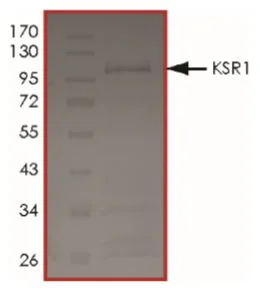
SDS-PAGE - Recombinant Human KSR1 protein (GST tag N-Terminus) (AB268719)
  • SDS-PAGE

Supplier Data

SDS-PAGE - Recombinant Human KSR1 protein (GST tag N-Terminus) (AB268719)

SDS-PAGE analysis of ab268719.

Key facts

Purity

>70% SDS-PAGE

Affinity purified.

Expression system

Baculovirus infected Sf9 cells

Tags

GST tag N-Terminus

Applications

SDS-PAGE

applications

Biologically active

No

Accession

Q8IVT5-1

Animal free

No

Carrier free

No

Species

Human

Storage buffer

pH: 7.5 Constituents: 25% Glycerol (glycerin, glycerine), 0.87% Sodium chloride, 0.79% Tris HCl, 0.31% Glutathione, 0.004% (R*,R*)-1,4-Dimercaptobutan-2,3-diol, 0.003% EDTA, 0.002% PMSF

storage-buffer

Reactivity data

{ "title": "Reactivity Data", "filters": { "stats": ["", "Reactivity", "Dilution Info", "Notes"] }, "values": { "SDS-PAGE": { "reactivity":"TESTED_AND_REACTS", "dilution-info":"", "notes":"<p></p>" } } }

Sequence info

[{"linker":null,"sequence":"PQMVRRDIGLSVTHRFSTKSWLSQVCHVCQKSMIFGVKCKHCRLKCHNKCTKEAPACRISFLPLTRLRRTESVPSDINNPVDRAAEPHFGTLPKALTKKEHPPAMNHLDSSSNPSSTTSSTPSSPAPFPTSSNPSSATTPPNPSPGQRDSRFNFPAAYFIHHRQQFIFPVPSAGHCWKCLLIAESLKENAFNISAFAHAAPLPEAADGTRLDDQPKADVLEAHEAEAEEPEAGKSEAEDDEDEVDDLPSSRRPWRGPISRKASQTSVYLQEWDIPFEQVELGEPIGQGRWGRVHRGRWHGEVAIRLLEMDGHNQDHLKLFKKEVMNYRQTRHENVVLFMGACMNPPHLAIITSFCKGRTLHSFVRDPKTSLDINKTRQIAQEIIKGMGYLHAKGIVHKDLKSKNVFYDNGKVVITDFGLFGISGVVREGRRENQLKLSHDWLCYLAPEIVREMTPGKDEDQLPFSKAADVYAFGTVWYELQARDWPLKNQAAEASIWQIGSGEGMKRVLTSVSLGKEVSEILSACWAFDLQERPSFSLLMDMLEKLPKLNRRLSHPGHFWKSADINSSKVVPRFERFGLGVLESSNPKM","proteinLength":"Fragment","predictedMolecularWeight":null,"actualMolecularWeight":null,"aminoAcidEnd":923,"aminoAcidStart":335,"nature":"Recombinant","expressionSystem":"Baculovirus infected Sf9 cells","accessionNumber":"Q8IVT5","tags":[{"tag":"GST","terminus":"N-Terminus"}]}]

Properties and storage information

Form
Liquid
Purification technique
Affinity purification
Shipped at conditions
Dry Ice
Appropriate short-term storage conditions
-80°C
Appropriate long-term storage conditions
-80°C
Aliquoting information
Upon delivery aliquot
Storage information
Avoid freeze / thaw cycle
False

Supplementary information

This supplementary information is collated from multiple sources and compiled automatically.

KSR1 also known as Kinase Suppressor of Ras 1 serves as an important scaffold protein in cellular signaling. Weighing around 87 kDa KSR1 localizes in both the cytoplasm and the membrane of cells and shows expression in various tissues including the brain lung and ovaries. KSR1 does not have kinase activity itself but influences the activity of other kinases through its interactions.
Biological function summary

KSR1 exerts a regulatory role by organizing multi-protein complexes necessary for effective Ras and Raf signaling. This protein helps assemble the mitogen-activated protein kinase (MAPK) cascade complex which plays an essential role in cell growth and differentiation. As an important scaffolding component KSR1 enhances the efficiency of signal transduction pathways by facilitating the spatial organization of kinases involved in MAPK/ERK signaling.

Pathways

Signaling through KSR1 significantly impacts the MAPK/ERK and Ras pathways both of which are important for transmitting extracellular signals to the nucleus. KSR1 interacts with c-Raf MEK1/2 and ERK1/2 within these pathways forming a bridge that allows effective transduction of signals necessary for various cellular responses. By providing a platform for these kinases KSR1 ensures precise regulation of the signaling processes that control cell proliferation and survival.

Dysfunction in KSR1 activity associates with cancer and neurodegenerative disorders. KSR1 aberrations can contribute to oncogenic Ras-driven cancers due to its central role in controlling the Ras signaling pathway. Furthermore irregular KSR1 expression also links to neurodegenerative diseases through its impact on MAPK/ERK signaling. Proteins such as c-Raf and ERK1/2 which interact with KSR1 also play roles in these pathologies emphasizing the potential of KSR1 as a target for therapeutic interventions.

Product protocols

Target data

Part of a multiprotein signaling complex which promotes phosphorylation of Raf family members and activation of downstream MAP kinases (By similarity). Independently of its kinase activity, acts as MAP2K1/MEK1 and MAP2K2/MEK2-dependent allosteric activator of BRAF; upon binding to MAP2K1/MEK1 or MAP2K2/MEK2, dimerizes with BRAF and promotes BRAF-mediated phosphorylation of MAP2K1/MEK1 and/or MAP2K2/MEK2 (PubMed : 29433126). Promotes activation of MAPK1 and/or MAPK3, both in response to EGF and to cAMP (By similarity). Its kinase activity is unsure (By similarity). Some protein kinase activity has been detected in vitro, however the physiological relevance of this activity is unknown (By similarity).
See full target information KSR1

Alternative Names

KSR, KSR1, Kinase suppressor of Ras 1

Product promise

We are committed to supporting your work with high-quality reagents, and we're here for you every step of the way. In the unlikely event that one of our products does not perform as expected, you're protected by our Product Promise.
For full details, please see our Terms & Conditions

Please note: All products are 'FOR RESEARCH USE ONLY. NOT FOR USE IN DIAGNOSTIC OR THERAPEUTIC PROCEDURES'.

For licensing inquiries, please contact partnerships@abcam.com