JavaScript is disabled in your browser. Please enable JavaScript to view this website.
AB276715

Recombinant Human NCAM2 protein (His tag)

Be the first to review this product! Submit a review

|

(0 Publication)

Recombinant Human NCAM2 protein (His tag) is a Human Fragment protein, in the 1 to 697 aa range, expressed in HEK 293 cells, with >95%, < 1 EU/µg endotoxin level, suitable for SDS-PAGE.

View Alternative Names

NCAM21, NCAM2, Neural cell adhesion molecule 2, N-CAM-2, NCAM-2
1 Images
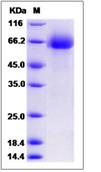
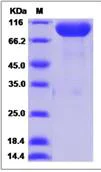
SDS-PAGE - Recombinant Human NCAM2 protein (His tag) (AB276715)
  • SDS-PAGE

Supplier Data

SDS-PAGE - Recombinant Human NCAM2 protein (His tag) (AB276715)

SDS-PAGE analysis of ab276715

Key facts

Purity

>95% SDS-PAGE

Endotoxin level

< 1 EU/µg

Expression system

HEK 293 cells

Tags

His tag C-Terminus

Applications

SDS-PAGE

applications

Biologically active

No

Accession

Animal free

No

Carrier free

No

Species

Human

Storage buffer

pH: 7.4 Constituents: PBS

storage-buffer

Reactivity data

{ "title": "Reactivity Data", "filters": { "stats": ["", "Reactivity", "Dilution Info", "Notes"] }, "values": { "SDS-PAGE": { "reactivity":"TESTED_AND_REACTS", "dilution-info":"", "notes":"<p></p>" } } }

Sequence info

[{"linker":null,"sequence":"MSLLLSFYLLGLLVSSGQALLQVTISLSKVELSVGESKFFTCTAIGEPESIDWYNPQGEKIISTQRVVVQKEGVRSRLTIYNANIEDAGIYRCQATDAKGQTQEATVVLEIYQKLTFREVVSPQEFKQGEDAEVVCRVSSSPAPAVSWLYHNEEVTTISDNRFAMLANNNLQILNINKSDEGIYRCEGRVEARGEIDFRDIIVIVNVPPAISMPQKSFNATAERGEEMTFSCRASGSPEPAISWFRNGKLIEENEKYILKGSNTELTVRNIINSDGGPYVCRATNKAGEDEKQAFLQVFVQPHIIQLKNETTYENGQVTLVCDAEGEPIPEITWKRAVDGFTFTEGDKSLDGRIEVKGQHGSSSLHIKDVKLSDSGRYDCEAASRIGGHQKSMYLDIEYAPKFISNQTIYYSWEGNPINISCDVKSNPPASIHWRRDKLVLPAKNTTNLKTYSTGRKMILEIAPTSDNDFGRYNCTATNHIGTRFQEYILALADVPSSPYGVKIIELSQTTAKVSFNKPDSHGGVPIHHYQVDVKEVASEIWKIVRSHGVQTMVVLNNLEPNTTYEIRVAAVNGKGQGDYSKIEIFQTLPVREPSPPSIHGQPSSGKSFKLSITKQDDGGAPILEYIVKYRSKDKEDQWLEKKVQGNKDHIILEHLQWTMGYEVQITAANRLGYSEPTVYEFSMPPKPNIIKDTLFN","proteinLength":"Fragment","predictedMolecularWeight":"77.4 kDa","actualMolecularWeight":null,"aminoAcidEnd":697,"aminoAcidStart":1,"nature":"Recombinant","expressionSystem":"HEK 293 cells","accessionNumber":"O15394","tags":[{"tag":"His","terminus":"C-Terminus"}]}]

Properties and storage information

Form
Lyophilized
Shipped at conditions
Ambient - Can Ship with Ice
Appropriate short-term storage conditions
-20°C
Appropriate long-term storage conditions
-20°C
Aliquoting information
Upon delivery aliquot
Storage information
Avoid freeze / thaw cycle
False

Supplementary information

This supplementary information is collated from multiple sources and compiled automatically.

NCAM2 also called Neural Cell Adhesion Molecule 2 is a protein that facilitates cell–cell adhesion mainly in the nervous system. It belongs to the immunoglobulin superfamily and has a mass of approximately 100 kDa. This protein is present in several tissues with high expression in the brain particularly within the hippocampus and olfactory bulb. It plays an important role in the organization of synapses and neural circuit formation.
Biological function summary

NCAM2 functions as a cell adhesion molecule important for neurite outgrowth and synaptic plasticity. It does not operate alone; instead it participates in complexes with other neural cell adhesion molecules contributing to the assembly and stabilization of synaptic junctions. The protein assists neurons in maintaining their connections and supports brain development and neuroplastic changes.

Pathways

NCAM2 gets involved in both the MAPK and the PI3K-Akt signaling pathways which are essential for cell survival and growth. In these pathways NCAM2 interacts with proteins like FGF receptors and integrins facilitating the activation of downstream signaling cascades. The regulation of these pathways directly influences neuronal growth and differentiation highlighting its importance in the nervous system.

Disruptions in NCAM2 function affect conditions such as autism spectrum disorder and Alzheimer's disease. Its role in synaptic connectivity links it to cognitive and developmental disorders. In Alzheimer's disease NCAM2 connections to amyloid precursor protein processing suggest its involvement in plaque formation. Changes in NCAM2 expression and its interaction with beta-amyloid pathogenesis could contribute to synaptic dysfunction in neurodegenerative diseases.

General info

Function

May play important roles in selective fasciculation and zone-to-zone projection of the primary olfactory axons.

Product protocols

Target data

May play important roles in selective fasciculation and zone-to-zone projection of the primary olfactory axons.
See full target information NCAM2

Product promise

We are committed to supporting your work with high-quality reagents, and we're here for you every step of the way. In the unlikely event that one of our products does not perform as expected, you're protected by our Product Promise.
For full details, please see our Terms & Conditions

Please note: All products are 'FOR RESEARCH USE ONLY. NOT FOR USE IN DIAGNOSTIC OR THERAPEUTIC PROCEDURES'.

For licensing inquiries, please contact partnerships@abcam.com