JavaScript is disabled in your browser. Please enable JavaScript to view this website.
AB307789

Recombinant Human Nectin-4 Protein (His-tag)

Be the first to review this product! Submit a review

|

(0 Publication)
Recombinant Human Nectin-4 Protein (His-tag) is a Human Fragment protein, in the 32 to 349 aa range, expressed in HEK 293 cells, with >95%, <0.005 EU/µg endotoxin level, suitable for HPLC, SDS-PAGE, Mass Spec.
3 Images
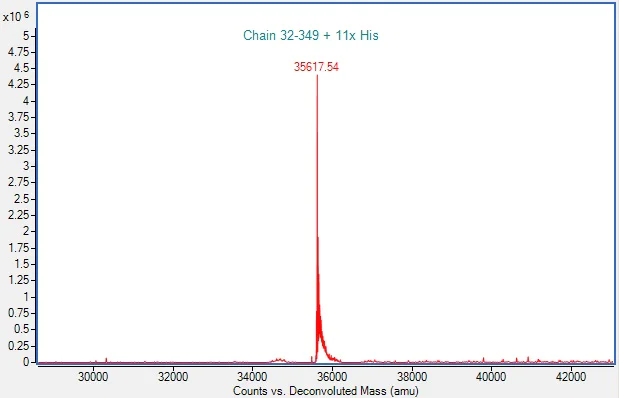
Mass Spectrometry - Recombinant Human Nectin-4 Protein (His-tag) (AB307789)
  • Mass Spec

Supplier Data

Mass Spectrometry - Recombinant Human Nectin-4 Protein (His-tag) (AB307789)

Mass determination by ESI-TOF. Predicted MW is 35615.91 Da (+/- 10 Da by ESI-TOF). Observed MW is 35617.54 Da.
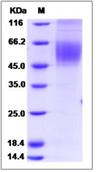
SDS-PAGE - Recombinant Human Nectin-4 Protein (His-tag) (AB307789)
  • SDS-PAGE

Supplier Data

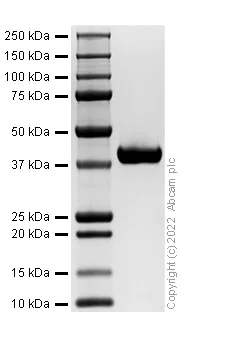
SDS-PAGE - Recombinant Human Nectin-4 Protein (His-tag) (AB307789)

SDS-PAGE analysis of ab307789
HPLC - Recombinant Human Nectin-4 Protein (His-tag) (AB307789)
  • HPLC

Supplier Data

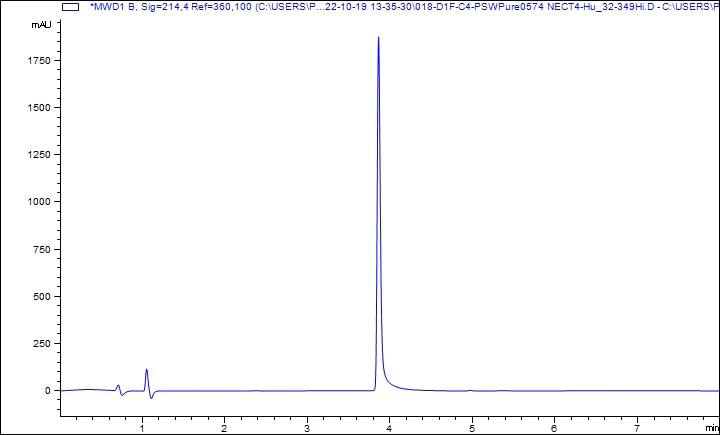
HPLC - Recombinant Human Nectin-4 Protein (His-tag) (AB307789)

HPLC analysis of ab307789

Key facts

Purity

>95% HPLC

SDS-PAGE >= 95%

Endotoxin level

<0.005 EU/µg

Expression system

HEK 293 cells

Tags

His tag C-Terminus

Applications

SDS-PAGE, HPLC, Mass Spec

applications

Biologically active

No

Accession

Q96NY8-1

Animal free

Yes

Carrier free

No

Species

Human

Reconstitution

Reconstitute in PBS

Storage buffer

pH: 7.4 Constituents: 10.26% Trehalose, 0.727% Dibasic monohydrogen potassium phosphate, 0.248% Potassium phosphate monobasic

storage-buffer

Reactivity data

{ "title": "Reactivity Data", "filters": { "stats": ["", "Reactivity", "Dilution Info", "Notes"] }, "values": { "HPLC": { "reactivity":"TESTED_AND_REACTS", "dilution-info":"", "notes":"<p></p>" }, "SDS-PAGE": { "reactivity":"TESTED_AND_REACTS", "dilution-info":"", "notes":"<p></p>" }, "Mass Spec": { "reactivity":"TESTED_AND_REACTS", "dilution-info":"", "notes":"<p></p>" } } }

Sequence info

[{"linker":null,"sequence":"GELETSDVVTVVLGQDAKLPCFYRGDSGEQVGQVAWARVDAGEGAQELALLHSKYGLHVSPAYEGRVEQPPPPRNPLDGSVLLRNAVQADEGEYECRVSTFPAGSFQARLRLRVLVPPLPSLNPGPALEEGQGLTLAASCTAEGSPAPSVTWDTEVKGTTSSRSFKHSRSAAVTSEFHLVPSRSMNGQPLTCVVSHPGLLQDQRITHILHVSFLAEASVRGLEDQNLWHIGREGAMLKCLSEGQPPPSYNWTRLDGPLPSGVRVDGDTLGFPPLTTEHSGIYVCHVSNEFSSRDSQVTVDVLDPQEDSGKQVDLVSAS","proteinLength":"Fragment","predictedMolecularWeight":"35.62 kDa","actualMolecularWeight":"35.62 kDa","aminoAcidEnd":349,"aminoAcidStart":32,"nature":"Recombinant","expressionSystem":"HEK 293 cells","accessionNumber":"Q96NY8","tags":[{"tag":"His","terminus":"C-Terminus"}]}]

Properties and storage information

Form
Lyophilized
Shipped at conditions
Blue Ice
Appropriate short-term storage conditions
Ambient
Appropriate long-term storage conditions
Ambient
False

Supplementary information

This supplementary information is collated from multiple sources and compiled automatically.

Nectin-4 also known as PVRL4 is a member of the immunoglobulin-like adhesion molecule family. It has a molecular weight of approximately 66 kDa. Nectin-4 plays an important role in cell-cell adhesion by forming trans-dimers promoting cellular cohesion. It is expressed in tissues such as placenta embryonic tissues and several epithelial cancers indicating its potential involvement in developmental processes and pathological conditions. When utilizing methods such as 'nectin-4 ELISA' and 'nectin-4 IHC' researchers can study its expression extensively across different tissue samples.
Biological function summary

Nectin-4 functions as an important adhesion molecule that contributes to the maintenance and organization of cell junctions. It is often part of larger adhesive complexes that include afadin which links nectin proteins to the actin cytoskeleton stabilizing cell structure. Besides its role in maintaining cell-cell adhesion nectin-4 is significant in processes like cellular polarization and migration. These properties make it an important target for understanding tissue development and integrity as well as cancer metastasis.

Pathways

Nectin-4 belongs to the pathways regulating cell adhesion and the cytoskeletal organization. It is closely associated with the cadherin and integrin signaling pathways where it collaborates with other nectin family members and afadin to regulate these networks. These interactions impact cellular processes such as signal transduction and intercellular communication critical for tissue maintenance. Studies involving 'nectin expression' help further elucidate these pathway connections and their implications in healthy and diseased tissues.

Nectin-4 shows significant correlation with certain cancers such as breast and lung carcinoma. Its elevated expression in tumor tissues suggests a role in tumorigenesis and cancer progression. The protein's interaction with oncogenes like HER2 indicates a possible pathway by which nectin-4 affects cancer cell proliferation and survival. Understanding 'nectin-4 expression' in the context of these diseases aids in identifying potential biomarkers and therapeutic targets for cancer diagnosis and treatment.

Product protocols

Target data

Seems to be involved in cell adhesion through trans-homophilic and -heterophilic interactions, the latter including specifically interactions with NECTIN1. Does not act as receptor for alpha-herpesvirus entry into cells.. (Microbial infection) Acts as a receptor for measles virus.
See full target information NECTIN4

Alternative Names

LNIR, PRR4, PVRL4, NECTIN4, Nectin-4, Ig superfamily receptor LNIR, Nectin cell adhesion molecule 4, Poliovirus receptor-related protein 4

Product promise

We are committed to supporting your work with high-quality reagents, and we're here for you every step of the way. In the unlikely event that one of our products does not perform as expected, you're protected by our Product Promise.
For full details, please see our Terms & Conditions

Please note: All products are 'FOR RESEARCH USE ONLY. NOT FOR USE IN DIAGNOSTIC OR THERAPEUTIC PROCEDURES'.

For licensing inquiries, please contact partnerships@abcam.com