JavaScript is disabled in your browser. Please enable JavaScript to view this website.
AB322290

Recombinant Human P-cadherin Protein Standard (His tag)

Be the first to review this product! Submit a review

|

(0 Publication)
Recombinant Human P-cadherin Protein Standard (His tag) is a Human Fragment protein, expressed in HEK 293 cells, with >80%, suitable for SDS-PAGE, sELISA.
2 Images
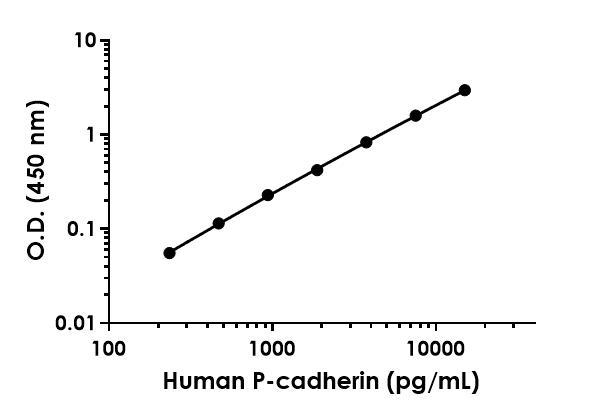
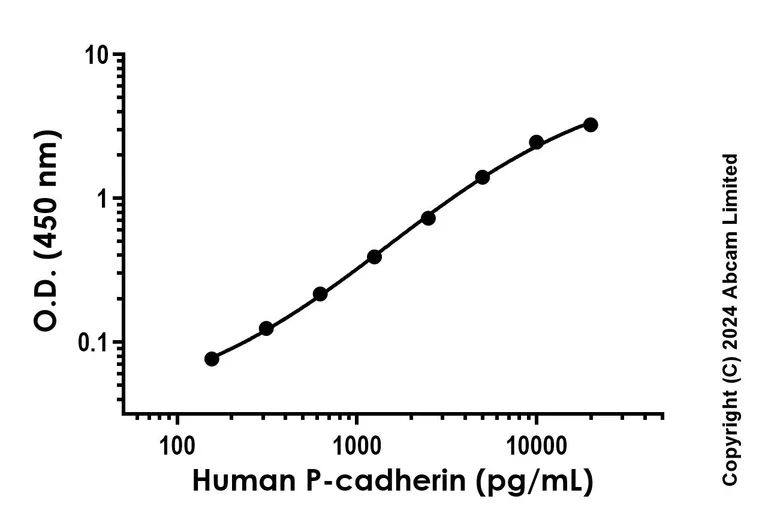
Sandwich ELISA - Recombinant Human P-cadherin Protein Standard (His tag) (AB322290)
  • sELISA

Supplier Data

Sandwich ELISA - Recombinant Human P-cadherin Protein Standard (His tag) (AB322290)

Sandwich ELISA with the capture antibody ab274442 dilution at 2 μg/mL and detector antibody ab274443 dilution at 0.5 μg/mL after biotin conjugation.

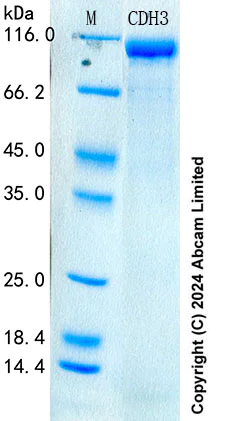
SDS-PAGE - Recombinant Human P-cadherin Protein Standard (His tag) (AB322290)
  • SDS-PAGE

Supplier Data

SDS-PAGE - Recombinant Human P-cadherin Protein Standard (His tag) (AB322290)

SDS-PAGE analysis of ab322290 under reducing conditions for 2ug protein.

Key facts

Purity

>80% SDS-PAGE

Expression system

HEK 293 cells

Tags

His tag C-Terminus

Applications

sELISA, SDS-PAGE

applications

Biologically active

No

Accession

P22223-1

Animal free

Yes

Carrier free

No

Species

Human

Storage buffer

pH: 7.3 - 7.5 Constituents: 2.922% Sodium chloride, 0.64107% disodium;hydrogen phosphate;dodecahydrate, 0.02858% Potassium phosphate monobasic

storage-buffer

Reactivity data

{ "title": "Reactivity Data", "filters": { "stats": ["", "Reactivity", "Dilution Info", "Notes"] }, "values": { "SDS-PAGE": { "reactivity":"TESTED_AND_REACTS", "dilution-info":"", "notes":"<p></p>" }, "sELISA": { "reactivity":"TESTED_AND_REACTS", "dilution-info":"", "notes":"<p></p>" } } }

Product details

While the standard is the same as the one provided in the corresponding SimpleStep ELISA Kit, it cannot be treated as the consumable provided with our SimpleStep ELISA Kit due to differences in its concentration calibration.

Abcam guarantee that this protein standard is suitable for use in a sandwich ELISA. Individual results may vary due to differences in technique, laboratory equipment, buffers, and other experimental factors. The detection range provided for this protein standard is based on initial sandwich ELISA validation data.

The protein concentration is the concentration after validation on our sandwich ELISA platform. This Standard protein is guaranteed to work with our Capture and Detector antibodies in sELISA. Please contact our Scientific Supportteam to know which antibody pair is suitable for this protein.

Sequence info

[{"linker":null,"sequence":null,"proteinLength":"Fragment","predictedMolecularWeight":"84.3 kDa","actualMolecularWeight":null,"aminoAcidEnd":0,"aminoAcidStart":0,"nature":"Recombinant","expressionSystem":"HEK 293 cells","accessionNumber":"P22223","tags":[{"tag":"His","terminus":"C-Terminus"}]}]

Properties and storage information

Form
Liquid
Purification technique
Affinity purification His Tag
Shipped at conditions
Dry Ice
Appropriate short-term storage conditions
-80°C
Appropriate long-term storage conditions
-80°C
Aliquoting information
Upon delivery aliquot
Storage information
Avoid freeze / thaw cycle
False

Supplementary information

This supplementary information is collated from multiple sources and compiled automatically.

P cadherin also known as cadherin-3 or CDH3 is a calcium-dependent cell-cell adhesion glycoprotein. Scientists often refer to it as P-cadherin and it belongs to the cadherin protein family which includes other members like E-cadherin and N-cadherin. The molecular mass of P cadherin is approximately 120 kDa. It is mainly expressed in epithelial tissues including the basal side of scalp and mammary glands acting as an important mediator in maintaining tissue integrity.
Biological function summary

P cadherin plays an important role in facilitating cell adhesion and establishing proper tissue architecture. It often forms part of a larger complex by interacting with catenins including beta-catenin which helps link the cadherin itself to the actin cytoskeleton. Through these interactions P cadherin influences processes such as cell sorting boundary formation and cell polarization essential for embryonic development and tissue homeostasis.

Pathways

Cell adhesion and signal transduction are influenced by P cadherin through its involvement in the Wnt signaling pathway and cadherin-catenin complex. Within the Wnt pathway P cadherin interacts with other key proteins such as beta-catenin which transduces signals leading to gene expression changes. This interaction is important for controlling cellular processes including cell proliferation and differentiation.

P cadherin associates with various cancer types particularly breast and prostate cancers. Altered expression or dysfunction of P cadherin correlates with tumor progression and metastasis. Its interaction with E-cadherin may also contribute to the development and progression of skin disease hypotrichosis with juvenile macular dystrophy. Understanding the role of P cadherin within these contexts offers potential for developing targeted therapies and diagnostic tools.

Product protocols

Target data

Cadherins are calcium-dependent cell adhesion proteins. They preferentially interact with themselves in a homophilic manner in connecting cells; cadherins may thus contribute to the sorting of heterogeneous cell types.
See full target information CDH3

Alternative Names

CDHP, CDH3, Cadherin-3, Placental cadherin, P-cadherin

Product promise

We are committed to supporting your work with high-quality reagents, and we're here for you every step of the way. In the unlikely event that one of our products does not perform as expected, you're protected by our Product Promise.
For full details, please see our Terms & Conditions

Please note: All products are 'FOR RESEARCH USE ONLY. NOT FOR USE IN DIAGNOSTIC OR THERAPEUTIC PROCEDURES'.

For licensing inquiries, please contact partnerships@abcam.com