JavaScript is disabled in your browser. Please enable JavaScript to view this website.
AB316670

Recombinant Human Pancreatic Polypeptide Protein Standard

Be the first to review this product! Submit a review

|

(0 Publication)
Recombinant Human Pancreatic Polypeptide Protein Standard is a Human Full Length protein, expressed in HEK 293 cells, with >80%, suitable for SDS-PAGE, sELISA.
2 Images
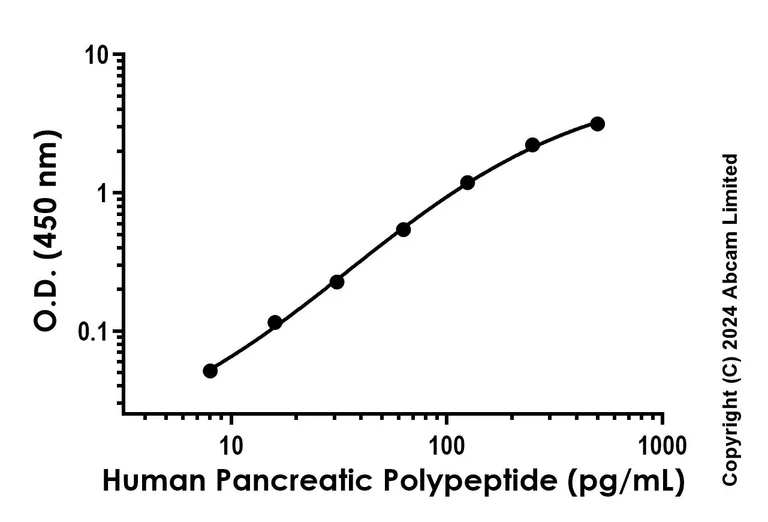
Sandwich ELISA - Recombinant Human Pancreatic Polypeptide Protein Standard (AB316670)
  • sELISA

Lab

Sandwich ELISA - Recombinant Human Pancreatic Polypeptide Protein Standard (AB316670)

Sandwich ELISA with the capture antibody ab281153 dilution at 2 μg/mL and detector antibody ab281003 dilution at 0.5 μg/mL after biotin conjugation.

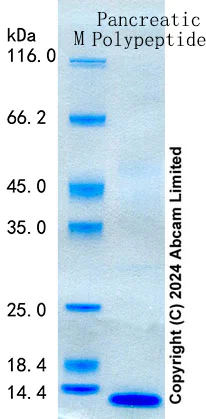
SDS-PAGE - Recombinant Human Pancreatic Polypeptide Protein Standard (AB316670)
  • SDS-PAGE

Supplier Data

SDS-PAGE - Recombinant Human Pancreatic Polypeptide Protein Standard (AB316670)

SDS-PAGE analysis of ab316670 under reducing conditions for 2ug protein.

Key facts

Purity

>80% SDS-PAGE

Expression system

HEK 293 cells

Tags

Tag free

Applications

SDS-PAGE, sELISA

applications

Biologically active

No

Accession

P01298-1

Animal free

Yes

Carrier free

No

Species

Human

Storage buffer

pH: 7.3 - 7.5 Constituents: 2.922% Sodium chloride, 0.64107% disodium;hydrogen phosphate;dodecahydrate, 0.02858% Potassium phosphate monobasic

storage-buffer

Reactivity data

{ "title": "Reactivity Data", "filters": { "stats": ["", "Reactivity", "Dilution Info", "Notes"] }, "values": { "SDS-PAGE": { "reactivity":"TESTED_AND_REACTS", "dilution-info":"", "notes":"<p></p>" }, "sELISA": { "reactivity":"TESTED_AND_REACTS", "dilution-info":"", "notes":"<p></p>" } } }

Product details

While the standard is the same as the one provided in the corresponding SimpleStep ELISA Kit, it cannot be treated as the consumable provided with our SimpleStep ELISA Kit due to differences in its concentration calibration.

Abcam guarantee that this protein standard is suitable for use in a sandwich ELISA. Individual results may vary due to differences in technique, laboratory equipment, buffers, and other experimental factors. The detection range provided for this protein standard is based on initial sandwich ELISA validation data.

The protein concentration is the concentration after validation on our sandwich ELISA platform. This Standard protein is guaranteed to work with our Capture and Detector antibodies in sELISA. Please contact our Scientific Supportteam to know which antibody pair is suitable for this protein.

Sequence info

[{"linker":null,"sequence":null,"proteinLength":"Full Length","predictedMolecularWeight":"7.6 kDa","actualMolecularWeight":null,"aminoAcidEnd":0,"aminoAcidStart":0,"nature":"Recombinant","expressionSystem":"HEK 293 cells","accessionNumber":"P01298","tags":[]}]

Properties and storage information

Form
Liquid
Purification technique
Affinity purification His Tag
Shipped at conditions
Dry Ice
Appropriate short-term storage conditions
-80°C
Appropriate long-term storage conditions
-80°C
Aliquoting information
Upon delivery aliquot
Storage information
Avoid freeze / thaw cycle
False

Supplementary information

This supplementary information is collated from multiple sources and compiled automatically.

Pancreatic Polypeptide also known as PP is a small protein with a molecular mass approximately 4200 Da. It is secreted by PP cells in the pancreas particularly in the F-cells located in the Langerhans islets. This peptide is highly conserved among different species including the rat where it displays similar function and expression patterns. Pancreatic polypeptide regulates various physiological processes by binding to specific receptors on target tissues.
Biological function summary

In various mammalian species including rats pancreatic polypeptide plays a significant role in the regulation of appetite and pancreatic secretion. It is not recognized as part of a multi-protein complex but it directly influences the function of digestive organs by inhibiting pancreatic exocrine secretions and gallbladder contraction. This makes it an important mediator in controlling the body's energy balance and digestive functions.

Pathways

Pancreatic polypeptide is involved in the peptidergic pathway regulating energy homeostasis and digestive processes. It interacts with the Y receptor family particularly the Y4 receptor which contributes to its regulatory actions on appetite and digestive enzyme secretion. This peptide works alongside other polypeptides such as neuropeptide Y and peptide YY in mediating these complex physiological pathways.

Pancreatic polypeptide levels relate to conditions such as obesity and diabetes. Altered secretion of this peptide can contribute to obesity by affecting appetite regulation and energy homeostasis. Furthermore in diabetes pancreatic polypeptide is connected to abnormal pancreatic function often observed alongside insulin and glucagon dysregulation. Understanding these relationships can provide insight into therapeutic strategies targeting metabolic and endocrine disorders.

Product protocols

Target data

Pancreatic polypeptide. Hormone secreted by pancreatic cells that acts as a regulator of pancreatic and gastrointestinal functions probably by signaling through the G protein-coupled receptor NPY4R2.
See full target information PPY

Alternative Names

PNP, PPY, Pancreatic polypeptide prohormone, PH, Pancreatic polypeptide Y

Product promise

We are committed to supporting your work with high-quality reagents, and we're here for you every step of the way. In the unlikely event that one of our products does not perform as expected, you're protected by our Product Promise.
For full details, please see our Terms & Conditions

Please note: All products are 'FOR RESEARCH USE ONLY. NOT FOR USE IN DIAGNOSTIC OR THERAPEUTIC PROCEDURES'.

For licensing inquiries, please contact partnerships@abcam.com