JavaScript is disabled in your browser. Please enable JavaScript to view this website.
AB125647

Recombinant human PDE4C protein (GST tag N-Terminus)

Be the first to review this product! Submit a review

|

(0 Publication)
Recombinant human PDE4C protein (GST tag N-Terminus) is a Human Fragment protein, in the 287 to 712 aa range, expressed in Baculovirus infected Sf9 cells, with >80%, suitable for SDS-PAGE, FuncS.
4 Images
Functional Studies - Recombinant human PDE4C protein (GST tag N-Terminus) (AB125647)
  • FuncS

Unknown

Functional Studies - Recombinant human PDE4C protein (GST tag N-Terminus) (AB125647)

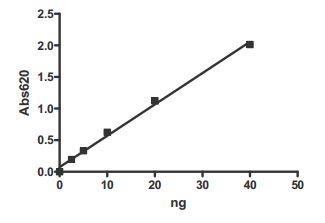
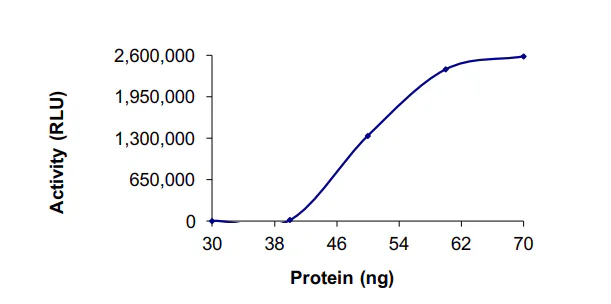
Sample assay showing the specific activity of ab125647 to be 83 nmol/min/mg.
Functional Studies - Recombinant human PDE4C protein (GST tag N-Terminus) (AB125647)
  • FuncS

Unknown

Functional Studies - Recombinant human PDE4C protein (GST tag N-Terminus) (AB125647)

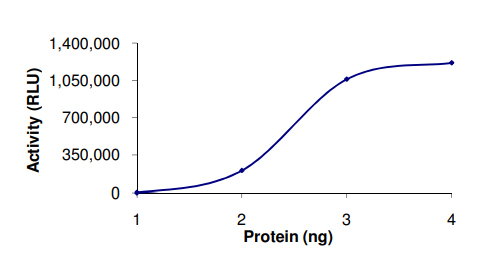
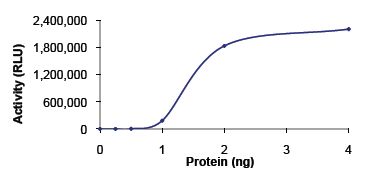
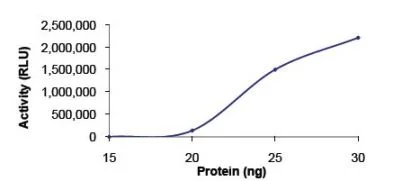
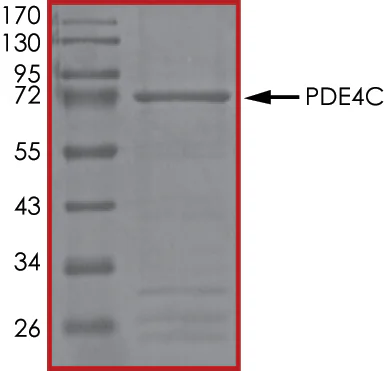
The specific activity of PDE4C (ab125647) was determined to be 71.2 nmol/min/mg as per activity assay protocol
SDS-PAGE - Recombinant human PDE4C protein (GST tag N-Terminus) (AB125647)
  • SDS-PAGE

Unknown

SDS-PAGE - Recombinant human PDE4C protein (GST tag N-Terminus) (AB125647)

SDS PAGE analysis of ab125647
SDS-PAGE - Recombinant human PDE4C protein (GST tag N-Terminus) (AB125647)
  • SDS-PAGE

Unknown

SDS-PAGE - Recombinant human PDE4C protein (GST tag N-Terminus) (AB125647)

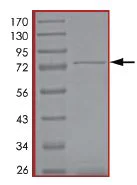
SDS-PAGE analysis of ab125647.

Key facts

Purity

>80% Densitometry

Affinity purified.

Expression system

Baculovirus infected Sf9 cells

Tags

GST tag N-Terminus

Applications

FuncS, SDS-PAGE

applications

Biologically active

Yes

Biological activity

The specific activity of ab125647 was determined to be 83 nmol/min/mg.

Accession

Q08493-1

Animal free

No

Carrier free

No

Species

Human

Storage buffer

pH: 7.5 Constituents: 25% Glycerol (glycerin, glycerine), 0.88% Sodium chloride, 0.79% Tris HCl, 0.005% (R*,R*)-1,4-Dimercaptobutan-2,3-diol, 0.002% PMSF

storage-buffer

Reactivity data

{ "title": "Reactivity Data", "filters": { "stats": ["", "Reactivity", "Dilution Info", "Notes"] }, "values": { "SDS-PAGE": { "reactivity":"TESTED_AND_REACTS", "dilution-info":"", "notes":"<p></p>" }, "FuncS": { "reactivity":"TESTED_AND_REACTS", "dilution-info":"", "notes":"<p></p>" } } }

Sequence info

[{"linker":null,"sequence":"","proteinLength":"Fragment","predictedMolecularWeight":"75 kDa","actualMolecularWeight":null,"aminoAcidEnd":712,"aminoAcidStart":287,"nature":"Recombinant","expressionSystem":null,"accessionNumber":"Q08493","tags":[{"tag":"GST","terminus":"N-Terminus"}]}]

Properties and storage information

Form
Liquid
Purification technique
Affinity purification
Shipped at conditions
Dry Ice
Appropriate short-term storage conditions
-80°C
Appropriate long-term storage conditions
-80°C
Aliquoting information
Upon delivery aliquot
Storage information
Avoid freeze / thaw cycle
True

Supplementary information

This supplementary information is collated from multiple sources and compiled automatically.

PDE4C also known as phosphodiesterase 4C is an enzyme that breaks down cyclic adenosine monophosphate (cAMP) to regulate its cellular levels. This target has a mass of approximately 80 kDa. PDE4C is expressed in various tissues including the brain lung and immune cells. It belongs to the larger group of PDE4 enzymes which share similar functions in hydrolyzing cAMP and are key in controlling cellular responses to extracellular signals.
Biological function summary

PDE4C modulates intracellular cAMP levels to influence various physiological functions. It does not function alone; rather it is a part of a regulatory complex that includes other PDE4 isoforms. This regulation of cAMP is important in processes like immune response mood regulation and cognitive function. The enzyme's role implies its involvement in controlling inflammation by modulating immune cell movement and activation.

Pathways

PDE4C plays significant roles in both the cAMP signaling pathway and the inflammatory response pathway. The cAMP pathway involves several proteins including adenylyl cyclase which synthesizes cAMP and protein kinase A (PKA) which is activated by cAMP. Through these interactions PDE4C influences signal transduction and regulatory mechanisms in cellular responses including those linked to inflammation and neural processes.

PDE4C associates with conditions such as asthma and depression. Its dysregulation can lead to abnormal inflammatory responses or altered neurotransmission. In asthma PDE4C affects airway reactivity and inflammation through interactions with other PDE4 enzymes such as PDE4A. In depression altered cAMP signaling involving PDE4C influences mood regulation and neuroplasticity highlighting its potential impact on psychological states and responses.

Product protocols

Target data

Hydrolyzes the second messenger cAMP, which is a key regulator of many important physiological processes.
See full target information PDE4C

Alternative Names

DPDE1, PDE4C, PDE21, cAMP-specific phosphodiesterase 4C

Product promise

We are committed to supporting your work with high-quality reagents, and we're here for you every step of the way. In the unlikely event that one of our products does not perform as expected, you're protected by our Product Promise.
For full details, please see our Terms & Conditions

Please note: All products are 'FOR RESEARCH USE ONLY. NOT FOR USE IN DIAGNOSTIC OR THERAPEUTIC PROCEDURES'.

For licensing inquiries, please contact partnerships@abcam.com