JavaScript is disabled in your browser. Please enable JavaScript to view this website.
AB125566

Recombinant human RIP3 protein (GST tag N-Terminus)

Be the first to review this product! Submit a review

|

(2 Publications )
Recombinant human RIP3 protein (GST tag N-Terminus) is a Human Full Length protein, in the 1 to 518 aa range, expressed in Baculovirus infected Sf9 cells, with >70%, suitable for SDS-PAGE, WB, FuncS.
4 Images
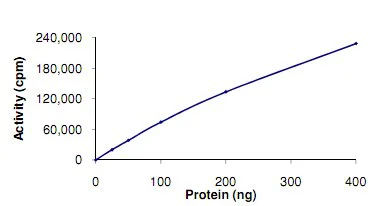
Functional Studies - Recombinant human RIP3 protein (GST tag N-Terminus) (AB125566)
  • FuncS

Unknown

Functional Studies - Recombinant human RIP3 protein (GST tag N-Terminus) (AB125566)

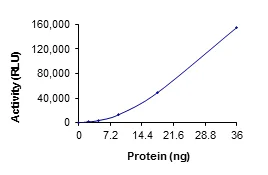
The specific activity of ab125566 was determined to be 38 nmol/min/mg.
Functional Studies - Recombinant human RIP3 protein (GST tag N-Terminus) (AB125566)
  • FuncS

Unknown

Functional Studies - Recombinant human RIP3 protein (GST tag N-Terminus) (AB125566)

The specific activity of RIP3 (ab125566) was determined to be 10.6 nmol/min/mg as per activity assay protocol and was equivalent to 32 nmol/min/mg as per radiometric assay
SDS-PAGE - Recombinant human RIP3 protein (GST tag N-Terminus) (AB125566)
  • SDS-PAGE

Unknown

SDS-PAGE - Recombinant human RIP3 protein (GST tag N-Terminus) (AB125566)

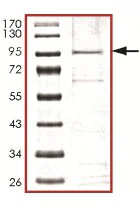
SDS-PAGE analysis of ab125566.
SDS-PAGE - Recombinant human RIP3 protein (GST tag N-Terminus) (AB125566)
  • SDS-PAGE

Unknown

SDS-PAGE - Recombinant human RIP3 protein (GST tag N-Terminus) (AB125566)

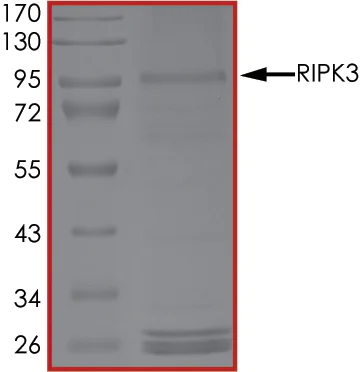
SDS PAGE analysis of ab125566

Key facts

Purity

>70% Densitometry

Purity was determined to be >70% by densitometry.

Expression system

Baculovirus infected Sf9 cells

Tags

GST tag N-Terminus

Applications

WB, FuncS, SDS-PAGE

applications

Biologically active

Yes

Biological activity

The specific activity of ab125566 was determined to be 38nmol/min/mg.

Accession

Q9Y572-1

Animal free

No

Carrier free

No

Species

Human

Storage buffer

pH: 7.5 Constituents: 25% Glycerol (glycerin, glycerine), 0.88% Sodium chloride, 0.79% Tris HCl, 0.31% Glutathione, 0.004% (R*,R*)-1,4-Dimercaptobutan-2,3-diol, 0.003% EDTA, 0.002% PMSF

storage-buffer

Reactivity data

{ "title": "Reactivity Data", "filters": { "stats": ["", "Reactivity", "Dilution Info", "Notes"] }, "values": { "SDS-PAGE": { "reactivity":"TESTED_AND_REACTS", "dilution-info":"", "notes":"<p></p>" }, "WB": { "reactivity":"TESTED_AND_REACTS", "dilution-info":"", "notes":"<p></p>" }, "FuncS": { "reactivity":"TESTED_AND_REACTS", "dilution-info":"", "notes":"<p></p>" } } }

Product details

ab64311 (Myelin Basic Protein protein) can be utilized as a substrate for assessing kinase activity

Sequence info

[{"linker":null,"sequence":"","proteinLength":"Full Length","predictedMolecularWeight":"96 kDa","actualMolecularWeight":null,"aminoAcidEnd":518,"aminoAcidStart":1,"nature":"Recombinant","expressionSystem":null,"accessionNumber":"Q9Y572","tags":[{"tag":"GST","terminus":"N-Terminus"}]}]

Properties and storage information

Form
Liquid
Shipped at conditions
Dry Ice
Appropriate short-term storage conditions
-80°C
Appropriate long-term storage conditions
-80°C
Aliquoting information
Upon delivery aliquot
Storage information
Avoid freeze / thaw cycle
True

Supplementary information

This supplementary information is collated from multiple sources and compiled automatically.

'Receptor-interacting protein kinase 3' (RIP3) also known as RIPK3 is a serine/threonine-protein kinase with a molecular weight of approximately 57 kDa. Mechanically it contains a kinase domain that allows it to phosphorylate specific substrates which is important for mediating its function within the cell. RIP3 is expressed in various tissues with notable presence in the spleen heart and adipose tissue. The protein localizes predominantly in the cytoplasm where it interacts with other cellular proteins to initiate downstream signaling events.
Biological function summary

RIP3 facilitates the execution of necroptosis a form of programmed cell death distinct from apoptosis. It becomes activated upon binding with RIP1 forming a necrosome complex that is essential for this pathway. This complex promotes phosphorylation events that subsequently lead to membrane rupture and cell death. Apart from its role in necroptosis RIP3 also engages in metabolic regulation processes linking energy status and cell death under conditions of stress.

Pathways

RIP3 is a principal component of the necroptotic pathway interacting closely with RIP1 to trigger cell death in conditions where caspase activation is inhibited. Alternatively it integrates into metabolic pathways participating in sensing and responding to changes in cellular energy states. The interplay between RIP3 and RIP1 within these pathways illustrates their shared involvement in maintaining cellular homeostasis and triggering cell death when necessary.

RIP3 has significant implications for conditions involving excessive or dysfunctional cell death such as inflammatory diseases and reperfusion injury. The necroptotic activity of RIP3 can exacerbate inflammation by promoting the release of pro-inflammatory factors upon cell death. Furthermore during ischemia-reperfusion injury increased RIP3 activity in conjunction with MLKL another necroptosis-associated protein contributes to tissue damage highlighting its potential as a therapeutic target for reducing cell death-related tissue damage.

Product protocols

Target data

Serine/threonine-protein kinase that activates necroptosis and apoptosis, two parallel forms of cell death (PubMed : 19524512, PubMed : 19524513, PubMed : 22265413, PubMed : 22265414, PubMed : 22421439, PubMed : 29883609, PubMed : 32657447). Necroptosis, a programmed cell death process in response to death-inducing TNF family members, is triggered by RIPK3 following activation by ZBP1 (PubMed : 19524512, PubMed : 19524513, PubMed : 22265413, PubMed : 22265414, PubMed : 22421439, PubMed : 29883609, PubMed : 32298652). Activated RIPK3 forms a necrosis-inducing complex and mediates phosphorylation of MLKL, promoting MLKL localization to the plasma membrane and execution of programmed necrosis characterized by calcium influx and plasma membrane damage (PubMed : 19524512, PubMed : 19524513, PubMed : 22265413, PubMed : 22265414, PubMed : 22421439, PubMed : 25316792, PubMed : 29883609). In addition to TNF-induced necroptosis, necroptosis can also take place in the nucleus in response to orthomyxoviruses infection : following ZBP1 activation, which senses double-stranded Z-RNA structures, nuclear RIPK3 catalyzes phosphorylation and activation of MLKL, promoting disruption of the nuclear envelope and leakage of cellular DNA into the cytosol (By similarity). Also regulates apoptosis : apoptosis depends on RIPK1, FADD and CASP8, and is independent of MLKL and RIPK3 kinase activity (By similarity). Phosphorylates RIPK1 : RIPK1 and RIPK3 undergo reciprocal auto- and trans-phosphorylation (PubMed : 19524513). In some cell types, also able to restrict viral replication by promoting cell death-independent responses (By similarity). In response to Zika virus infection in neurons, promotes a cell death-independent pathway that restricts viral replication : together with ZBP1, promotes a death-independent transcriptional program that modifies the cellular metabolism via up-regulation expression of the enzyme ACOD1/IRG1 and production of the metabolite itaconate (By similarity). Itaconate inhibits the activity of succinate dehydrogenase, generating a metabolic state in neurons that suppresses replication of viral genomes (By similarity). RIPK3 binds to and enhances the activity of three metabolic enzymes : GLUL, GLUD1, and PYGL (PubMed : 19498109). These metabolic enzymes may eventually stimulate the tricarboxylic acid cycle and oxidative phosphorylation, which could result in enhanced ROS production (PubMed : 19498109).. (Microbial infection) In case of herpes simplex virus 1/HHV-1 infection, forms heteromeric amyloid structures with HHV-1 protein RIR1/ICP6 which may inhibit RIPK3-mediated necroptosis, thereby preventing host cell death pathway and allowing viral evasion.
See full target information RIPK3

Alternative Names

RIP3, RIPK3, Receptor-interacting serine/threonine-protein kinase 3, RIP-like protein kinase 3, Receptor-interacting protein 3, RIP-3

Publications (2)

Recent publications for all applications. Explore the full listand refine your search

Redox biology 50:102232 PubMed35101798

2022

Inactivation of RIP3 kinase sensitizes to 15LOX/PEBP1-mediated ferroptotic death.

Applications

Unspecified application

Species

Unspecified reactive species

Andrew M Lamade,Limin Wu,Haider H Dar,Heather L Mentrup,Indira H Shrivastava,Michael W Epperly,Claudette M St Croix,Yulia Y Tyurina,Tamil S Anthonymuthu,Qin Yang,Aleksandr A Kapralov,Zhentai Huang,Gaowei Mao,Andrew A Amoscato,Zachary E Hier,Margarita A Artyukhova,Galina Shurin,Joel C Rosenbaum,Peter J Gough,John Bertin,Andrew P VanDemark,Simon C Watkins,Kevin P Mollen,Ivet Bahar,Joel S Greenberger,Valerian E Kagan,Michael J Whalen,Hülya Bayır

Molecular cell 70:920-935.e7 PubMed29883609

2018

PELI1 Selectively Targets Kinase-Active RIP3 for Ubiquitylation-Dependent Proteasomal Degradation.

Applications

Unspecified application

Species

Unspecified reactive species

Seung-Won Choi,Han-Hee Park,Soyeon Kim,Jee Min Chung,Hyun-Jin Noh,Sue Kyung Kim,Hyun Kyu Song,Chang-Woo Lee,Michael J Morgan,Ho Chul Kang,You-Sun Kim
View all publications

Product promise

We are committed to supporting your work with high-quality reagents, and we're here for you every step of the way. In the unlikely event that one of our products does not perform as expected, you're protected by our Product Promise.
For full details, please see our Terms & Conditions

Please note: All products are 'FOR RESEARCH USE ONLY. NOT FOR USE IN DIAGNOSTIC OR THERAPEUTIC PROCEDURES'.

For licensing inquiries, please contact partnerships@abcam.com