JavaScript is disabled in your browser. Please enable JavaScript to view this website.
AB269096

Recombinant human SFT protein (Active) (His tag N-Terminus)

Be the first to review this product! Submit a review

|

(0 Publication)
Recombinant human SFT protein (Active) (His tag N-Terminus) is a Human Full Length protein, in the 1 to 147 aa range, expressed in Escherichia coli, with >95%, suitable for SDS-PAGE, FuncS.
2 Images
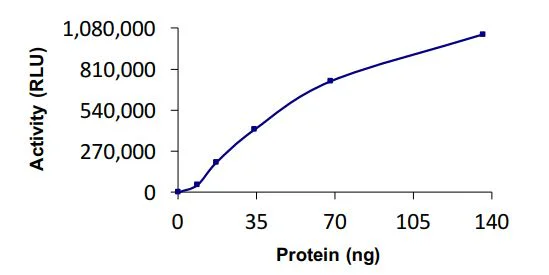
Functional Studies - Recombinant human SFT protein (Active) (His tag N-Terminus) (AB269096)
  • FuncS

Supplier Data

Functional Studies - Recombinant human SFT protein (Active) (His tag N-Terminus) (AB269096)

The specific activity of ab269096 was 22 nmol/min/mg in a ubiquitinating assay using wild-type ubiquitin protein as substrate.
SDS-PAGE - Recombinant human SFT protein (Active) (His tag N-Terminus) (AB269096)
  • SDS-PAGE

Supplier Data

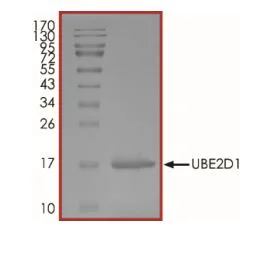
SDS-PAGE - Recombinant human SFT protein (Active) (His tag N-Terminus) (AB269096)

SDS-PAGE analysis of ab269096.

Key facts

Purity

>95% SDS-PAGE

Expression system

Escherichia coli

Tags

His tag N-Terminus

Applications

FuncS, SDS-PAGE

applications

Biologically active

Yes

Biological activity

The specific activity of ab269096 was 22 nmol/min/mg in a ubiquitinating assay using wild-type ubiquitin protein as substrate.

Accession

P51668-1

Animal free

No

Carrier free

No

Species

Human

Storage buffer

pH: 7 Preservative: 1.02% Imidazole Constituents: 25% Glycerol (glycerin, glycerine), 1.74% Sodium chloride, 0.82% Sodium phosphate, 0.004% (R*,R*)-1,4-Dimercaptobutan-2,3-diol, 0.002% PMSF

storage-buffer

Reactivity data

{ "title": "Reactivity Data", "filters": { "stats": ["", "Reactivity", "Dilution Info", "Notes"] }, "values": { "SDS-PAGE": { "reactivity":"TESTED_AND_REACTS", "dilution-info":"", "notes":"<p></p>" }, "FuncS": { "reactivity":"TESTED_AND_REACTS", "dilution-info":"", "notes":"<p></p>" } } }

Sequence info

[{"linker":null,"sequence":"MALKRIQKELSDLQRDPPAHCSAGPVGDDLFHWQATIMGPPDSAYQGGVFFLTVHFPTDYPFKPPKIAFTTKIYHPNINSNGSICLDILRSQWSPALTVSKVLLSICSLLCDPNPDDPLVPDIAQIYKSDKEKYNRHAREWTQKYAM","proteinLength":"Full Length","predictedMolecularWeight":null,"actualMolecularWeight":null,"aminoAcidEnd":147,"aminoAcidStart":1,"nature":"Recombinant","expressionSystem":"Escherichia coli","accessionNumber":"P51668","tags":[{"tag":"His","terminus":"N-Terminus"}]}]

Properties and storage information

Form
Liquid
Shipped at conditions
Dry Ice
Appropriate short-term storage conditions
-80°C
Appropriate long-term storage conditions
-80°C
Aliquoting information
Upon delivery aliquot
Storage information
Avoid freeze / thaw cycle
True

Supplementary information

This supplementary information is collated from multiple sources and compiled automatically.

The protein SFT also known as surfactant protein or SP plays a role in reducing surface tension in the lungs. It's a glycoprotein with a known mass of around 32 kDa. SFT mainly gets expressed in the alveolar type II cells in the lungs where it's secreted into the lung's extracellular lining. Its primary function involves aiding in lung stability and preventing alveolar collapse during respiration.
Biological function summary

Surfactant proteins contribute to innate immune defense and lung homeostasis. SFT is a component of the surfactant complex which includes other proteins and lipids. This protein acts at the air-liquid interface in the alveoli and engages in host defense functions. SFT activates alveolar macrophages and binds to a range of pathogens enhancing their clearance from the respiratory tract. It helps regulate inflammatory responses and maintain the balance of surfactant components in the lungs.

Pathways

SFT plays an integral role in the pulmonary surfactant metabolism pathway and the immune response pathway. In the pulmonary surfactant metabolism pathway it interacts with proteins like ABCA3 and lipids like phosphatidylcholine to ensure proper surfactant composition and recycling. In the immune response pathway SFT partners with complement proteins and defensins supporting pathogen clearance and preventing lung infections.

SFT relates primarily to respiratory distress syndrome (RDS) and pulmonary alveolar proteinosis (PAP). In RDS an insufficient amount or dysfunction of surfactant proteins including SFT leads to alveolar collapse and impaired gas exchange. In PAP the protein's accumulation affects surfactant homeostasis disrupting lung function. These diseases tie SFT to other proteins like GM-CSF and ABCA3 which influence surfactant production and regulation.

Product protocols

Target data

Accepts ubiquitin from the E1 complex and catalyzes its covalent attachment to other proteins (PubMed : 22496338). In vitro catalyzes 'Lys-48'-linked polyubiquitination (PubMed : 20061386). Mediates the selective degradation of short-lived and abnormal proteins. Functions in the E6/E6-AP-induced ubiquitination of p53/TP53. Mediates ubiquitination of PEX5 and auto-ubiquitination of STUB1, TRAF6 and TRIM63/MURF1 (PubMed : 18042044, PubMed : 18359941). Ubiquitinates STUB1-associated HSP90AB1 in vitro (PubMed : 18042044). Lacks inherent specificity for any particular lysine residue of ubiquitin (PubMed : 18042044). Essential for viral activation of IRF3 (PubMed : 19854139). Mediates polyubiquitination of CYP3A4 (PubMed : 19103148).
See full target information UBE2D1

Alternative Names

SFT, UBC5A, UBCH5, UBCH5A, UBE2D1, Ubiquitin-conjugating enzyme E2 D1, (E3-independent) E2 ubiquitin-conjugating enzyme D1, E2 ubiquitin-conjugating enzyme D1, Stimulator of Fe transport, UBC4/5 homolog, UbcH5, Ubiquitin carrier protein D1, Ubiquitin-conjugating enzyme E2(17)KB 1, Ubiquitin-conjugating enzyme E2-17 kDa 1, Ubiquitin-protein ligase D1

Product promise

We are committed to supporting your work with high-quality reagents, and we're here for you every step of the way. In the unlikely event that one of our products does not perform as expected, you're protected by our Product Promise.
For full details, please see our Terms & Conditions

Please note: All products are 'FOR RESEARCH USE ONLY. NOT FOR USE IN DIAGNOSTIC OR THERAPEUTIC PROCEDURES'.

For licensing inquiries, please contact partnerships@abcam.com