JavaScript is disabled in your browser. Please enable JavaScript to view this website.
AB314624

Recombinant Human SLFN12L Protein (His Tag)

Be the first to review this product! Submit a review

|

(1 Publication)
Recombinant Human SLFN12L Protein (His Tag) is a Human Full Length protein, in the 1 to 588 aa range, expressed in Escherichia coli, with >85%, suitable for SDS-PAGE.
1 Images
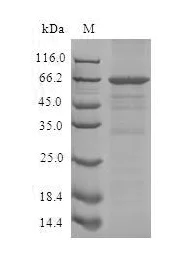
SDS-PAGE - Recombinant Human SLFN12L Protein (His Tag) (AB314624)
  • SDS-PAGE

Supplier Data

SDS-PAGE - Recombinant Human SLFN12L Protein (His Tag) (AB314624)

(Tris-Glycine gel) Discontinuous SDS-PAGE (reduced) with 5% enrichment gel and 15% separation gel.

Key facts

Purity

>85% SDS-PAGE

Expression system

Escherichia coli

Tags

10x His tag N-Terminus Myc tag C-Terminus

Applications

SDS-PAGE

applications

Biologically active

No

Accession

Q6IEE8-1

Animal free

Yes

Carrier free

No

Species

Human

Reconstitution

We recommend that this vial be briefly centrifuged prior to opening to bring the contents to the bottom. Please reconstitute protein in deionized sterile water to a concentration of 0.1-1.0 mg/mL. We recommend to add 5-50% of glycerol (final concentration) and aliquot for long-term storage at -20°C/-80°C. Our default final concentration of glycerol is 50%.

Storage buffer

pH: 7.4 - 8 Constituents: PBS, 6% Trehalose

storage-buffer

Reactivity data

{ "title": "Reactivity Data", "filters": { "stats": ["", "Reactivity", "Dilution Info", "Notes"] }, "values": { "SDS-PAGE": { "reactivity":"TESTED_AND_REACTS", "dilution-info":"", "notes":"<p></p>" } } }

Sequence info

[{"linker":null,"sequence":"MDLARKEFLRGNGLAAGKMNISIDLDTNYAELVLNVGRVTLGENNRKKMKDCQLRKQQNENVSRAVCALLNSGGGVIKAEVENKGYSYKKDGIGLDLENSFSNMLPFVPNFLDFMQNGNYFHIFVKSWSLETSGPQIATLSSSLYKRDVTSAKVMNASAALEFLKDMEKTGGRAYLRPEFPAKRACVDVQEESNMEALAADFFNRTELGYKEKLTFTESTHVEIKNFSTEKLLQRITEILPQYVSAFANTDGGYLFVGLNEDKEVIGFKAEKSYLTKLEEVTKNSIGKLPVHHFCVEKGTINYLCKFLGVYDKGRLCGYVYALRVERFCCAVFAKKPDSWHVKDNRVKQLTEKEWIQFMVDSEPVCEELPSPASTSSPVSQSYPLREYINFKIQPLRYHLPGLSEKITCAPKTFCRNLFSQHEGLKQLICEEMGSVNKGSLIFSRSWSLDLGLQENHKVLCDALLISQDKPPVLYTFHMVQDEEFKDYSTQTAQTLKQKLAKIGGYTKKVCVMTKIFYLSPEGKTSCQYDLNSQVIYPESYYWTTAQTMKDLEKALSNILPKENQIFLFVCLFRFCLFVCWFVCFFLR","proteinLength":"Full Length","predictedMolecularWeight":"72.1 kDa","actualMolecularWeight":null,"aminoAcidEnd":588,"aminoAcidStart":1,"nature":"Recombinant","expressionSystem":"Escherichia coli","accessionNumber":"Q6IEE8","tags":[{"tag":"10x His","terminus":"N-Terminus"},{"tag":"Myc","terminus":"C-Terminus"}]}]

Properties and storage information

Form
Lyophilized
Purification technique
Ion exchange chromatography
Shipped at conditions
Blue Ice
Appropriate short-term storage duration
1-2 weeks
Appropriate short-term storage conditions
+4°C
Appropriate long-term storage conditions
-80°C
Aliquoting information
Add glycerol to a final volume of 50% for extra stability and aliquot
Storage information
The product can be stored for up to 12 months
False

Supplementary information

This supplementary information is collated from multiple sources and compiled automatically.

SLFN12L also known as Schlafen family member 12-like is a protein with a molecular mass of approximately 122 kDa. It belongs to the Schlafen family of proteins which consist of both short and long isoform members. SLFN12L is expressed in multiple tissues but shows higher abundance in immune-related tissues and cells such as the spleen lymph nodes and peripheral blood mononuclear cells. This protein has functions that involve the regulation of cellular processes including cell cycle progression and differentiation.
Biological function summary

SLFN12L plays a role in the immune response and cell differentiation processes. It is not known to form part of a larger protein complex; rather it acts individually to exert its effects. The protein influences cell growth and differentiation by interacting with various molecular pathways that control these processes at the cellular level making it significant in maintaining cellular homeostasis.

Pathways

SLFN12L participates in pathways related to immune modulation and cell cycle. It is known to interfere with the interferon signaling pathway which involves proteins such as STAT1 and IFN-γ influencing immune responses. Additionally SLFN12L indirectly affects the cell cycle regulation pathway by modulating the expression of molecules involved in cell cycle checkpoints. This interaction positions SLFN12L as an important part of signaling that balances cell proliferation and immune defense mechanisms.

Research shows SLFN12L's involvement in conditions related to immune system dysregulation and cancer. Alterations in its expression levels have links to autoimmune diseases and certain types of cancer such as lymphoma. The protein's interactions within disease-related pathways often involve other proteins like MYC in cancerous transformations suggesting that SLFN12L might play a role in disease progression and could be a potential target for therapeutic interventions.

Product protocols

Target data

See full target information SLFN12L

Alternative Names

SLFN5, SLFN12L, Schlafen family member 12-like

Publications (1)

Recent publications for all applications. Explore the full listand refine your search

iScience 27:111255 PubMed39620128

2024

activates SLFN4MDSCs to accelerate gastric intestinal metaplasia.

Applications

Unspecified application

Species

Unspecified reactive species

Zhihong Zhao,Rui Liu,Ye Peng,Cun Li,Qian Li
View all publications

Product promise

We are committed to supporting your work with high-quality reagents, and we're here for you every step of the way. In the unlikely event that one of our products does not perform as expected, you're protected by our Product Promise.
For full details, please see our Terms & Conditions

Please note: All products are 'FOR RESEARCH USE ONLY. NOT FOR USE IN DIAGNOSTIC OR THERAPEUTIC PROCEDURES'.

For licensing inquiries, please contact partnerships@abcam.com