Recombinant human THIK-1 protein (His tag)
Be the first to review this product! Submit a review
|
(0 Publication)
Recombinant human THIK-1 protein (His tag) is a Human Full Length protein, in the 1 to 408 aa range, expressed in Escherichia coli, with >85%, suitable for SDS-PAGE.
View Alternative Names
Potassium channel subfamily K member 13, Tandem pore domain halothane-inhibited potassium channel 1, THIK-1, KCNK13
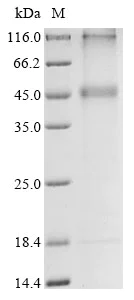
- SDS-PAGE
Supplier Data
SDS-PAGE - Recombinant human THIK-1 protein (His tag) (AB314518)
(Tris-Glycine gel) Discontinuous SDS-PAGE (reduced) with 5% enrichment gel and 15% separation gel. The difference between the theoretical value and the observed value may be related to the molecular structure of the protein. It is predicted that the isoelectric point pI of the fusion protein is 8.73, and the molecular weight of the basic protein is relatively small. At the same time, it is speculated that the protein may form a dimer, resulting in the appearance of high molecular weight bands. Observed band size : Monomer : 47 kDa Dimer : 116 kDa It is speculated that the protein forms a dimeric structure.
Complementary Products
Primary Antibodies
AB109629
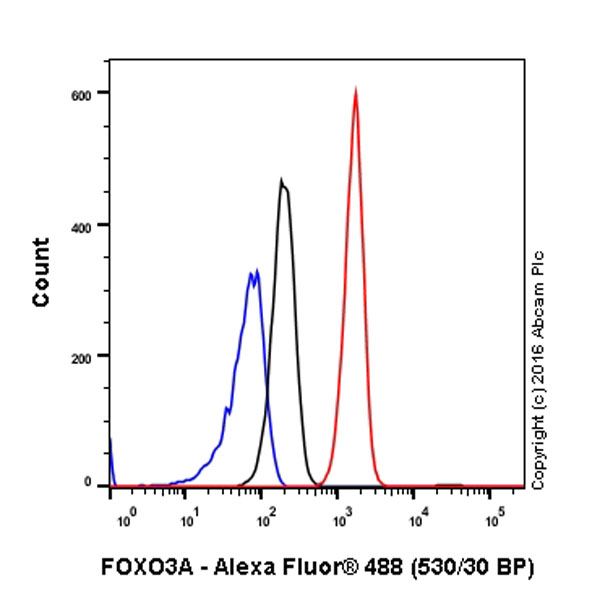
Anti-FOXO3A antibody [EPR1950]
20ul selling size|RabMAb|Recombinant|KO Validated|Advanced Validation
- 0
- 1
Reactivity data
Product details
Sequence info
Properties and storage information
Form
Purification technique
Shipped at conditions
Appropriate short-term storage conditions
Appropriate long-term storage conditions
Storage information
Supplementary information
This supplementary information is collated from multiple sources and compiled automatically.
Biological function summary
THIK-1 contributes to maintaining the cellular ionic homeostasis by facilitating the passive movement of potassium ions across the cell membrane. This movement does not require additional energy input like ATP making THIK-1 efficient in sustaining ionic gradients. THIK-1 does not function as part of a larger complex but works independently to influence cell polarization and signaling important for neuron function and immune cell response.
Pathways
THIK-1 is involved in the neuronal signaling pathway and the immune response pathway. In neuronal signaling THIK-1 contributes to setting the resting potential affecting neuronal excitability and neurotransmission. In connection to the immune response THIK-1 influences the activation and function of immune cells. THIK-1 interacts with proteins such as TREK-1 and TASK channels which are also potassium channels involved in similar pathways showing redundancy and complementarity within potassium channel families.
General info
Function
K(+) channel that conducts outward rectifying tonic currents potentiated by purinergic signals (PubMed : 24163367, PubMed : 25148687, PubMed : 30472253, PubMed : 38409076). Homo- and heterodimerizes to form functional channels with distinct regulatory and gating properties (PubMed : 25148687, PubMed : 40011745, PubMed : 40011746, PubMed : 40307591, PubMed : 40178898). Contributes most of K(+) currents at the plasma membrane of resting microglia (PubMed : 38409076). Maintains a depolarized membrane potential required for proper ramified microglia morphology and phagocytosis, selectively mediating microglial pruning of presynaptic compartments at hippocampal excitatory synapses (PubMed : 38409076). Upon local release of ATP caused by neuronal injury or infection, it is potentiated by P2RY12 and P2RX7 receptor signaling and contributes to ATP-triggered K(+) efflux underlying microglial NLRP3 inflammasome assembly and IL1B release (PubMed : 38409076).
Sequence similarities
Belongs to the two pore domain potassium channel (TC 1.A.1.8) family.
Target data
Product promise
Please note: All products are 'FOR RESEARCH USE ONLY. NOT FOR USE IN DIAGNOSTIC OR THERAPEUTIC PROCEDURES'.
For licensing inquiries, please contact partnerships@abcam.com