Recombinant human UBPY/USP8 protein (Active) (His tag N-Terminus)
Be the first to review this product! Submit a review
|
(0 Publication)
- FuncS
Supplier Data
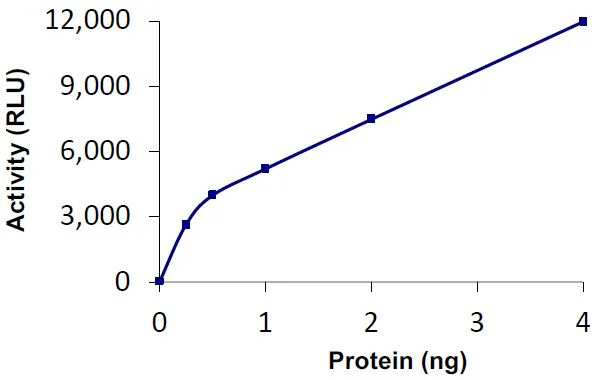
Functional Studies - Recombinant human UBPY/USP8 protein (Active) (His tag N-Terminus) (AB269128)
ab269128 specific activity was determined to be 80 nmol/min/mg in a DUB assay using recombinant human ubiquitin-based proluciferin substrate.
- SDS-PAGE
Supplier Data
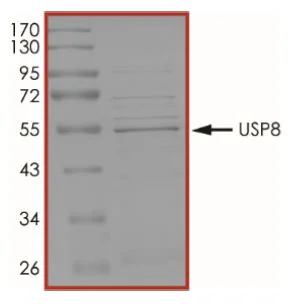
SDS-PAGE - Recombinant human UBPY/USP8 protein (Active) (His tag N-Terminus) (AB269128)
SDS-PAGE analysis of ab269128.
Complementary Products
Reagents, Controls & Accessories
AB116029
Prestained Protein Ladder - Extra broad molecular weight (5 - 245 kDa)

- 5
- 1

Reactivity data
Sequence info
Properties and storage information
Form
Shipped at conditions
Appropriate short-term storage conditions
Appropriate long-term storage conditions
Aliquoting information
Storage information
Supplementary information
This supplementary information is collated from multiple sources and compiled automatically.
Biological function summary
The deubiquitinating enzyme USP8 participates in endocytosis and lysosomal protein degradation processes. It does not function alone but associates with different protein complexes to regulate trafficking and degradation of membrane receptors. Through its action USP8 influences receptor tyrosine kinases like EGFR and impacts the sorting and degradation of these receptors. The enzyme's activity on these receptors is critical for controlling their signal transduction pathways and cellular responses.
Pathways
USP8 plays a role in the EGFR signaling pathway and the Wnt pathway. In the EGFR pathway its deubiquitinating action on EGFR affects receptor degradation and recycling impacting cell growth and differentiation. Within the Wnt pathway USP8 associates with proteins such as Axin and APC contributing to the regulation of β-catenin levels. By managing these pathways USP8 controls both normal physiological processes and pathological conditions when dysregulated.
General info
Function
Hydrolase that can remove conjugated ubiquitin from proteins and therefore plays an important regulatory role at the level of protein turnover by preventing degradation. Converts both 'Lys-48' an 'Lys-63'-linked ubiquitin chains. Catalytic activity is enhanced in the M phase. Involved in cell proliferation. Required to enter into S phase in response to serum stimulation. May regulate T-cell anergy mediated by RNF128 via the formation of a complex containing RNF128 and OTUB1. Probably regulates the stability of STAM2 and RASGRF1. Regulates endosomal ubiquitin dynamics, cargo sorting, membrane traffic at early endosomes, and maintenance of ESCRT-0 stability. The level of protein ubiquitination on endosomes is essential for maintaining the morphology of the organelle. Deubiquitinates EPS15 and controls tyrosine kinase stability. Removes conjugated ubiquitin from EGFR thus regulating EGFR degradation and downstream MAPK signaling. Involved in acrosome biogenesis through interaction with the spermatid ESCRT-0 complex and microtubules. Deubiquitinates BIRC6/bruce and KIF23/MKLP1. Deubiquitinates BACE1 which inhibits BACE1 lysosomal degradation and modulates BACE-mediated APP cleavage and amyloid-beta formation (PubMed : 27302062).
Sequence similarities
Belongs to the peptidase C19 family.
Post-translational modifications
Phosphorylation of Ser-718 is essential for interaction with YWHAE and for cytosol localization. Undergoes dephosphorylation at Ser-718 in the M phase. Tyrosine-phosphorylated in its N-terminal half in an EGFR-dependent manner.. Ubiquitinated. Inactive form is mostly monoubiquitinated, but polyubiquitination happens too. Ubiquitination is increased in EGF-stimulated cells. Ubiquitination of active form is undetectable, suggesting a possibility that USP8 deubiquitinates itself, thereby regulating its own function (By similarity).
Target data
Alternative Names
Product promise
Please note: All products are 'FOR RESEARCH USE ONLY. NOT FOR USE IN DIAGNOSTIC OR THERAPEUTIC PROCEDURES'.
For licensing inquiries, please contact partnerships@abcam.com