JavaScript is disabled in your browser. Please enable JavaScript to view this website.
AB237560

Recombinant Salmonella typhimurium PrgI protein (His tag)

Be the first to review this product! Submit a review

|

(0 Publication)
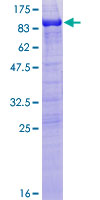
Recombinant Salmonella typhimurium PrgI protein (His tag) is a Salmonella enterica subsp. enterica serovar Typhimurium str. LT2 Full Length protein, in the 1 to 80 aa range, expressed in Escherichia coli, with >90%, suitable for SDS-PAGE, Mass Spec.
3 Images
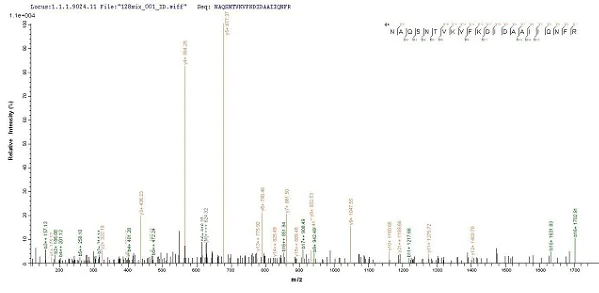
Mass Spectrometry - Recombinant Salmonella typhimurium PrgI protein (His tag) (AB237560)
  • Mass Spec

Supplier Data

Mass Spectrometry - Recombinant Salmonella typhimurium PrgI protein (His tag) (AB237560)

Based on the SEQUEST from database of E.coli host and target protein, the LC-MS/MS Analysis result of ab237560 could indicate that this peptide derived from E.coli-expressed Salmonella typhimurium (strain LT2 / SGSC1412 / ATCC 700720) prgI.
Mass Spectrometry - Recombinant Salmonella typhimurium PrgI protein (His tag) (AB237560)
  • Mass Spec

Supplier Data

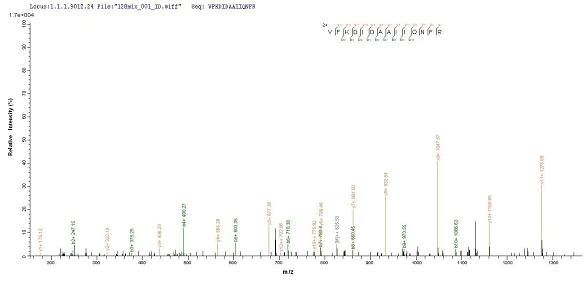
Mass Spectrometry - Recombinant Salmonella typhimurium PrgI protein (His tag) (AB237560)

Based on the SEQUEST from database of E.coli host and target protein, the LC-MS/MS Analysis result of ab237560 could indicate that this peptide derived from E.coli-expressed Salmonella typhimurium (strain LT2 / SGSC1412 / ATCC 700720) prgI.
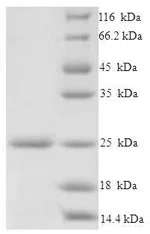
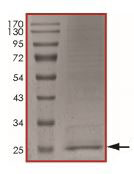
SDS-PAGE - Recombinant Salmonella typhimurium PrgI protein (His tag) (AB237560)
  • SDS-PAGE

Supplier Data

SDS-PAGE - Recombinant Salmonella typhimurium PrgI protein (His tag) (AB237560)

(Tris-Glycine gel) Discontinuous SDS-PAGE (reduced) analysis with 5% enrichment gel and 15% separation gel of ab237560.

Key facts

Purity

>90% SDS-PAGE

Expression system

Escherichia coli

Tags

6x His tag N-Terminus SUMO tag N-Terminus

Applications

SDS-PAGE, Mass Spec

applications

Biologically active

No

Accession

P41784-1

Animal free

No

Carrier free

No

Species

Salmonella enterica subsp. enterica serovar Typhimurium str. LT2

Storage buffer

pH: 7.2 - 7.4 Constituents: Tris buffer, 50% Glycerol (glycerin, glycerine)

storage-buffer

Reactivity data

{ "title": "Reactivity Data", "filters": { "stats": ["", "Reactivity", "Dilution Info", "Notes"] }, "values": { "SDS-PAGE": { "reactivity":"TESTED_AND_REACTS", "dilution-info":"", "notes":"<p></p>" }, "Mass Spec": { "reactivity":"TESTED_AND_REACTS", "dilution-info":"", "notes":"<p></p>" } } }

Sequence info

[{"linker":null,"sequence":"MATPWSGYLDDVSAKFDTGVDNLQTQVTEALDKLAAKPSDPALLAAYQSKLSEYNLYRNAQSNTVKVFKDIDAAIIQNFR","proteinLength":"Full Length","predictedMolecularWeight":"24.9 kDa","actualMolecularWeight":null,"aminoAcidEnd":80,"aminoAcidStart":1,"nature":"Recombinant","expressionSystem":"Escherichia coli","accessionNumber":"P41784","tags":[{"tag":"6x His","terminus":"N-Terminus"},{"tag":"SUMO","terminus":"N-Terminus"}]}]

Properties and storage information

Form
Liquid
Shipped at conditions
Blue Ice
Appropriate short-term storage conditions
-20°C
Appropriate long-term storage conditions
-20°C
Storage information
Avoid freeze / thaw cycle
False

Supplementary information

This supplementary information is collated from multiple sources and compiled automatically.

PrgI also known as PrgI protein serves as an essential component of the type III secretion system (T3SS) in certain bacteria notably Salmonella enterica. This protein functions as a needle component playing a mechanical role in piercing host cell membranes to deliver bacterial effectors directly into host cells. PrgI is a small protein with an estimated mass of around 9.6 kDa. Typically PrgI is expressed in pathogenic bacteria where T3SS is active which includes various specialized cells involved in infection.
Biological function summary

PrgI facilitates the translocation of virulence factors from the bacterial cytoplasm to host cell cytosol. PrgI forms a part of the needle complex a large structure spanning both bacterial membranes. The needle complex works together with other proteins such as PrgH and PrgK to ensure the successful injection of effector proteins into host cells. This protein assembly allows the bacterium to manipulate host cell functions aiding bacterial survival and replication within the host.

Pathways

PrgI integrates into the pathogenicity pathways of bacteria like Salmonella. It plays a significant role in the Salmonella pathogenicity island 1 (SPI-1) pathway which is important for enabling bacterial invasion into non-phagocytic cells. In this context PrgI works closely with other T3SS components such as InvG and SicA to mediate effector protein translocation and establish infection. Understanding PrgI's role highlights its importance in the formation and regulation of secretion systems that contribute to bacterial pathogenicity.

PrgI strongly connects to foodborne illnesses caused by Salmonella infections. Such infections can lead to gastroenteritis and more severe systemic diseases like typhoid fever. PrgI's interactions with proteins like SipA and SipC amplify its role in promoting bacterial virulence and disease progression. Research into PrgI not only aids in comprehending these bacterial infections but also provides opportunities to develop interventions that disrupt its function potentially reducing the disease burden stemming from Salmonella and related pathogens.

Product protocols

Target data

Component of the type III secretion system (T3SS), also called injectisome, which is used to inject bacterial effector proteins into eukaryotic host cells (PubMed : 12754250, PubMed : 16501225, PubMed : 30242280, PubMed : 33750771). PrgI/SctF1 forms the external needle filament that protrudes from the bacterial surface (PubMed : 12754250, PubMed : 16501225, PubMed : 22699623, PubMed : 30242280, PubMed : 31260457, PubMed : 33750771). Is probably involved in the transduction of an activating signal, thought to be mediated by the distal tip of the needle filament, to the secretion machine (PubMed : 31260457). Required for invasion of epithelial cells (PubMed : 17617421). Required for the secretion of the effector protein SptP (PubMed : 31260457, PubMed : 33750771).. During infection, can induce innate immune responses (PubMed : 24643544). The needle proteins interact with host TLR2 or TLR4, and induce signaling by NF-kappa-B and/or AP-1 (PubMed : 24643544). This activation is MyD88 dependent and results in increased expression of cytokines, including TNF, IL-6 and IL-8 (PubMed : 24643544).
See full target information sctF1

Alternative Names

prgI, STM2873, sctF1, SPI-1 type 3 secretion system needle filament protein, T3SS-1 needle filament protein

Product promise

We are committed to supporting your work with high-quality reagents, and we're here for you every step of the way. In the unlikely event that one of our products does not perform as expected, you're protected by our Product Promise.
For full details, please see our Terms & Conditions

Please note: All products are 'FOR RESEARCH USE ONLY. NOT FOR USE IN DIAGNOSTIC OR THERAPEUTIC PROCEDURES'.

For licensing inquiries, please contact partnerships@abcam.com