JavaScript is disabled in your browser. Please enable JavaScript to view this website.
AB207203

Estrogen Receptor Transcription Factor Assay Kit (Colorimetric)

Estrogen Receptor Transcription Factor 분석 키트 (Colorimetric)

Be the first to review this product! 리뷰 제출

|

(3 제품이 사용된 논문 )
Estrogen Receptor Transcription Factor Assay Kit (Colorimetric) (ab207203) is a high throughput assay to quantify Estrogen Receptor (ER) activation in nuclear extracts.
1 이미지
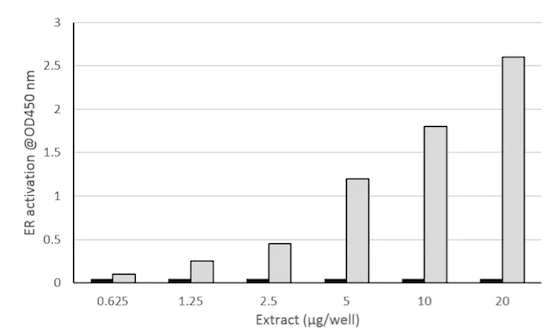
Functional Studies - Estrogen Receptor Transcription Factor Assay Kit (Colorimetric) (AB207203)
  • FuncS

Supplier Data

Functional Studies - Estrogen Receptor Transcription Factor Assay Kit (Colorimetric) (AB207203)

Different amounts of untreated (Gray) and H2O2 (Black) post-treated nuclear extracts from MCF-7 cells are tested for ERa activity.

Different amounts of untreated (grey) and hydrogen peroxide treated (black) MCF-7 were tested for ERα activity. These results are provided for demonstration purposes only.

주요 정보

검출 방식

Colorimetric

샘플 타입

Nuclear Extracts

Reacts with

Mouse, Rat, Human

결과 유형

Semi-Quantitative

Sensitivity

< 600 ng/well

분석 소요 시간

3h 30m

분석 플랫폼

Microplate reader

제품 세부 정보

Estrogen Receptor Transcription Factor Assay Kit (Colorimetric) (ab207203) is a high throughput assay to quantify Estrogen Receptor (ER) activation in nuclear extracts. This assay combines a quick ELISA format with a sensitive and specific non-radioactive assay for transcription factor activation.

A specific double stranded DNA sequence containing the Estrogen Receptor consensus binding site (5' –GGTCACAGTGACC– 3') has been immobilized onto a 96-well plate. Active Estrogen Receptor present in the nuclear extract specifically binds to the oligonucleotide. Estrogen Receptor is detected by a primary antibody that recognizes an epitope of Estrogen Receptor accessible only when the protein is activated and bound to its target DNA. An HRP-conjugated secondary antibody provides sensitive colorimetric readout that at OD 450 nm. This product detects human, mouse and rat Estrogen Receptor.

Key performance and benefits:

  • Assay time: 3.5 hours (cell extracts preparation not included).
  • Detection limit: < 0.6 μg nuclear extract/well.
  • Detection range: 0.6 – 20 μg nuclear extract/well.

ER belongs to the superfamily of ligand-inducible transcription factors. Human ERa is comprised of 595 amino acids and displays an approximate molecular weight of 66-70 kDa. Six functional regions have been identified. A hypervariable domain (aa 1-184) contains activation function 1 (AF1). The DNA binding domain (DBD, aa 185-263) contains two zinc finger motifs and is highly conserved across the nuclear receptor superfamily. It is responsible for the binding of the receptor to estrogen response elements (EREs) and contributes to dimerization and activation. Typically, EREs consist of two inverted half-sites separated by 3 bp (5´-GGTCAnnnTGACC-3´). The region which separates the ligand binding domain (LBD) and the DBD is called the hinge region (aa 264-302).

The LBD (aa 303-553) consists of 12 a-helices, which form a hydrophobic pocket responsible for ligand binding. The function of the final domain (aa 554-595) is not clear but is thought to play a role in distinguishing between agonist and antagonist binding. Human ERb is expressed as multiple isoforms. Structure and function studies have shown that the DBD of ERa and ERb are highly homologous, approaching 96%, whereas the LBD showed only 59% homology. The general mechanism of action of ERb is thought to be similar to that of ERa. ERa and ERb have the ability to interact with target promoters in three different complexes: ERa homodimers, ERb homodimers and ERa/ERb heterodimers.

The transcriptional effects of ER can be mediated through several mechanisms other than E2-ER complexes binding to EREs. E2-ER complexes can also trans activate genes through protein-protein interactions with transcription factors such as AP-1 or Sp1 that bind DNA, with coaccessory proteins (Src, ACTR), some of which have histone acetylase activity, and with RNA Polymerase II complex proteins. In addition, ERs serve to repress genes, which also plays an important role in E2 action.

제품 구성

{ "values": { "5x96Tests": { "sellingSize": "5 x 96 Tests", "publicAssetCode":"ab207203-5x96Tests", "assetComponentDetails": [ { "size":"5 x 2.2 mL", "name":"10X Antibody Binding Buffer", "number":"AB207203-CMP01" }, { "size":"5 x 1 Unit", "name":"96-well ER assay plate", "number":"AB207203-CMP03" }, { "size":"5 x 1 Unit", "name":"Plate sealer", "number":"AB207203-CMP12" }, { "size":"5 x 100 µL", "name":"Wild-type oligonucleotide (10 pmol/µL)", "number":"AB207203-CMP16" }, { "size":"5 x 11 mL", "name":"Stop Solution", "number":"AB207203-CMP15" }, { "size":"5 x 100 µL", "name":"Protease Inhibitor Cocktail", "number":"AB207203-CMP14" }, { "size":"5 x 100 µL", "name":"Poly [d(l-c)] (17 µg/μL)", "number":"AB207203-CMP13" }, { "size":"5 x 100 µL", "name":"Mutated oligonucleotide (10 pmol/µL)", "number":"AB207203-CMP11" }, { "size":"5 x 100 µL", "name":"Dithiothreitol (DTT) (1 M)", "number":"AB207203-CMP09" }, { "size":"5 x 11 mL", "name":"Developing Solution", "number":"AB207203-CMP08" }, { "size":"5 x 10 mL", "name":"Binding Buffer", "number":"AB207203-CMP07" }, { "size":"5 x 40 µL", "name":"MCF-7 nuclear extract (2.5 µg/µL)", "number":"AB207203-CMP05" }, { "size":"5 x 10 mL", "name":"Lysis Buffer", "number":"AB207203-CMP04" }, { "size":"5 x 22 mL", "name":"10X Wash Buffer", "number":"AB207203-CMP02" }, { "size":"5 x 11 µL", "name":"Anti-rabbit HRP-conjugated IgG", "number":"AB207203-CMP06" }, { "size":"5 x 11 µL", "name":"ERa antibody", "number":"AB207203-CMP10" } ] }, "1x96Tests": { "sellingSize": "1 x 96 Tests", "publicAssetCode":"ab207203-1x96Tests", "assetComponentDetails": [ { "size":"1 x 2.2 mL", "name":"10X Antibody Binding Buffer", "number":"AB207203-CMP01", "productcode":"" }, { "size":"1 x 1 Unit", "name":"Plate sealer", "number":"AB207203-CMP12", "productcode":"" }, { "size":"1 x 100 µL", "name":"Dithiothreitol (DTT) (1 M)", "number":"AB207203-CMP09", "productcode":"" }, { "size":"1 x 10 mL", "name":"Lysis Buffer", "number":"AB207203-CMP04", "productcode":"" }, { "size":"1 x 100 µL", "name":"Poly [d(l-c)] (17 µg/μL)", "number":"AB207203-CMP13", "productcode":"" }, { "size":"1 x 11 mL", "name":"Stop Solution", "number":"AB207203-CMP15", "productcode":"" }, { "size":"1 x 22 mL", "name":"10X Wash Buffer", "number":"AB207203-CMP02", "productcode":"" }, { "size":"1 x 10 mL", "name":"Binding Buffer", "number":"AB207203-CMP07", "productcode":"" }, { "size":"1 x 11 mL", "name":"Developing Solution", "number":"AB207203-CMP08", "productcode":"" }, { "size":"1 x 100 µL", "name":"Protease Inhibitor Cocktail", "number":"AB207203-CMP14", "productcode":"" }, { "size":"1 x 40 µL", "name":"MCF-7 nuclear extract (2.5 µg/µL)", "number":"AB207203-CMP05", "productcode":"" }, { "size":"1 x 100 µL", "name":"Wild-type oligonucleotide (10 pmol/µL)", "number":"AB207203-CMP16", "productcode":"" }, { "size":"1 x 1 Unit", "name":"96-well ER assay plate", "number":"AB207203-CMP03", "productcode":"" }, { "size":"1 x 100 µL", "name":"Mutated oligonucleotide (10 pmol/µL)", "number":"AB207203-CMP11", "productcode":"" }, { "size":"1 x 11 µL", "name":"Anti-rabbit HRP-conjugated IgG", "number":"AB207203-CMP06", "productcode":"" }, { "size":"1 x 11 µL", "name":"ERa antibody", "number":"AB207203-CMP10", "productcode":"" } ] } } }

특성 및 보관 정보

배송 시 보관 조건
Dry Ice
적절한 단기 보관 조건
Multi
적절한 장기 보관 조건
Multi
보관 정보
Please refer to protocols

추가 정보

This supplementary information is collated from multiple sources and compiled automatically.

The Estrogen Receptor (ER) also known by its alternate names NR3A1 (nuclear receptor subfamily 3 group A member 1) is a nuclear hormone receptor that binds estrogens such as the 17 beta estradiol molecule. Its molecular mass is approximately 66 kDa. This receptor locates mainly in the cytoplasm and nucleus of cells within tissues such as the breast uterus and bone. The ER exists in two primary subtypes ER alpha and ER beta which differ in their tissue distribution and functional roles.
Biological function summary

The Estrogen Receptor functions as a transcription factor that regulates gene expression when it binds to its ligand which is commonly estradiol. Upon binding 17 beta estradiol the receptor dimerizes and interacts with specific DNA sequences to influence transcription. It significantly regulates genes responsible for cell growth differentiation and reproductive functions. The estradiol chemical structure allows for specific interactions with ER altering the transcriptional regulation in a ligand-dependent manner. Though functioning mainly as a monomer ER can form heterodimers with other nuclear receptors affecting its biological role.

Pathways

The Estrogen Receptor is an important player in the genomic signaling pathway where it modulates the expression of numerous target genes by direct DNA binding. It also participates in the non-genomic signaling pathway where it involves the activation of second messengers and kinases. ER closely associates with important proteins such as coactivators and corepressors in these pathways. Estradiol chemical formula interactions facilitate molecular events involving ER-alpha to influence components of cell proliferation and survival.

The Estrogen Receptor is intricately linked to breast cancer and osteoporosis. Dysfunction in ER signaling promotes the proliferation of breast cancer cells often requiring targeted therapies that inhibit its action. In osteoporosis ER activity impacts bone density and turnover through regulation of osteoclasts and osteoblasts. The receptor's interaction with growth factor receptors like HER2 in breast cancer further highlights its significance in disease pathogenesis.

제품 프로토콜

타겟 정보

Nuclear hormone receptor. The steroid hormones and their receptors are involved in the regulation of eukaryotic gene expression and affect cellular proliferation and differentiation in target tissues. Ligand-dependent nuclear transactivation involves either direct homodimer binding to a palindromic estrogen response element (ERE) sequence or association with other DNA-binding transcription factors, such as AP-1/c-Jun, c-Fos, ATF-2, Sp1 and Sp3, to mediate ERE-independent signaling. Ligand binding induces a conformational change allowing subsequent or combinatorial association with multiprotein coactivator complexes through LXXLL motifs of their respective components. Mutual transrepression occurs between the estrogen receptor (ER) and NF-kappa-B in a cell-type specific manner. Decreases NF-kappa-B DNA-binding activity and inhibits NF-kappa-B-mediated transcription from the IL6 promoter and displace RELA/p65 and associated coregulators from the promoter. Recruited to the NF-kappa-B response element of the CCL2 and IL8 promoters and can displace CREBBP. Present with NF-kappa-B components RELA/p65 and NFKB1/p50 on ERE sequences. Can also act synergistically with NF-kappa-B to activate transcription involving respective recruitment adjacent response elements; the function involves CREBBP. Can activate the transcriptional activity of TFF1. Also mediates membrane-initiated estrogen signaling involving various kinase cascades. Essential for MTA1-mediated transcriptional regulation of BRCA1 and BCAS3 (PubMed : 17922032). Maintains neuronal survival in response to ischemic reperfusion injury when in the presence of circulating estradiol (17-beta-estradiol/E2) (By similarity).. Isoform 3. Involved in activation of NOS3 and endothelial nitric oxide production (PubMed : 21937726). Isoforms lacking one or several functional domains are thought to modulate transcriptional activity by competitive ligand or DNA binding and/or heterodimerization with the full-length receptor (PubMed : 10970861). Binds to ERE and inhibits isoform 1 (PubMed : 10970861).
See full target information ESR1

대체 명칭 보기

ESR, NR3A1, ESR1, Estrogen receptor, ER, ER-alpha, Estradiol receptor, Nuclear receptor subfamily 3 group A member 1

제품이 사용된 논문 (3)

Recent publications for all applications. Explore the 전체 목록and refine your search

Science advances 8:eadd4150 PubMed36449624

2022

The SARS-CoV-2 spike protein binds and modulates estrogen receptors.

Applications

Unspecified application

Species

Unspecified reactive species

Oscar Solis,Andrea R Beccari,Daniela Iaconis,Carmine Talarico,Camilo A Ruiz-Bedoya,Jerome C Nwachukwu,Annamaria Cimini,Vanessa Castelli,Riccardo Bertini,Monica Montopoli,Veronica Cocetta,Stefano Borocci,Ingrid G Prandi,Kelly Flavahan,Melissa Bahr,Anna Napiorkowski,Giovanni Chillemi,Masato Ooka,Xiaoping Yang,Shiliang Zhang,Menghang Xia,Wei Zheng,Jordi Bonaventura,Martin G Pomper,Jody E Hooper,Marisela Morales,Avi Z Rosenberg,Kendall W Nettles,Sanjay K Jain,Marcello Allegretti,Michael Michaelides

Communications biology 5:51 PubMed35027651

2022

Maternal diabetes-mediated RORA suppression in mice contributes to autism-like offspring through inhibition of aromatase.

Applications

Unspecified application

Species

Unspecified reactive species

Hong Yu,Yanbin Niu,Guohua Jia,Yujie Liang,Baolin Chen,Ruoyu Sun,Min Wang,Saijun Huang,Jiaying Zeng,Jianpin Lu,Ling Li,Xiaoling Guo,Paul Yao

Biochimica et biophysica acta. Molecular basis of 1863:2808-2820 PubMed28712835

2017

Biological impact of advanced glycation endproducts on estrogen receptor-positive MCF-7 breast cancer cells.

Applications

Unspecified application

Species

Unspecified reactive species

Sabine Matou-Nasri,Hana Sharaf,Qiuyu Wang,Nasser Almobadel,Zaki Rabhan,Hamad Al-Eidi,Wesam Bin Yahya,Thadeo Trivilegio,Rizwan Ali,Nasser Al-Shanti,Nessar Ahmed
제품이 사용된 논문 모두 보기
websiteProtocolBooklet
en

Product promise

저희는 고품질 시약으로 고객님의 연구를 서포트하고자 최선을 다하고 있으며, 모든 단계에서 함께 하겠습니다. 만약 제품이 기대한 성능을 보이지 않을 경우에도 Product Promise로 보호받으실 수 있습니다.
자세한 내용은 이용 약관을 확인해 주세요.

Please note: All products are 'FOR RESEARCH USE ONLY. NOT FOR USE IN DIAGNOSTIC OR THERAPEUTIC PROCEDURES'.

For licensing inquiries, please contact partnerships@abcam.com