JavaScript is disabled in your browser. Please enable JavaScript to view this website.
AB120840

IBMX, Non-specific cAMP and cGMP inhibitor

Be the first to review this product! 리뷰 제출

|

(2 제품이 사용된 논문 )
MW 222.24 Da, Purity >98%. Non-specific cAMP and cGMP inhibitor. Achieve your results faster with highly validated, pure and trusted compounds.
2 이미지
Functional Studies - IBMX, Non-specific cAMP and cGMP inhibitor (AB120840)
  • FuncS

Unknown

Functional Studies - IBMX, Non-specific cAMP and cGMP inhibitor (AB120840)

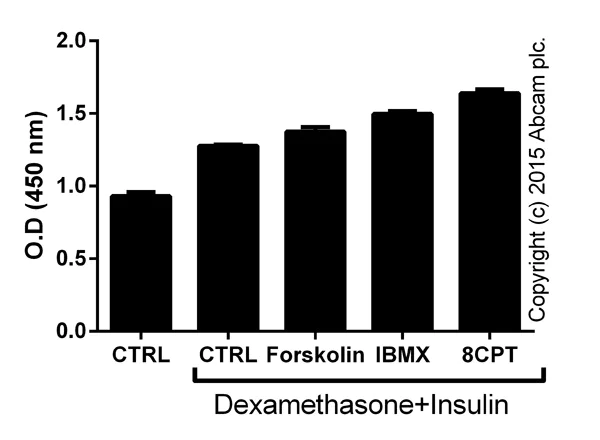
1e7 3T3-L1 cells were treated for 15 minutes with 1 µM dexamethasone (ab120743) and 1 µg x mL-1 insulin (ab123768) with the addition of 50 µM forskolin (ab120058), 0.5 mM IBMX (ab120840) or 0.1 mM 8-CPT-cAMP (ab120424), extracted according to the protocol. Lysates were diluted 50-fold, and tested in duplicates (+/-SD).
Chemical Structure - IBMX, Non-specific cAMP and cGMP inhibitor (AB120840)
  • Chemical Structure

Lab

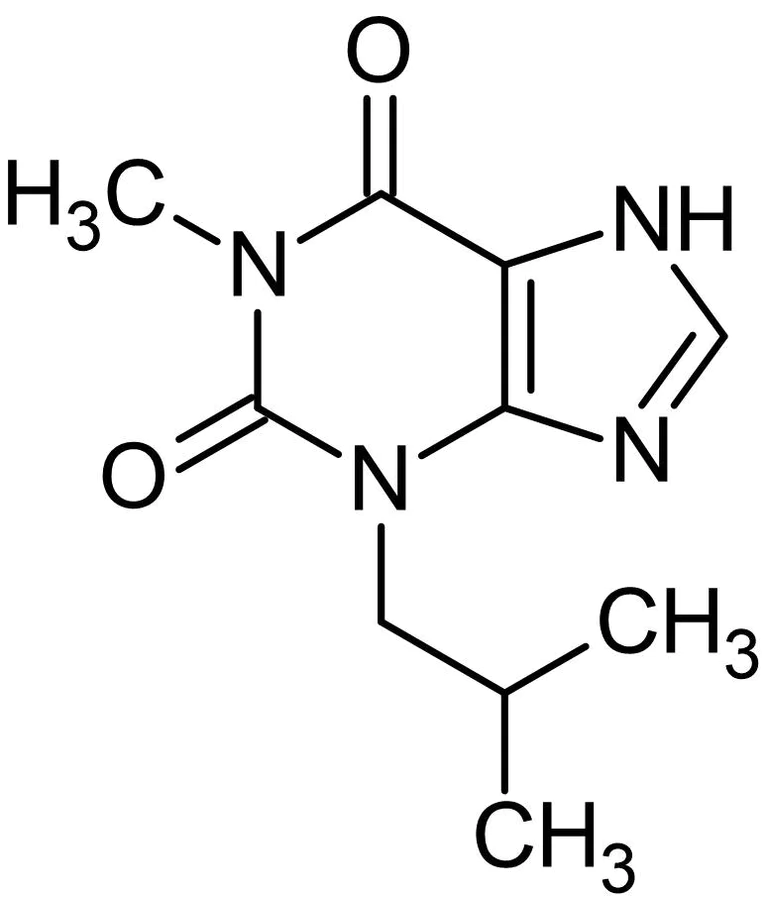
Chemical Structure - IBMX, Non-specific cAMP and cGMP inhibitor (AB120840)

2D chemical structure image of ab120840, IBMX, Non-specific cAMP and cGMP inhibitor

주요 정보

CAS 번호

28822-58-4

Purity

>98%

제형

Solid

form

Formulation

Constituents: 100% 3,7-Dihydro-3-isobutyl-1-methyl-1h-purine-2,6-dione

Molecular weight

222.24 Da

Molecular formula

C<sub>1</sub><sub>0</sub>H<sub>1</sub><sub>4</sub>N<sub>4</sub>O<sub>2</sub>

PubChem

3758

Nature

Synthetic

Solubility

Soluble in DMSO to 75 mM

Soluble in ethanol to 50 mM

생화학적 명칭

3-Isobutyl-1-methylxanthine

생물학적 정보

Non-specific cAMP and cGMP inhibitor

Canonical SMILES

CC(C)CN1C2=C(C(=O)N(C1=O)C)NC=N2

InChi

InChI=1S/C10H14N4O2/c1-6(2)4-14-8-7(11-5-12-8)9(15)13(3)10(14)16/h5-6H,4H2,1-3H3,(H,11,12)

InChiKey

APIXJSLKIYYUKG-UHFFFAOYSA-N

IUPAC Name

1-methyl-3-(2-methylpropyl)-7H-purine-2,6-dione

특성 및 보관 정보

배송 시 보관 조건
Ambient - Can Ship with Ice
적절한 단기 보관 조건
-20°C
적절한 장기 보관 조건
-20°C
보관 정보
Store under desiccating conditions|The product can be stored for up to 12 months
취급 방법

Need more advice on solubility, usage and handling? Please visit our our product support page for more details.

|

Wherever possible, you should prepare and use solutions on the same day. However, if you need to make up stock solutions in advance, we recommend that you store the solution as aliquots in tightly sealed vials at -20°C. Generally, these will be useable for up to one month. Before use, and prior to opening the vial we recommend that you allow your product to equilibrate to room temperature for at least 1 hour.

추가 정보

This supplementary information is collated from multiple sources and compiled automatically.

Adenosine A1 Receptor also called ADORA1 alongside its counterparts adenosine receptors A2a (ADORA2A) A2b (ADORA2B) and A3 (A3AR) and the phosphodiesterases PDE1B and PDE1C along with sodium channels SCN1A SCN2A and SCN3A play a significant role in signal transduction. These receptors and enzymes interact with cAMP and cGMP molecules to modulate cellular responses while the sodium channels particularly Scn1a mediate electrical signaling in nerve cells. The molecular weight of many of these proteins varies widely for instance ADORA1 has an approximate mass of 37 kDa. These proteins are highly expressed in tissues such as the brain and heart contributing to diverse physiological processes.
Biological function summary

These proteins and receptors are integral to several cellular functions. For example adenosine receptors participate in the regulation of neurotransmitter release and cardiovascular functions. PDE1B and PDE1C hydrolyze cAMP and cGMP critical secondary messengers that influence vascular tone and neuronal signaling. Meanwhile sodium channels like SCN1A form parts of voltage-gated sodium channel complexes that are key for action potential generation and propagation in neurons.

Pathways

These proteins and receptors are incorporated into critical signaling routes. Adenosine receptors and phosphodiesterases are involved in G protein-coupled receptor signaling and cAMP-dependent pathways highlighting their role in maintaining cellular homeostasis and response to external stimuli. Sodium channels SCN1A SCN2A and SCN3A are prominent in pathways governing nervous system excitability and conductance with interconnected proteins including other channels and kinases that modulate neuronal activities.

These protein targets relate strongly to neurological and cardiovascular conditions. For instance mutations in SCN1A are closely linked to epilepsy while dysregulation in adenosine receptor signaling can contribute to arrhythmias or heart failure. The phosphodiesterase inhibitors including compounds like IBMX (isobutylmethylxanthine) affect cAMP and cGMP pathways and can overlap with therapeutic interventions targeting these disorders. These associations highlight the need for precise modulation of their activity to mitigate disease effects.

제품 프로토콜

제품이 사용된 논문 (2)

Recent publications for all applications. Explore the 전체 목록and refine your search

Communications biology 8:595 PubMed40240542

2025

Acoustic modulation of mechanosensitive genes and adipocyte differentiation.

Applications

Unspecified application

Species

Unspecified reactive species

Masahiro Kumeta,Makoto Otani,Masahiro Toyoda,Shige H Yoshimura

Acta pharmaceutica Sinica. B 12:1899-1912 PubMed35847503

2022

Disruption of adipocyte HIF-1 improves atherosclerosis through the inhibition of ceramide generation.

Applications

Unspecified application

Species

Unspecified reactive species

Pengcheng Wang,Guangyi Zeng,Yu Yan,Song-Yang Zhang,Yongqiang Dong,Yangming Zhang,Xingzhong Zhang,Huiying Liu,Zhipeng Zhang,Changtao Jiang,Yanli Pang
제품이 사용된 논문 모두 보기

Product promise

저희는 고품질 시약으로 고객님의 연구를 서포트하고자 최선을 다하고 있으며, 모든 단계에서 함께 하겠습니다. 만약 제품이 기대한 성능을 보이지 않을 경우에도 Product Promise로 보호받으실 수 있습니다.
자세한 내용은 이용 약관을 확인해 주세요.

Please note: All products are 'FOR RESEARCH USE ONLY. NOT FOR USE IN DIAGNOSTIC OR THERAPEUTIC PROCEDURES'.

For licensing inquiries, please contact partnerships@abcam.com