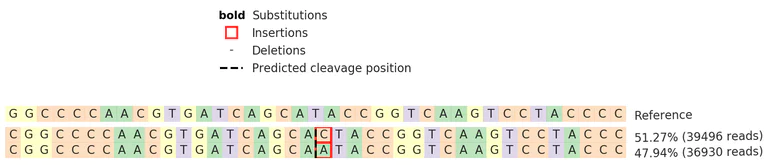
ATP13A2 KO cell lysate available now. KO validated by Next Generation Sequencing. Free of charge wild type control included. Knockout achieved by CRISPR/Cas9 X = 1 bp insertion Frameshift: 99%.
대체 명칭 보기
Polyamine-transporting ATPase 13A2, PARK9, ATP13A2
- NGS
Supplier Data
Next Generation Sequencing - Human ATP13A2 knockout HEK-293 cell lysate (AB274983)
Knockout achieved by CRISPR/Cas9; X = 1 bp insertion; Frameshift : 99%
- WB
Lab
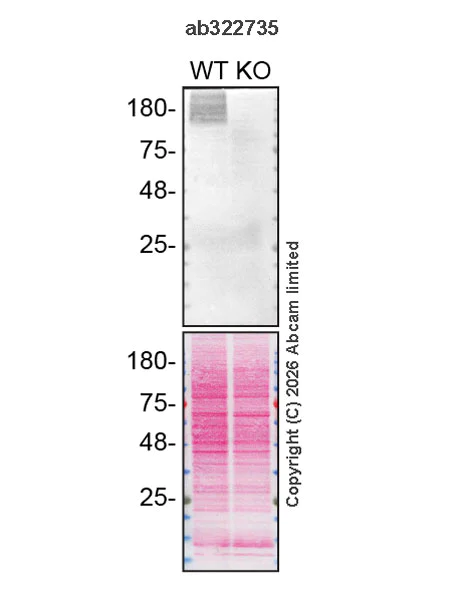
Western blot - Human ATP13A2 knockout HEK-293 cell lysate (AB274983)
Blocking and diluting buffer and concentration : 5% NFDM/TBST.
ab322735 was shown to react with ATP13A2 in wild-type HEK-293 cells in Western blot with loss of signal observed in ATP13A2 knockout cell line ab274925. Wild-type HEK-293 and ATP13A2 knockout cell lysates were subjected to SDS-PAGE. Membranes were blocked in 5% milk in TBST for 1 hr before incubation with ab322735 overnight at 4 °C at a 1/1000 dilution. Blots were incubated with secondary antibodies at 0.2 µg/mL before imaging. This data was provided by YCharOS Inc., an open science company with the mission of characterizing commercially available antibody reagents for all human proteins. Abcam and YCharOS are working together to help address the reproducibility crisis by enabling the life science community to better evaluate commercially available antibodies.
All lanes:
Western blot - Anti-ATP13A2 antibody [MJF-D29756-28] (<a href='/ko/products/primary-antibodies/atp13a2-antibody-mjf-d29756-28-ab322735'>ab322735</a>) at 1/1000 dilution
Lane 1:
HEK-293 (human embryonic kidney epithelial cell) whole cell lysate at 20 µg
Lane 2:
Western blot - Human ATP13A2 knockout HEK-293 cell lysate (ab274983) at 20 µg
Secondary
All lanes:
Western blot - Goat Anti-Rabbit IgG H&L (HRP) (<a href='/ko/products/secondary-antibodies/goat-rabbit-igg-h-l-hrp-ab97051'>ab97051</a>) at 1/20000 dilution
Observed band size: 150 kDa
false
Exposure time: 180s
- WB
Lab
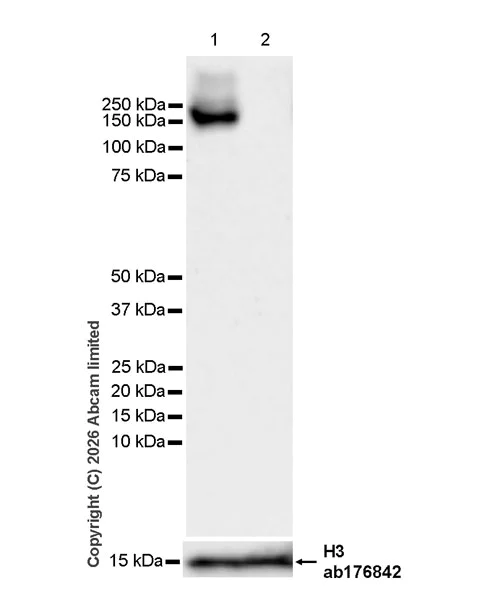
Western blot - Human ATP13A2 knockout HEK-293 cell lysate (AB274983)
Blocking and diluting buffer and concentration : 5% NFDM/TBST.
In Western blot, ab322735 was shown to bind specifically to ATP13A2. Target of interest was observed at 150 kDa in wild-type HEK-293 cell lysates (lane 1) with no signal observed at this size in ATP13A2 knockout cell line (lane 2)(knockout cell line ab274925)(knockout lysate ab274983)
Samples are non-boiled as boiling may cause protein aggregation.
In Western blot, Anti-Histone H3 antibody [EPR16987] - Nuclear Marker and ChIP Grade (ab176842) 1 : 100000 (15Kda).
All lanes:
Western blot - Anti-ATP13A2 antibody [MJF-D29756-28] (<a href='/ko/products/primary-antibodies/atp13a2-antibody-mjf-d29756-28-ab322735'>ab322735</a>) at 1/1000 dilution
Lane 1:
HEK-293 (human embryonic kidney epithelial cell) whole cell lysate at 50 µg
Lane 2:
Western blot - Human ATP13A2 knockout HEK-293 cell lysate (ab274983) at 50 µg
Secondary
All lanes:
Goat Anti-Rabbit IgG (HRP) with minimal cross-reactivity with human IgG at 1/2000 dilution
Observed band size: 150 kDa,15 kDa
false
Exposure time: 92s
보완 제품

제품 세부 정보
Knockout cell lysate achieved by CRISPR/Cas9.
REACH authorisation
Abcam has not and does not intend to apply for the REACH Authorisation of customers' uses of products that contain European Authorisation list (Annex XIV) substances.
It is the responsibility of our customers to check the necessity of application of REACH Authorisation, and any other relevant authorisations, for their intended uses.
Lysate preparation: Our lysates are made using RIPA buffer to which we add a protease inhibitor cocktail and phosphatase inhibitor cocktail (ratio: 300:100:10). This means that the protein of interest is denatured. If you require a native form of the protein please use the live cell version. Please refer to our lysis protocol for further details on how our lysates are prepared.
User storage instructions: Lyophilizate may be stored at 4°C. After reconstitution, store at -20°C for short-term storage or -80°C for long-term storage.
This product is subject to limited use licenses from The Broad Institute, ERS Genomics Limited and Sigma-Aldrich Co. LLC, and is developed with patented technology. For full details of the licenses and patents please refer to our limited use license and patent pages.
제품 구성
특성 및 보관 정보
유전자명
유전자 편집 종류
유전자 편집 방식
Knockout 검증
배송 시 보관 조건
적절한 단기 보관 조건
적절한 장기 보관 조건
추가 정보
This supplementary information is collated from multiple sources and compiled automatically.
Biological function summary
ATP13A2 plays a significant role in maintaining metal ion homeostasis inside cells. It is an essential component of the complex regulatory system that ensures proper lysosomal function. The protein impacts autophagy by influencing lysosomal biogenesis and integrity. Furthermore its function in metal ion transport and detoxification suggests a protective role for neurons against metal-induced oxidative stress.
Pathways
ATP13A2 is an important participant in the lysosomal degradation pathway and the autophagy-lysosome pathway. It interacts with proteins such as alpha-synuclein known for its role in neurodegenerative diseases and cellular stress responses. In the context of metal ion homeostasis ATP13A2 operates alongside other transporters and enzymes to maintain cellular ion balance and prevent toxicity.
품질 관리
STR analysis
CSF1PO, D13S317, D7S820, D5S818, TH01, D16S539, TPOX
Cell culture
Biosafety level
EU: 2 US: 2
Adherent/suspension
Adherent
Gender
Female
Product promise
Please note: All products are 'FOR RESEARCH USE ONLY. NOT FOR USE IN DIAGNOSTIC OR THERAPEUTIC PROCEDURES'.
For licensing inquiries, please contact partnerships@abcam.com