Human Apolipoprotein B ELISA Kit
Human Apolipoprotein B ELISA 키트
- Recombinant
- SimpleStep
- 각 태그의 뜻
4
(1 리뷰)
|
(13 제품이 사용된 논문 )
- Colorimetric Sandwich ELISA - 450 nm readout : works on any standard plate reader
- Design your own immunoassay: we also offer the conjugation-ready antibody pair
- Cited in over 10 citations
- ELISA
Supplier Data
ELISA - Human Apolipoprotein B ELISA Kit (AB190806)
- sELISA
Supplier Data
Sandwich ELISA - Human Apolipoprotein B ELISA Kit (AB190806)
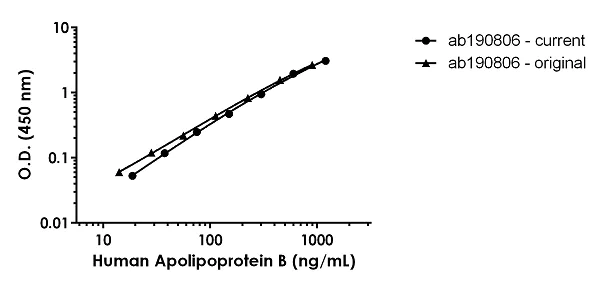
Human Apolipoprotein B comparison.
Standard Curve comparison between the original human Apolipoprotein B SimpleStep ELISA kit and current human Apolipoprotein B SimpleStep ELISA kit.
- sELISA
Supplier Data
Sandwich ELISA - Human Apolipoprotein B ELISA Kit (AB190806)
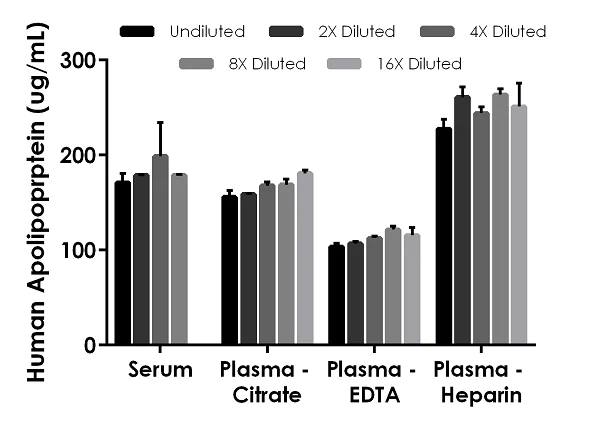
Interpolated concentrations of native Apolipoprotein B in human serum and plasma samples.
The concentrations of Apolipoprotein B were measured in duplicates, interpolated from the Apolipoprotein B standard curves and corrected for sample dilution. Undiluted samples are as follows : serum 0.5%, plasma (citrate) 0.5%, plasma (EDTA) 0.5%, and plasma (heparin) 0.5%. The interpolated dilution factor corrected values are plotted (mean +/- SD, n=2). The mean Apolipoprotein B concentration was determined to be 181.94 ug/mL in serum, 166.45 ug/mL in plasma (citrate) and 112.11 ug/mL plasma (EDTA), and 249.45 ug/mL plasma (heparin).
- sELISA
Supplier Data
Sandwich ELISA - Human Apolipoprotein B ELISA Kit (AB190806)
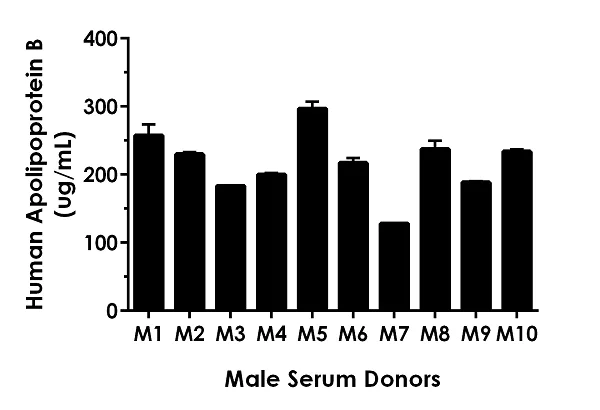
0.5% Serum from ten individual healthy human male donors was measured in duplicate.
Interpolated dilution factor corrected values are plotted (mean +/- SD, n=2). The mean Apolipoprotein B concentration was determined to be 217.38 ug/mL with a range of 127.53 – 304.1 ug/mL.
- sELISA
Supplier Data
Sandwich ELISA - Human Apolipoprotein B ELISA Kit (AB190806)
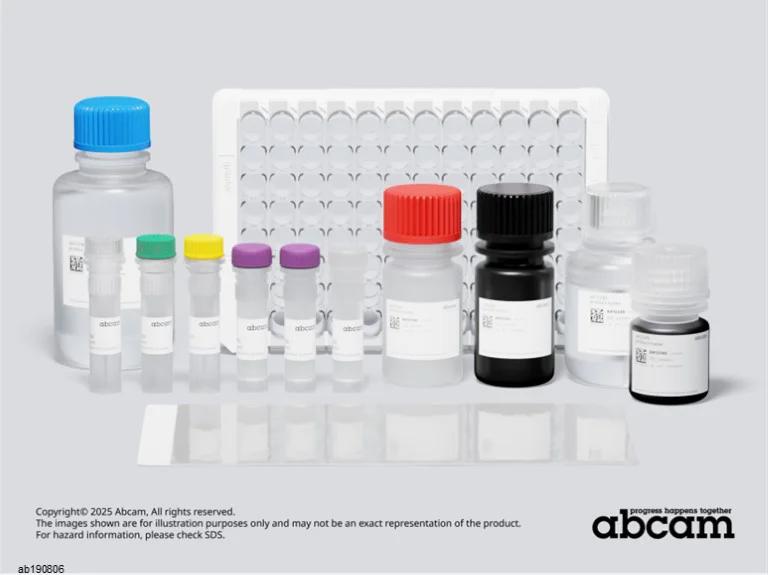
Representative image of Human Apolipoprotein B ELISA Kit (ab190806)
Components shown from left to right :
- Sample diluent NS
- Denaturant
- 10X Human Apolipoprotein B Capture Antibody
- 10X Human Apolipoprotein B Detector Antibody
- Human Apolipoprotein B Lyophilised Purified Protein (2 vials)
- 50X Cell Extraction Enhancer Solution (ab193971)
- Stop Solution
- TMB solution
- 10X Wash Buffer PT (ab206977)
- Antibody Diluent 5BI
SimpleStep Pre-Coated 96-Well Microplate (ab206978) - shown behind bottles / vials.
Plate Seals - shown underneath bottles / vials.
Note : The vial labels shown in this image use generic names for illustrative purposes only and may not exactly match the specific component names included in the ELISA kit.
Note : Colors of solutions in image may not precisely match the shade of colors in the actual kit
- sELISA
Supplier Data
Sandwich ELISA - Human Apolipoprotein B ELISA Kit (AB190806)
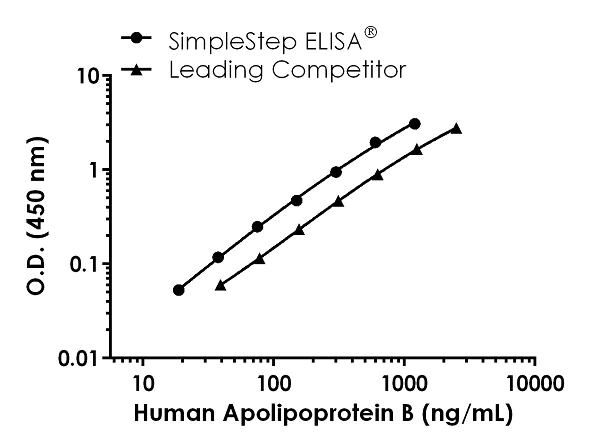
Human Apolipoprotein B standard curve comparison.
Standard Curve comparison between human Apolipoprotein B SimpleStep ELISA kit and traditional ELISA kit from leading competitor. SimpleStep ELISA kit shows increased sensitivity.
- sELISA
Supplier Data
Sandwich ELISA - Human Apolipoprotein B ELISA Kit (AB190806)
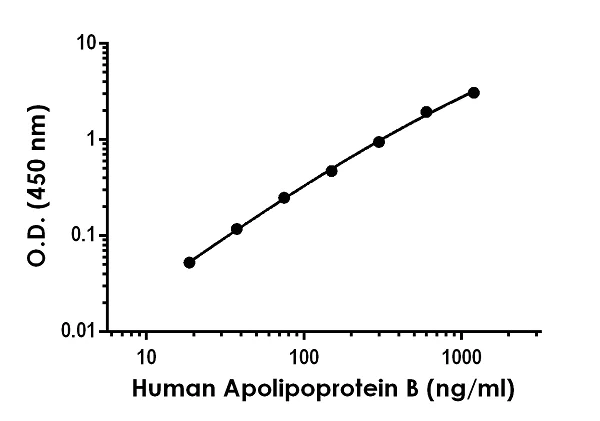
Example of human Apolipoprotein B standard curve in Sample Diluent NS + 1X Enhancer.
The Apolipoprotein B standard curve was prepared as described in Section 10. Raw data values are shown in the table. Background-subtracted data values (mean +/- SD) are graphed.
보완 제품

Reactivity 정보
제품 세부 정보
Human Apolipoprotein B ELISA Kit ab190806 is a rapid single-wash 90-min Sandwich ELISA to measure Human Apolipoprotein B in citrate plasma, EDTA plasma, heparin plasma, serum. This SimpleStep sensitivity is 5.28 ng/mL.
How the assay works
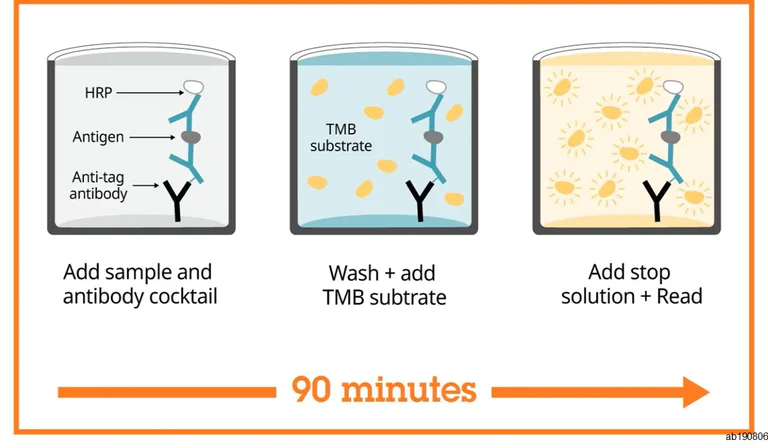
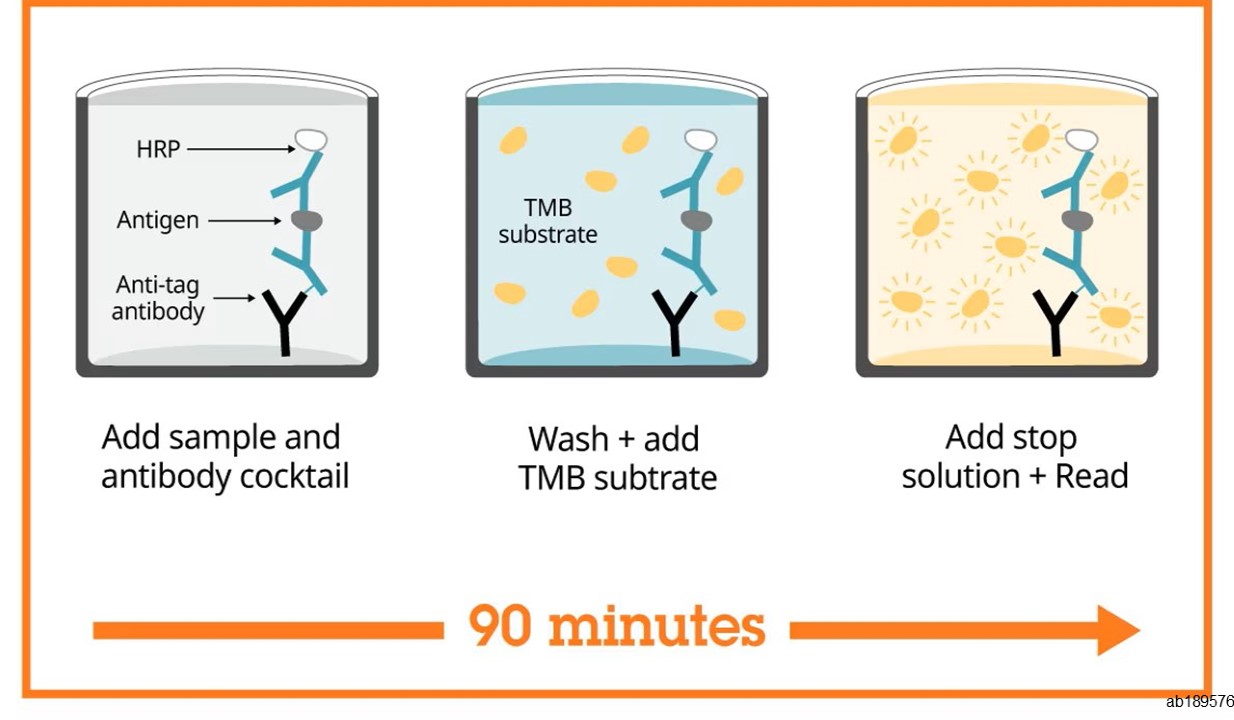
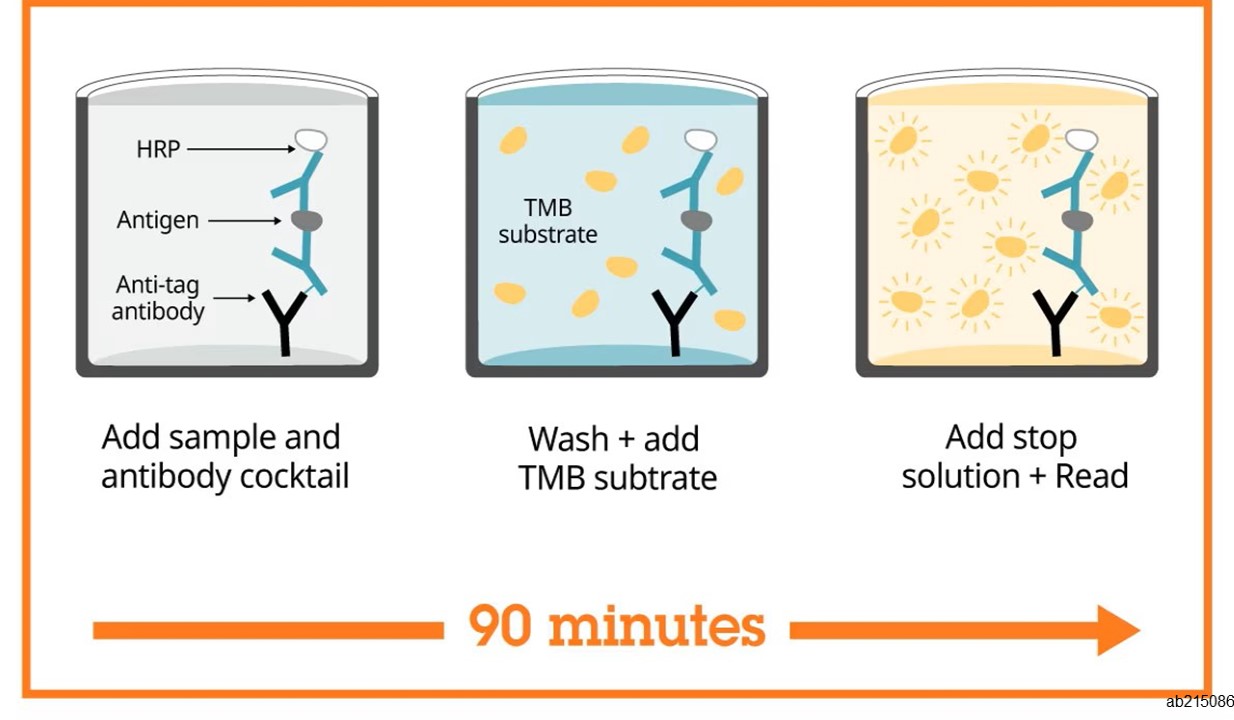
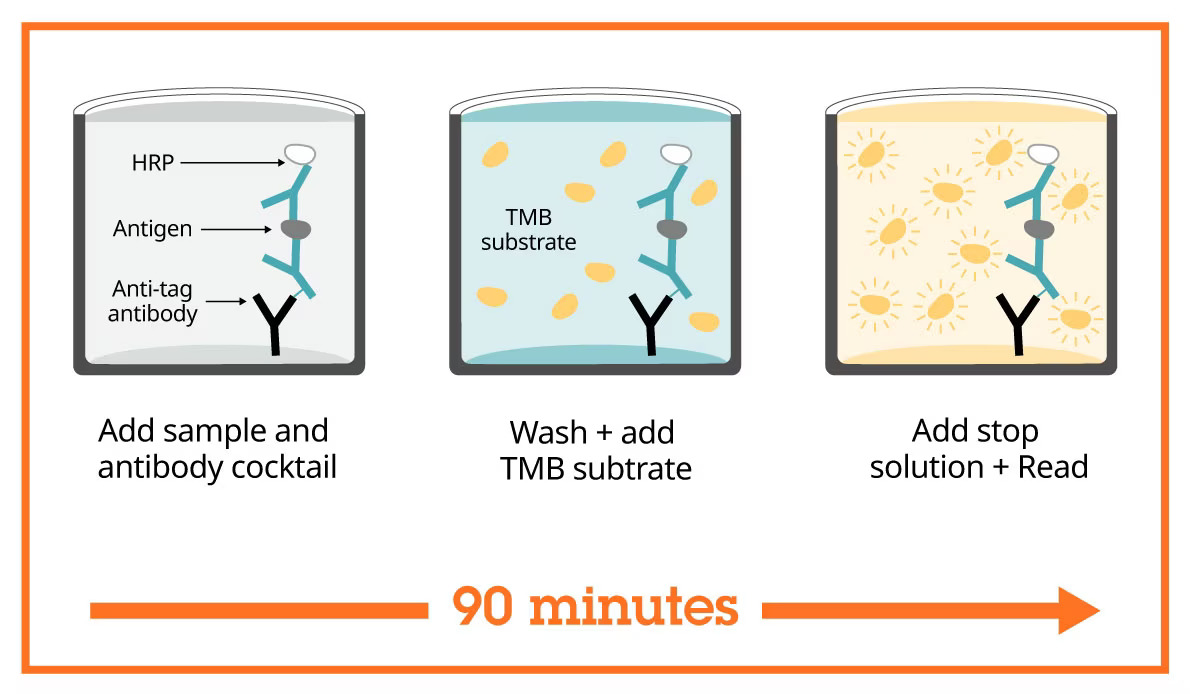
Human Apolipoprotein B SimpleStep ELISA®employs capture antibodies conjugated to an affinity tag that is recognized by the monoclonal antibody used to coat our SimpleStep ELISA® plates. This approach to sandwich ELISA allows the formation of the antibody-analyte sandwich complex in a single step, significantly reducing assay time. See the SimpleStep ELISA® protocol summary in the image section for further details.
Assay Specificity
Our SimpleStep ELISA® kits use recombinant monoclonal antibodies rigorously validated to ensure the highest level of consistency and reproducibility, improved sensitivity and specificity and ease of scalability and security of supply.
Please refer to our protocol booklet for more details.
Human Apolipoprotein B ELISA Kit ab190806 protocol summary
1. Mix: add samples/standards to the wells together with the capture and detector antibody cocktail. Incubate 1 hr at room temperature
2. Wash
3. Add TMB development solution - incubate for 10 min
4. Add Stop solution
5. Read the results on a plate reader at 450 nm
Design your own immunoassay
We offer the antibody pair used in this kit in a BSA and Azide-free format, ready for conjugation:
- Anti-Apolipoprotein B antibody [EPR18817-107] - BSA and Azide free (Capture) ab252574
- Anti-Apolipoprotein B antibody [EPR18817-119] - BSA and Azide free (Detector) ab252633
Apolipoproteins are proteins that bind lipids to form lipoproteins, which carry fats and cholesterol in the bloodstream. Apolipoproteins provide structural support to these lipoproteins, may act as ligands for specific cell surface receptors or may modulate the activity of metabolic enzymes that act on lipoproteins. A major class of apolipoproteins is ApoB, which is found in two forms: ApoB-100 (550 kDa) and ApoB-48 (264 kDa). ApoB-48 is made from the N-terminal 48% of the Apolipoprotein B-100 protein due to a post-transcriptional mRNA editing by the ApoB mRNA editing enzyme ApoBec1. ApoBec1 causes a C to U transition, replacing a CAA glutamine encoding codon for a UAA stop codon and generating ApoB-48. ApoBec1 is expressed in the intestine but not the liver, thus ApoB-48 is secreted by the intestine to become the building block of chylomicrons, while ApoB-100 is secreted by the liver to become a component of very low-density lipoproteins (VLDLs), intermediate-density lipoproteins (IDLs), and low-density lipoproteins (LDLs). Importantly, ApoB is also post-translationally palmitoylated; palmitoylation is necessary for proper assembly of lipoproteins (including proper assembly of the hydrophobic core). Furthermore, ApoB-100 operates on the surface of LDLs to allow binding to the LDL receptor and transport for breakdown of LDLs.
Mutations in the Apolipoprotein B gene can cause several diseases. First, in familial hypobetalipoproteinemia (FHBL), mutations in the Apolipoprotein B gene cause production of abnormally short lengths of ApoB protein, lowering the amount of lipoproteins and hence decreasing the body's capacity to transport and absorb fat and fat-soluble vitamins. Second, in a form of inherited hypercholesterolemia called familial defective ApoB-100 (FDB), mutations in the Apolipoprotein B gene prevent LDLs from effectively binding to their receptors. As a result, fewer LDLs are removed from the blood, leading to hypercholesterolemia, distribution and buildup of cholesterol into tissues such as the skin and arteries, and an increased risk of coronary artery disease (CAD).
Precision & recovery 정보
Precision
[ { "reproducibilityType": "Inter", "sample": "Human Serum", "replicates": 3, "mean": null, "standardDeviation": null, "coefficientOfVariability": "2.4" }, { "reproducibilityType": "Intra", "sample": "Human Serum", "replicates": 8, "mean": null, "standardDeviation": null, "coefficientOfVariability": "5.9" } ]
Recovery
[ { "sample": "Cell culture supernatant", "range": "92 - 107 %", "average": "= 100" }, { "sample": "Serum", "range": "81 - 87 %", "average": "= 84" }, { "sample": "EDTA Plasma", "range": "85 - 98 %", "average": "= 90" }, { "sample": "Heparin Plasma", "range": "104 - 120 %", "average": "= 114" }, { "sample": "Citrate plasma", "range": "81 - 97 %", "average": "= 86" } ]
제품 구성
특성 및 보관 정보
배송 시 보관 조건
적절한 단기 보관 조건
적절한 장기 보관 조건
보관 정보
추가 정보
This supplementary information is collated from multiple sources and compiled automatically.
Biological function summary
ApoB plays a significant role in lipid transport and metabolism. It is a critical component of the lipoprotein particle complex which is responsible for the transport of lipids such as cholesterol and triglycerides through the bloodstream. ApoB helps in the binding of lipoproteins to cell receptors facilitating the uptake of lipids by tissues. Its presence on the surface of lipoproteins makes it important for normal cholesterol homeostasis in the human body.
Pathways
ApoB is integrated within the lipid metabolism pathway. It interacts with proteins such as microsomal triglyceride transfer protein (MTP) during the assembly and secretion of lipoproteins. This pathway is essential for the normal transport of lipids throughout the body and influences processes like absorption of dietary fats. ApoB also plays a role in the pathways related to atherosclerosis where it influences the deposition of cholesterol in arterial walls.
타겟 정보
대체 명칭 보기
제품이 사용된 논문 (13)
Recent publications for all applications. Explore the 전체 목록and refine your search
Experimental & molecular medicine 57:349-363 PubMed39900792
2025
Applications
Unspecified application
Species
Unspecified reactive species
JACC. Basic to translational science 9:1057-1072 PubMed39444932
2024
Applications
Unspecified application
Species
Unspecified reactive species
Arteriosclerosis, thrombosis, and vascular biology 44:2038-2052 PubMed39087349
2024
Applications
Unspecified application
Species
Unspecified reactive species
Journal of lipid research 64:100451 PubMed37777014
2023
Applications
Unspecified application
Species
Unspecified reactive species
BMC infectious diseases 22:158 PubMed35177035
2022
Applications
Unspecified application
Species
Unspecified reactive species
Current protocols 2:e345 PubMed35007406
2022
Applications
Unspecified application
Species
Unspecified reactive species
Journal of lipid research 63:100166 PubMed35016907
2022
Applications
Unspecified application
Species
Unspecified reactive species
Translational oncology 15:101274 PubMed34800917
2021
Applications
Unspecified application
Species
Unspecified reactive species
Journal of extracellular vesicles 10:e12122 PubMed34429857
2021
Applications
Unspecified application
Species
Unspecified reactive species
Frontiers in cell and developmental biology 8:367 PubMed32528952
2020
Applications
Unspecified application
Species
Unspecified reactive species
Product promise
Please note: All products are 'FOR RESEARCH USE ONLY. NOT FOR USE IN DIAGNOSTIC OR THERAPEUTIC PROCEDURES'.
For licensing inquiries, please contact partnerships@abcam.com