Human soluble EGFR Antibody Pair - BSA and Azide free
- RabMAb
- Recombinant
- 각 태그의 뜻
Be the first to review this product! 리뷰 제출
|
(0 출판물)
Human soluble EGFR Antibody Pair - BSA and Azide free is a kit containing recombinant capture and detector antibodies in a carrier-free formulation for the measurement of Human soluble EGFR.
대체 명칭 보기
ERBB, ERBB1, HER1, EGFR, Epidermal growth factor receptor, Proto-oncogene c-ErbB-1, Receptor tyrosine-protein kinase erbB-1
- sELISA
Supplier Data
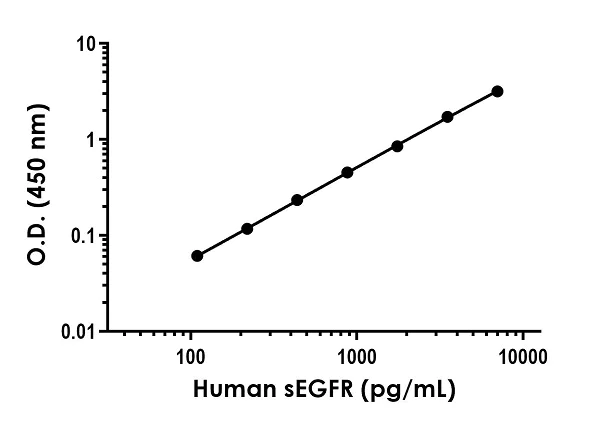
Sandwich ELISA - Human soluble EGFR Antibody Pair - BSA and Azide free (AB270393)
Representative standard curve from corresponding SimpleStep ELISA® Kit (ab269558), which uses the same antibody pair. For additional information on the performance of pair and kit, refer to the corresponding kit datasheet. Due to differences in the formulation and format of the antibodies in this pair, they cannot be used as substitutes for the antibody components in our SimpleStep ELISA® Kits.
- sELISA
Supplier Data
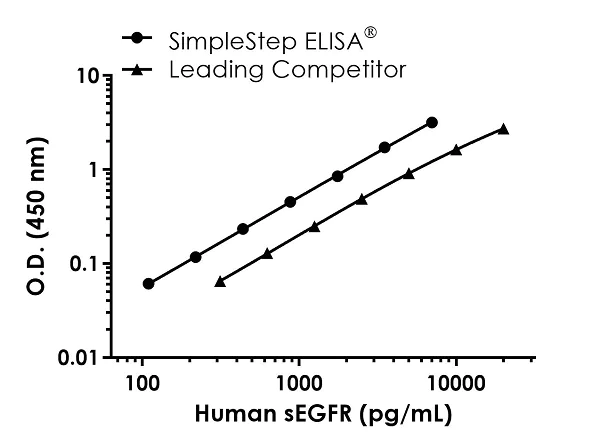
Sandwich ELISA - Human soluble EGFR Antibody Pair - BSA and Azide free (AB270393)
Representative standard curve from corresponding SimpleStep ELISA® Kit (ab269558), which uses the same antibody pair. For additional information on the performance of pair and kit, refer to the corresponding kit datasheet. Due to differences in the formulation and format of the antibodies in this pair, they cannot be used as substitutes for the antibody components in our SimpleStep ELISA® Kits.
- sELISA
Supplier Data
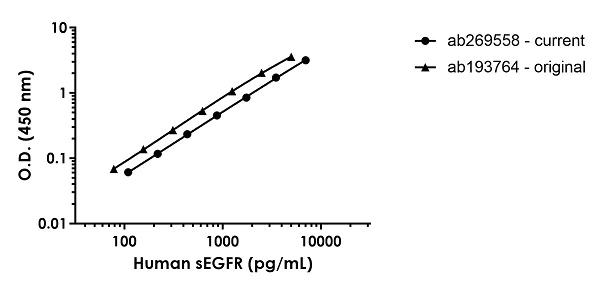
Sandwich ELISA - Human soluble EGFR Antibody Pair - BSA and Azide free (AB270393)
Representative standard curve from corresponding SimpleStep ELISA® Kit (ab269558), which uses the same antibody pair. For additional information on the performance of pair and kit, refer to the corresponding kit datasheet. Due to differences in the formulation and format of the antibodies in this pair, they cannot be used as substitutes for the antibody components in our SimpleStep ELISA® Kits.
보완 제품
Primary Antibodies
AB52894
BOND RX™ Validated|KO Validated|RabMAb|Lab Essentials|20ul selling size|Recombinant

- 5
- 24
Reactivity 정보
제품 세부 정보
The Antibody Pair can be used to quantify Human soluble EGFR. BSA and Azide free antibody pairs include unconjugated capture and detector antibodies suitable for sandwich ELISAs. The antibodies are provided at an approximate concentration of 1 mg/ml as measured by the protein A280 method. The recommended antibody orientation is based on internal optimization for ELISA-based assays. Antibody orientation is assay dependent and needs to be optimized for each assay type. Both capture and detector antibodies are rabbit monoclonal antibodies delivering consistent, specific, and sensitive results.
For additional information on the performance of the antibody pair, see the equivalent SimpleStep ELISA® Kit (ab269558), which uses the same antibodies. However, due to differences in their formulation, this antibody pair cannot be used with the consumables provided with our SimpleStep ELISA Kits. Please note that the range provided for the pairs is only an estimation based on the performance of the related product using the same antibody pair. Performance of the antibody pair will depend on the specific characteristics of your assay. We guarantee the product works in sandwich ELISA, but we do not guarantee the sensitivity or dynamic range of the antibody pair in your assay.
Patented technology
Our RabMAb® technology is a patented hybridoma-based technology for making rabbit monoclonal antibodies. For details on our patents, please refer to RabMAb® patents.
Use our conjugation kits for antibody conjugates that are ready-to-use in as little as 20 minutes with <1 minute hands-on-time and 100% antibody recovery: available for fluorescent dyes, HRP, biotin and gold.
The pair can be used in variety of assays and platforms including but not limited to:
- Sandwich ELISA
- FRET/TR-FRET/HTRF
- Meso Scale Discovery® (MSD®)
- Bead-based assays
- AlphaLISA®/AlphaScreen®
- DELFIA® immunoassays
- Simoa® and Single Molecule Counting (SMC™) immunoassays
- Multiplex
Our antibody pairs are supplied in a carrier-free format that is conjugation-ready:
- Buffer free of BSA, sodium azide, and glycerol for higher conjugation efficiency.
- Concentration of ~1 mg/ml as measured by the protein A280 method.
We can label antibodies for you: get in touch today to discuss how we can help accelerate your assay development with custom conjugation services.
Pairs are screened in biological samples, including plasma and serum, to ensure specificity in complex samples.
Please note:
The recommended antibody orientation is based on internal optimization in sandwich ELISA. Antibody orientation is assay dependent and needs to be optimized for each assay type.
The range provided for this antibody pair is based on initial sandwich ELISA validation data using recombinant protein. Performance and range of the antibody pair will depend on the specific characteristics of your assay, including standard protein selection.
We guarantee the product works in sandwich ELISA, but we do not guarantee the sensitivity or dynamic range of the antibodies in other assays.
Antibody properties:
Capture antibody: recombinant rabbit monoclonal (unconjugated) – 100 µg
Detector antibody: recombinant rabbit monoclonal (unconjugated) - 100 µg
Concentration: ~1 mg/ml
Storage buffer: 100% PBS
Form: Liquid
Isotype: IgG
Recombinant monoclonal antibodies offer several advantages including:
- High batch-to-batch consistency and reproducibility
- Improved sensitivity and specificity
- Long-term security of supply
- Animal-free production
Meso Scale Discovery and MSD are registered trademarks of Meso Scale Diagnostics, LLC.
AlphaLISA, AlphaScreen, and DELFIA are registered trademarks of PerkinElmer, Inc.
Simoa is a registered trademark of Quanterix, Inc.
SMC is a registered trademark of Merck KGaA, Darmstadt, Germany.
제품 구성
특성 및 보관 정보
배송 시 보관 조건
적절한 단기 보관 조건
적절한 장기 보관 조건
보관 정보
추가 정보
This supplementary information is collated from multiple sources and compiled automatically.
Biological function summary
The EGFR protein plays an important role in cellular communication and signaling processes. EGFR pairs with other receptor family members to form active dimers or even higher-order complexes which in turn initiate intracellular signaling cascades. Through these complexes EGFR influences many processes including cell differentiation and repair. This function of EGFR makes it an integral part of mammalian biology affecting how cells respond to their environment by mediating changes in gene expression.
Pathways
EGFR is a central player in the MAPK and PI3K/Akt signaling pathways. Alongside other protein partners like KRAS and PI3 kinase it contributes to transmitting signals from the cell surface to the nucleus affecting gene transcription and cell behavior. These pathways are important for normal cell growth and division and aberrations in these pathways can lead to excessive or insufficient cell proliferation.
타겟 정보
Product promise
Please note: All products are 'FOR RESEARCH USE ONLY. NOT FOR USE IN DIAGNOSTIC OR THERAPEUTIC PROCEDURES'.
For licensing inquiries, please contact partnerships@abcam.com