JavaScript is disabled in your browser. Please enable JavaScript to view this website.
AB245359

Anti-ATF6 antibody

Be the first to review this product! 리뷰 제출

|

(1 출판물)

Rabbit Polyclonal ATF6 antibody. Suitable for IP, WB and reacts with Human samples. Cited in 1 publication. Immunogen corresponding to Synthetic Peptide within Human ATF6 aa 100-200.

대체 명칭 보기

Cyclic AMP-dependent transcription factor ATF-6 alpha, cAMP-dependent transcription factor ATF-6 alpha, Activating transcription factor 6 alpha, ATF6-alpha, ATF6
2 이미지
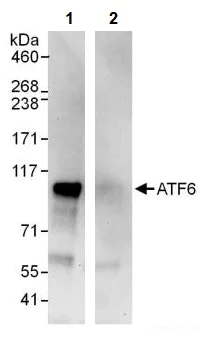
Immunoprecipitation - Anti-ATF6 antibody (AB245359)
  • IP

Supplier Data

Immunoprecipitation - Anti-ATF6 antibody (AB245359)

ATF6 was immunoprecipitated from 1 mg HeLa (human epithelial cell line from cervix adenocarcinoma) whole cell lysate using ab245359 at 6 μg/mg lysate. Western blot was performed on the immunoprecipitate using ab245359 at 1 μg/ml.

Lane 1 : ab245359 IP in HeLa whole cell lysate.
Lane 2 : Control IgG in HeLa whole cell lysate.

Detection : Chemiluminescence at an exposure time of 30 seconds.

All lanes:

Immunoprecipitation - Anti-ATF6 antibody (ab245359)

Predicted band size: 74 kDa

false
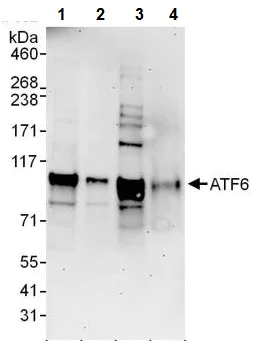
Western blot - Anti-ATF6 antibody (AB245359)
  • WB

Supplier Data

Western blot - Anti-ATF6 antibody (AB245359)

All lanes:

Western blot - Anti-ATF6 antibody (ab245359) at 0.1 µg/mL

Lane 1:

HeLa (human epithelial cell line from cervix adenocarcinoma) whole cell lysate at 50 µg

Lane 2:

HeLa whole cell lysate at 15 µg

Lane 3:

HEK-293T (human epithelial cell line from embryonic kidney transformed with large T antigen) whole cell lysate at 50 µg

Lane 4:

Jurkat (human T cell leukemia cell line from peripheral blood) whole cell lysate at 50 µg

Predicted band size: 74 kDa

false

Exposure time: 3min

주요 정보

Host species

Rabbit

Clonality

Polyclonal

Isotype

IgG

Carrier free

No

Reacts with

Human

Applications

IP, WB

applications

Immunogen

Synthetic Peptide within Human ATF6 aa 100-200. The exact immunogen used to generate this antibody is proprietary information.

P18850

Reactivity 정보

{ "title": "Reactivity Data", "filters": { "stats": ["", "Species", "Dilution Info", "Notes"], "tabs": { "all-applications": {"fullname" : "All Applications", "shortname": "All Applications"}, "IP" : {"fullname" : "Immunoprecipitation", "shortname":"IP"}, "WB" : {"fullname" : "Western blot", "shortname":"WB"} }, "product-promise": { "all": "all", "testedAndGuaranteed": "tested", "guaranteed": "expected", "predicted": "predicted", "notRecommended": "not-recommended" } }, "values": { "Human": { "IP-species-checked": "testedAndGuaranteed", "IP-species-dilution-info": "2-10 µg/mg of lysate", "IP-species-notes": "<p></p>", "WB-species-checked": "testedAndGuaranteed", "WB-species-dilution-info": "1/2000 - 1/10000", "WB-species-notes": "<p></p>" } } }

특성 및 보관 정보

제형
Liquid
Purification 테크닉
Affinity purification Immunogen
Purification 관련 사항
ab245359 was affinity purified using an epitope specific to ATF6 immobilized on solid support.
보관 버퍼
pH: 7 - 8 Preservative: 0.09% Sodium azide Constituents: Tris citrate/phosphate
배송 시 보관 조건
Blue Ice
적절한 단기 보관 기간
1-2 weeks
적절한 단기 보관 조건
+4°C
적절한 장기 보관 조건
-20°C
분주 정보
Upon delivery aliquot
보관 정보
Avoid freeze / thaw cycle

추가 정보

This supplementary information is collated from multiple sources and compiled automatically.

Activating Transcription Factor 6 (ATF6) also known as ATF 6 is a significant protein in the endoplasmic reticulum (ER) stress response. The ATF6 protein has a molecular weight of approximately 84 kDa. It expresses predominantly in the endoplasmic reticulum membrane and plays a critical role in the unfolded protein response (UPR). During ER stress ATF6 relocates to the Golgi apparatus where it undergoes cleavage to become an active transcription factor. This process helps the cell to manage the accumulation of unfolded proteins.
Biological function summary

ATF6 operates as part of the transcription regulation mechanisms responding to ER stress. The ATF6 protein is essential in managing the expression of chaperone genes and ER-associated degradation (ERAD) components thereby maintaining protein homeostasis. ATF6 itself does not operate within a traditional complex but its activation involves proteolytic cleavage which subsequently releases the active form to the nucleus where it influences gene expression to alleviate stress conditions.

Pathways

ATF6 is prominently involved in the unfolded protein response pathway which manages cell survival and stress adaptation. This pathway closely interacts with other proteins like IRE1 and PERK forming a network that modulates the transcription of UPR target genes. Additionally ATF6 contributes to checkpoint control pathways that stabilize cellular environment by regulating genes related to chaperone and protein folding.

Malfunction or dysregulation of ATF6 links to conditions like diabetes and neurodegenerative diseases. In diabetes improper ATF6 function affects insulin signaling and glucose homeostasis often alongside proteins such as XBP1. In neurodegenerative diseases an inappropriate response to ER stress influences the progression of disorders like Alzheimer's disease where protein misfolding and aggregation play pivotal roles. Understanding how ATF6 interplays with these diseases could lead to new therapeutic avenues.

제품 프로토콜

For this product, it's our understanding that no specific protocols are required. You can visit:

타겟 정보

Cyclic AMP-dependent transcription factor ATF-6 alpha. Precursor of the transcription factor form (Processed cyclic AMP-dependent transcription factor ATF-6 alpha), which is embedded in the endoplasmic reticulum membrane (PubMed : 10564271, PubMed : 11158310, PubMed : 11779464). Endoplasmic reticulum stress promotes processing of this form, releasing the transcription factor form that translocates into the nucleus, where it activates transcription of genes involved in the unfolded protein response (UPR) (PubMed : 10564271, PubMed : 11158310, PubMed : 11779464).. Processed cyclic AMP-dependent transcription factor ATF-6 alpha. Transcription factor that initiates the unfolded protein response (UPR) during endoplasmic reticulum stress by activating transcription of genes involved in the UPR (PubMed : 10564271, PubMed : 11158310, PubMed : 11163209, PubMed : 11779464). Binds DNA on the 5'-CCAC[GA]-3'half of the ER stress response element (ERSE) (5'-CCAAT-N(9)-CCAC[GA]-3') and of ERSE II (5'-ATTGG-N-CCACG-3') (PubMed : 10564271, PubMed : 11158310, PubMed : 11779464). Binding to ERSE requires binding of NF-Y to ERSE. Could also be involved in activation of transcription by the serum response factor (PubMed : 10564271, PubMed : 11158310, PubMed : 11779464). May play a role in foveal development and cone function in the retina (PubMed : 26029869).
See full target information ATF6

제품이 사용된 논문 (1)

Recent publications for all applications. Explore the 전체 목록 and refine your search

Biochemistry and biophysics reports 41:101907 PubMed39830524

2025

Effect of β-catenin on hypoxia induced epithelial mesenchymal transition in HK-2 cells by regulating Brachyury.

Applications

Unspecified application

Species

Unspecified reactive species

Ping Sun,Haihui Yang,Binying Min,Yongfu Li,Jun Wang,Mo Chen,Diping Yu,Wenjuan Sun
제품이 사용된 논문 모두 보기

Product promise

저희는 고품질 시약으로 고객님의 연구를 서포트하고자 최선을 다하고 있으며, 모든 단계에서 함께 하겠습니다. 만약 제품이 기대한 성능을 보이지 않을 경우에도 Product Promise로 보호받으실 수 있습니다.
자세한 내용은 이용 약관을 확인해 주세요.

Please note: All products are 'FOR RESEARCH USE ONLY. NOT FOR USE IN DIAGNOSTIC OR THERAPEUTIC PROCEDURES'.

For licensing inquiries, please contact partnerships@abcam.com