Anti-ATM (phospho S1981) antibody [10H11.E12] - BSA and Azide free
Be the first to review this product! 리뷰 제출
|
(1 출판물)
Mouse Monoclonal ATM phospho S1981 antibody. Carrier free. Suitable for IHC-P, Flow Cyt (Intra), WB and reacts with Human samples. Cited in 1 publication.
대체 명칭 보기
Serine-protein kinase ATM, Ataxia telangiectasia mutated, A-T mutated, ATM
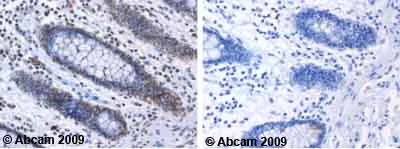
- IHC-P
Supplier Data
Immunohistochemistry (Formalin/PFA-fixed paraffin-embedded sections) - Anti-ATM (phospho S1981) antibody [10H11.E12] - BSA and Azide free (AB264520)
ab36810 staining human colon tissue. Staining is localized to the nucleus.
Left panel : with primary antibody at 4 μg/ml. Right panel : Isotype control.
Sections were stained using an automated system DAKO Autostainer Plus at room temperature. Sections were rehydrated and antigen retrieved with the DAKO 3-in-1 antigen retrieval buffer citrate pH 6.0 in a DAKO PT Link. Slides were peroxidase blocked in 3% H2O2 in methanol for 10 minutes. They were then blocked with Dako Protein block for 10 minutes (containing casein 0.25% in PBS) then incubated with primary antibody for 20 minutes and detected with Dako Envision Flex amplification kit for 30 minutes. Colorimetric detection was completed with diaminobenzidine for 5 minutes. Slides were counterstained with hematoxylin and coverslipped under DePeX.
Please note that for manual staining we recommend to optimize the primary antibody concentration and incubation time (overnight incubation), and amplification may be required.
This data was developed using the same antibody clone in a different buffer formulation containing PBS, L-Arginine and sodium azide (ab36810).
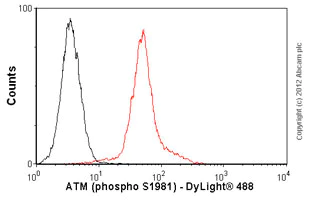
- Flow Cyt (Intra)
Supplier Data
Flow Cytometry (Intracellular) - Anti-ATM (phospho S1981) antibody [10H11.E12] - BSA and Azide free (AB264520)
Overlay histogram showing HeLa cells stained with ab36810 (red line). The cells were fixed with 80% methanol (5 min) and then permeabilized with 0.1% PBS-Tween for 20 min. The cells were then incubated in 1x PBS / 10% normal goat serum / 0.3M glycine to block non-specific protein-protein interactions followed by the antibody (ab36810, 1μg/1x106 cells) for 30 min at 22°C. The secondary antibody used was DyLight® 488 goat anti-mouse IgG (H+L) (ab96879) at 1/500 dilution for 30 min at 22°C. Isotype control antibody (black line) was mouse IgG1 [ICIGG1] (ab91353, 2μg/1x106 cells) used under the same conditions. Acquisition of >5,000 events was performed.
This antibody gave a positive signal in HeLa cells fixed with 4% paraformaldehyde (10 min)/permeabilized with 0.1% PBS-Tween for 20 min used under the same conditions.
This data was developed using the same antibody clone in a different buffer formulation containing PBS, L-Arginine and sodium azide (ab36810).
관련 conjugated 항체와 다양한 조성의 항체 (1)
-
Anti-ATM (phospho S1981) antibody [10H11.E12]
대체품
Primary Antibodies
AB201022
Anti-ATM antibody [EPR20100] - ChIP Grade
RabMAb|Recombinant|KO Validated|20ul selling size
- 0
- 0
Primary Antibodies
AB199726
RabMAb|Recombinant|KO Validated|20ul selling size
- 2
- 1
Primary Antibodies
AB81292
Anti-ATM (phospho S1981) antibody [EP1890Y]
RabMAb|Recombinant|20ul selling size

- 5
- 18
Primary Antibodies
AB32420
RabMAb|Recombinant|KO Validated|20ul selling size

- 5
- 8
Primary Antibodies
AB208775
Anti-ATM (phospho S1981) antibody [EP1890Y] - BSA and Azide free
RabMAb|Recombinant

- 0
- 0

Primary Antibodies
AB223533
Anti-ATM antibody [EPR20100] - BSA and Azide free
RabMAb|Recombinant|KO Validated

- 0
- 0
Primary Antibodies
AB216617
Anti-ATM antibody [Y170] - BSA and Azide free
RabMAb|Recombinant|KO Validated
- 0
- 0
Primary Antibodies
AB232588
Anti-ATM antibody [EPR17059] - BSA and Azide free
RabMAb|Recombinant|KO Validated
- 0
- 0
보완 제품
Primary Antibodies
AB32420
RabMAb|Recombinant|KO Validated|20ul selling size
- 5
- 8
Primary Antibodies
AB223258
Anti-ATR (phospho T1989) antibody [EPR21991]
RabMAb|Recombinant|20ul selling size
- 5
- 1
Primary Antibodies
AB81299
Anti-gamma H2A.X (phospho S139) antibody [EP854(2)Y]
BOND RX™ Validated|20ul selling size|RabMAb|Recombinant

- 4
- 18
Primary Antibodies
AB109520
RabMAb|Recombinant|KO Validated|Lab Essentials|20ul selling size

- 5
- 17
Reactivity 정보
제품 세부 정보
ab264520 is the carrier-free version of ab36810.
Want a custom formulation?
This antibody clone is manufactured by Abcam. If you require a custom buffer formulation or conjugation for your experiments, please contact orders@abcam.com
Conjugation ready
Our carrier-free antibodies are typically supplied in a PBS-only formulation, purified and free of BSA, sodium azide and glycerol. This conjugation-ready format is designed for use with fluorochromes, metal isotopes, oligonucleotides, and enzymes, which makes them ideal for antibody labelling, functional and cell-based assays, flow-based assays (e.g. mass cytometry) and Multiplex Imaging applications.
Use our conjugation kits for antibody conjugates that are ready-to-use in as little as 20 minutes with 1 minute hands-on-time and 100% antibody recovery: available for fluorescent dyes, HRP, biotin and gold.
Compatibility
This product is compatible with the Maxpar® Antibody Labeling Kit from Fluidigm, without the need for antibody preparation. Maxpar® is a trademark of Fluidigm Canada Inc.
특성 및 보관 정보
제형
Purity
보관 버퍼
배송 시 보관 조건
적절한 단기 보관 조건
적절한 장기 보관 조건
보관 정보
추가 정보
This supplementary information is collated from multiple sources and compiled automatically.
Biological function summary
ATM acts as a coordinator in cellular response to DNA damage highly interacting with multiple components of the DNA repair machinery. It forms a complex with proteins like NBS1 and MRN complex facilitating repair by recruiting and activating other proteins involved in homologous recombination and non-homologous end joining pathways. ATM also modulates p53 activity a primary response factor in cellular stress management linking ATM to control of cell cycle arrest and apoptosis. This positions ATM as an integral part of maintaining cellular integrity in face of genomic insult.
Pathways
ATM integrates neatly within the DNA damage response and cell cycle control pathways. ATM's operative relationship with the MRN complex and its role in the PI3K-related protein kinase family helps initiate appropriate repair processes upon DNA damage detection. Additionally ATM regulates the activity of proteins such as Chk2 which further propagates signals to p53 influencing decisions between cell cycle arrest and apoptosis. These interactions link ATM closely to essential processes like DNA repair and cell survival highlighting its role in genomic maintenance.
제품 프로토콜
- Visit the General protocols
- Visit the Troubleshooting
타겟 정보
제품이 사용된 논문 (1)
Recent publications for all applications. Explore the 전체 목록 and refine your search
Scientific reports 15:12719 PubMed40223147
2025
Applications
Unspecified application
Species
Unspecified reactive species
Product promise
Please note: All products are 'FOR RESEARCH USE ONLY. NOT FOR USE IN DIAGNOSTIC OR THERAPEUTIC PROCEDURES'.
For licensing inquiries, please contact partnerships@abcam.com