JavaScript is disabled in your browser. Please enable JavaScript to view this website.
AB119799

Anti-ATM (phospho S794) antibody

Be the first to review this product! 리뷰 제출

|

(4 제품이 사용된 논문 )

Rabbit Polyclonal ATM phospho S794 antibody. Suitable for ICC, WB and reacts with Human samples. Cited in 4 publications. Immunogen corresponding to Synthetic Peptide within Human ATM pS794.

대체 명칭 보기

Serine-protein kinase ATM, Ataxia telangiectasia mutated, A-T mutated, ATM
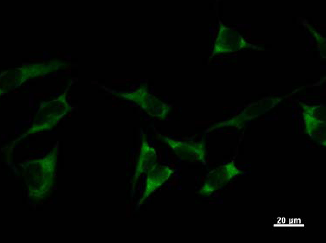
2 이미지
Immunocytochemistry - Anti-ATM (phospho S794) antibody (AB119799)
  • ICC

Unknown

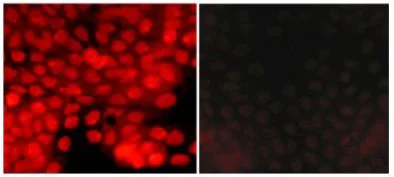
Immunocytochemistry - Anti-ATM (phospho S794) antibody (AB119799)

ab119799 at 1/200 dilution staining ATM (phospho S794) in A431 cells treated with Calyculin A in the absence (left) or presence (right) of blocking peptide. Detection used an appropriate secondary antibody conjugated to DyLight 594.
Western blot - Anti-ATM (phospho S794) antibody (AB119799)
  • WB

Unknown

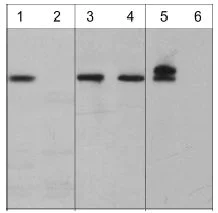
Western blot - Anti-ATM (phospho S794) antibody (AB119799)

Lanes 1 - 2:

Western blot - Anti-ATM (phospho S794) antibody (ab119799) at 1/1000 dilution

Lanes 3 - 4:

Anti-ATM (C-Terminal) at 1/1000 dilution

Lanes 5 - 6:

Anti-ATM (phospho S1981) at 1/1000 dilution

Lanes 1, 3 and 5:

Human A431 cells treated with Calyculin A(100 nM) for 30 min

Lanes 2, 4 and 6:

Human A431 cells treated with Calyculin A(100 nM) for 30 min, then treated with lambda phosphatase

Predicted band size: 351 kDa

false

주요 정보

Host species

Rabbit

Clonality

Polyclonal

Isotype

IgG

Carrier free

No

Reacts with

Human

Applications

ICC, WB

applications

Immunogen

Synthetic Peptide within Human ATM pS794. The exact immunogen used to generate this antibody is proprietary information.

Q13315

Reactivity 정보

{ "title": "Reactivity Data", "filters": { "stats": ["", "Species", "Dilution Info", "Notes"], "tabs": { "all-applications": {"fullname" : "All Applications", "shortname": "All Applications"}, "ICC" : {"fullname" : "Immunocytochemistry", "shortname":"ICC"}, "WB" : {"fullname" : "Western blot", "shortname":"WB"} }, "product-promise": { "all": "all", "testedAndGuaranteed": "tested", "guaranteed": "expected", "predicted": "predicted", "notRecommended": "not-recommended" } }, "values": { "Human": { "ICC-species-checked": "testedAndGuaranteed", "ICC-species-dilution-info": "1/200", "ICC-species-notes": "<p></p>", "WB-species-checked": "testedAndGuaranteed", "WB-species-dilution-info": "1/1000", "WB-species-notes": "<p></p>" }, "Mouse": { "ICC-species-checked": "predicted", "ICC-species-dilution-info": "", "ICC-species-notes": "", "WB-species-checked": "predicted", "WB-species-dilution-info": "", "WB-species-notes": "" } } }

제품 세부 정보

Do not aliquot.

특성 및 보관 정보

제형
Liquid
Purification 테크닉
Affinity purification Protein A
보관 버퍼
Preservative: 0.05% Sodium azide Constituents: PBS, 50% Glycerol (glycerin, glycerine), 0.1% BSA
배송 시 보관 조건
Blue Ice
적절한 단기 보관 조건
+4°C
적절한 장기 보관 조건
-20°C
보관 정보
Stable for 12 months at -20°C

추가 정보

This supplementary information is collated from multiple sources and compiled automatically.

ATM also known as Ataxia Telangiectasia Mutated is a protein kinase with a molecular weight of approximately 370 kDa. ATM protein primarily resides in the cell nucleus and functions as a critical regulator of the cell cycle. It plays a significant role in the detection of DNA damage and initiation of repair processes. As part of its mechanical functions ATM phosphorylates serine and threonine residues on various substrates most notably in response to double-strand breaks in DNA. This activity is important for maintaining genomic stability.
Biological function summary

ATM acts as a coordinator in cellular response to DNA damage highly interacting with multiple components of the DNA repair machinery. It forms a complex with proteins like NBS1 and MRN complex facilitating repair by recruiting and activating other proteins involved in homologous recombination and non-homologous end joining pathways. ATM also modulates p53 activity a primary response factor in cellular stress management linking ATM to control of cell cycle arrest and apoptosis. This positions ATM as an integral part of maintaining cellular integrity in face of genomic insult.

Pathways

ATM integrates neatly within the DNA damage response and cell cycle control pathways. ATM's operative relationship with the MRN complex and its role in the PI3K-related protein kinase family helps initiate appropriate repair processes upon DNA damage detection. Additionally ATM regulates the activity of proteins such as Chk2 which further propagates signals to p53 influencing decisions between cell cycle arrest and apoptosis. These interactions link ATM closely to essential processes like DNA repair and cell survival highlighting its role in genomic maintenance.

ATM mutations or dysregulation leads to Ataxia Telangiectasia an autosomal recessive disorder characterized by neurodegeneration immune deficiencies and cancer predisposition. ATM dysfunction also connects to cancer development particularly breast cancer where it transmits signals involving BRCA1 contributing to DNA repair through homologous recombination. Understanding ATM dynamics and related pathways has important implications for developing therapeutic strategies to manage or mitigate effects associated with its dysfunction.

제품 프로토콜

For this product, it's our understanding that no specific protocols are required. You can visit:

타겟 정보

Serine/threonine protein kinase which activates checkpoint signaling upon double strand breaks (DSBs), apoptosis and genotoxic stresses such as ionizing ultraviolet A light (UVA), thereby acting as a DNA damage sensor (PubMed : 10550055, PubMed : 10839545, PubMed : 10910365, PubMed : 12556884, PubMed : 14871926, PubMed : 15064416, PubMed : 15448695, PubMed : 15456891, PubMed : 15790808, PubMed : 15916964, PubMed : 17923702, PubMed : 21757780, PubMed : 24534091, PubMed : 35076389, PubMed : 9733514). Recognizes the substrate consensus sequence [ST]-Q (PubMed : 10550055, PubMed : 10839545, PubMed : 10910365, PubMed : 12556884, PubMed : 14871926, PubMed : 15448695, PubMed : 15456891, PubMed : 15916964, PubMed : 17923702, PubMed : 24534091, PubMed : 9733514). Phosphorylates 'Ser-139' of histone variant H2AX at double strand breaks (DSBs), thereby regulating DNA damage response mechanism (By similarity). Also plays a role in pre-B cell allelic exclusion, a process leading to expression of a single immunoglobulin heavy chain allele to enforce clonality and monospecific recognition by the B-cell antigen receptor (BCR) expressed on individual B-lymphocytes. After the introduction of DNA breaks by the RAG complex on one immunoglobulin allele, acts by mediating a repositioning of the second allele to pericentromeric heterochromatin, preventing accessibility to the RAG complex and recombination of the second allele. Also involved in signal transduction and cell cycle control. May function as a tumor suppressor. Necessary for activation of ABL1 and SAPK. Phosphorylates DYRK2, CHEK2, p53/TP53, FBXW7, FANCD2, NFKBIA, BRCA1, CREBBP/CBP, RBBP8/CTIP, FBXO46, MRE11, nibrin (NBN), RAD50, RAD17, PELI1, TERF1, UFL1, RAD9, UBQLN4 and DCLRE1C (PubMed : 10550055, PubMed : 10766245, PubMed : 10802669, PubMed : 10839545, PubMed : 10910365, PubMed : 10973490, PubMed : 11375976, PubMed : 12086603, PubMed : 15456891, PubMed : 19965871, PubMed : 21757780, PubMed : 24534091, PubMed : 26240375, PubMed : 26774286, PubMed : 30171069, PubMed : 30612738, PubMed : 30886146, PubMed : 30952868, PubMed : 38128537, PubMed : 9733515, PubMed : 9843217). May play a role in vesicle and/or protein transport. Could play a role in T-cell development, gonad and neurological function. Plays a role in replication-dependent histone mRNA degradation. Binds DNA ends. Phosphorylation of DYRK2 in nucleus in response to genotoxic stress prevents its MDM2-mediated ubiquitination and subsequent proteasome degradation (PubMed : 19965871). Phosphorylates ATF2 which stimulates its function in DNA damage response (PubMed : 15916964). Phosphorylates ERCC6 which is essential for its chromatin remodeling activity at DNA double-strand breaks (PubMed : 29203878). Phosphorylates TTC5/STRAP at 'Ser-203' in the cytoplasm in response to DNA damage, which promotes TTC5/STRAP nuclear localization (PubMed : 15448695). Also involved in pexophagy by mediating phosphorylation of PEX5 : translocated to peroxisomes in response to reactive oxygen species (ROS), and catalyzes phosphorylation of PEX5, promoting PEX5 ubiquitination and induction of pexophagy (PubMed : 26344566).
See full target information ATM pS794

제품이 사용된 논문 (4)

Recent publications for all applications. Explore the 전체 목록 and refine your search

European journal of medical research 30:765 PubMed40830974

2025

Coordinating oncogenesis and immune evasion: KPNA2, GOLM1, and TK1 as novel CAR T-cell targets in lung adenocarcinoma.

Applications

Unspecified application

Species

Unspecified reactive species

Wangrui Liu,Hui Zou,Lei Guo,Zhonghua Zhou,Yahui Xie,Huaqi Guo,Gang Wei,Kai Zhang,Hui Yin,Shiyin Wei,Jiachang Chi

Heliyon 10:e37227 PubMed39296007

2024

Molecular basis of CX-5461-induced DNA damage response in primary vascular smooth muscle cells.

Applications

Unspecified application

Species

Unspecified reactive species

Tengfei Liu,Guopin Pan,Jing Zhang,Jianli Wang,Xiaosun Guo,Ye Chen,Xiaoyun Wang,Xiaopei Cui,Huiqing Liu,Fan Jiang

Aging 16:9692-9708 PubMed38843391

2024

Prognostic and therapeutic roles of in cutaneous melanoma.

Applications

Unspecified application

Species

Unspecified reactive species

Jiani Xiong,Liping Zhu,Yunrong Fu,Zhoujie Ye,Cuimin Deng,Xinrui Wang,Yu Chen

Aging 12:22174-22198 PubMed33146634

2020

Nucleolar stress induces a senescence-like phenotype in smooth muscle cells and promotes development of vascular degeneration.

Applications

Unspecified application

Species

Unspecified reactive species

Wenjing Zhang,Wen Cheng,Rosanna Parlato,Xiaosun Guo,Xiaopei Cui,Chaochao Dai,Lei Xu,Jiankang Zhu,Min Zhu,Kun Luo,Wencheng Zhang,Bo Dong,Jianli Wang,Fan Jiang
제품이 사용된 논문 모두 보기

Product promise

저희는 고품질 시약으로 고객님의 연구를 서포트하고자 최선을 다하고 있으며, 모든 단계에서 함께 하겠습니다. 만약 제품이 기대한 성능을 보이지 않을 경우에도 Product Promise로 보호받으실 수 있습니다.
자세한 내용은 이용 약관을 확인해 주세요.

Please note: All products are 'FOR RESEARCH USE ONLY. NOT FOR USE IN DIAGNOSTIC OR THERAPEUTIC PROCEDURES'.

For licensing inquiries, please contact partnerships@abcam.com